The Best 5 Cu Ft Microwaves for Bigger Kitchens
Panasonic NN-SN966S wins on inverter power delivery, 1250 watts and a 16.5 inch turntable. Toshiba ML-EM45PIT adds convection, air fry and broil in one 1.6 cubic foot cabinet. GE JES1657SMSS suits a shared kitchen that just needs sensor reheating and clear controls.
Panasonic NN-SN966S tops this ranking because inverter power delivery fixes the uneven reheating that frustrates most owners. Short on counter space for a separate oven? Toshiba ML-EM45PIT folds convection and air frying into the same cabinet. For plain everyday duty, GE JES1657SMSS keeps controls simple and the turntable wide.
Capacity is where microwave shopping usually goes wrong. Cubic feet measures the whole cavity, including corners the turntable never sweeps, so a large-sounding oven can still refuse a dinner plate. Wattage figures also mix rated input with useful cooking output. We compared stated interior volume, turntable diameter, wattage and control layout, alongside what owners report about even heating and installation, then ranked on practical usable space.
The best picks, ranked
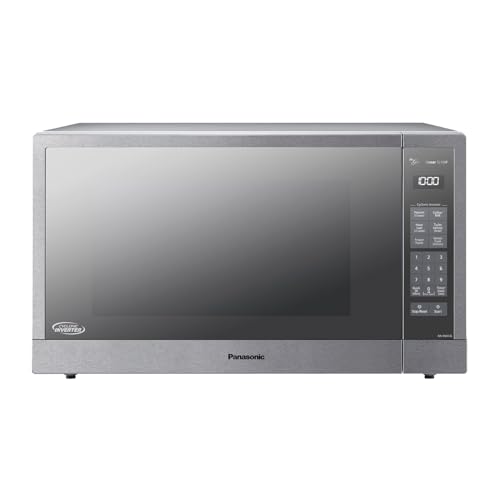
Panasonic NN-SN966S
Inverter circuitry supplies genuinely continuous reduced power instead of pulsing full power on and off. Defrosting and simmering both come out evenly as a result, with no rubbery edges around a cold centre. A 16.5 inch turntable inside a 2.2 cubic foot cavity swallows large casserole dishes that stall smaller ovens.
Pros
- Even heating at every reduced power level
- 16.5 inch turntable takes oversized dishes
- 1250 watts cuts everyday reheating time
Cons
- External footprint dominates a small counter
- Keypad carries more buttons than most people use

Toshiba ML-EM45PIT
Four cooking methods share one 1.6 cubic foot cabinet: microwave at 1000 watts, convection, air fry and broil. A wire rack and easy-clean interior coating come in the box, so roasting and crisping need no extra kit. Owners report the air fry mode works well for one or two portions rather than family-sized batches.
Pros
- Replaces three appliances on one counter
- Fits a full-sized casserole dish inside
- Interior coating wipes down without scrubbing
Cons
- Convection modes need several minutes to preheat
- Fan is loud during combination cooking
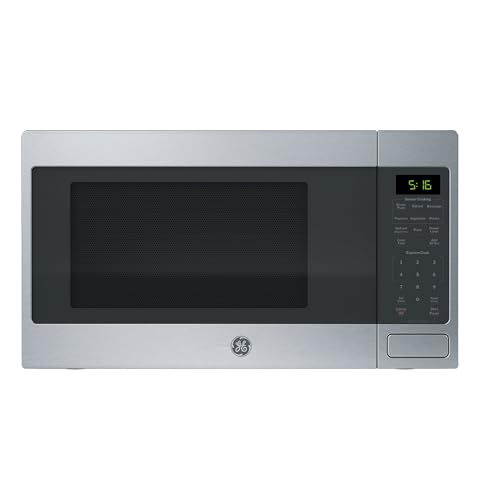
GE JES1657SMSS
Sensor cooking reads steam from the food and stops when it is done, which removes manual timing for most reheats. Controls stay conventional, so anyone in the household can use it without instruction. A turntable around 14.1 inches inside a 1.6 cubic foot cavity handles standard dinner plates comfortably.
Pros
- Sensor presets remove guesswork from reheating
- Controls are legible and self-explanatory
- 1150 watts is strong for a plain countertop unit
Cons
- No convection or air fry option
- Interior light is dim for the cavity size

Sharp SMC1585BS
Convection heating turns a 1.5 cubic foot cavity into a workable second oven for roasting and baking. Combination modes run microwave and convection together to cut cooking time on larger items. A stainless steel cavity handles scrubbing better than the painted interiors used elsewhere in this group.
Pros
- Convection covers roasting and baking duties
- Stainless cavity tolerates proper cleaning
- Compact body for a convection model
Cons
- 900 watts is the lowest microwave power here
- Combination modes take practice to time correctly
Whirlpool WMH31017HS
Mounting above the hob returns the entire worktop to you, which is the whole argument for this format. A 1.7 cubic foot cavity is larger than most over-the-range units offer, and a two-speed fan plus cooktop lighting handle everyday steam. Owners report installation genuinely needs two people and a stud-mounted bracket.
Pros
- Reclaims the whole counter surface
- Includes hob extraction and task lighting
- 1.7 cubic feet beats most over-range cavities
Cons
- Installation is a two-person job with brackets
- Mounting height is awkward for shorter cooks
Farberware FMO16AHTBSA
1100 watts inside a 1.6 cubic foot cavity is a strong pairing at this level, and a large dinner plate rotates freely. Sensor and one-touch programmes cover popcorn, beverages, potatoes and reheat without manual timing. Stainless exterior panels look the part, though the door and housing weigh noticeably less than premium units.
Pros
- Full 1.6 cubic feet at a modest outlay
- 1100 watts reheats quickly for the class
- Wide range of one-touch programmes
Cons
- Door and housing feel lighter than rivals
- Beeper volume is not adjustable on all units
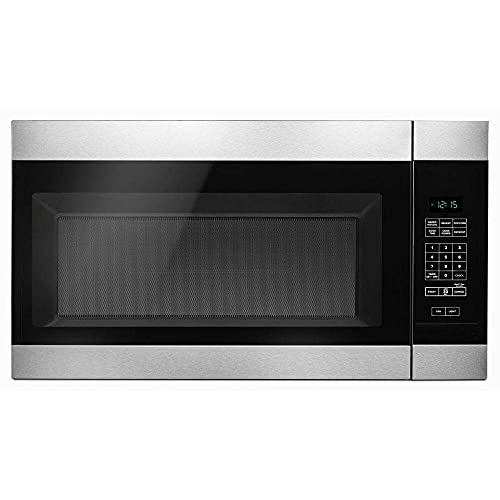
Amana AMV2307PFS
Fundamentals only: a 1.6 cubic foot cavity, 1000 watts, an extraction fan and a cooktop light. A basic keypad covers the common presets without menus to navigate. Rental kitchens and budget refits are the natural home for it, since it fits standard 30 inch cabinet openings.
Pros
- Least expensive route into an over-range unit
- Keypad is uncluttered and obvious to use
- Fits standard 30 inch cabinet openings
Cons
- Extraction is weaker than premium hoods
- Preset list is minimal
Compared at a glance
| # | Model | Capacity | Best for | Score | Price |
|---|---|---|---|---|---|
| 1 | Panasonic NN-SN966S | 2.2 cubic feet | Best overall | 9.4 | Check price |
| 2 | Toshiba ML-EM45PIT | 1.6 cubic feet | Best multi-function countertop | 9.2 | Check price |
| 3 | GE JES1657SMSS | 1.6 cubic feet | Best everyday countertop | 9.0 | Check price |
| 4 | Sharp SMC1585BS | 1.5 cubic feet | Best convection countertop | 8.8 | Check price |
| 5 | Whirlpool WMH31017HS | 1.7 cubic feet | Best over the range | 8.6 | Check price |
| 6 | Farberware FMO16AHTBSA | 1.6 cubic feet | Best budget large capacity | 8.3 | Check price |
| 7 | Amana AMV2307PFS | 1.6 cubic feet | Best simple over the range | 8.0 | Check price |
What to look for
What size microwave do you actually need? Cubic feet counts the entire cavity, corners included, and the turntable only sweeps a circle inside it. Turntable diameter is therefore the number that predicts whether your dishes fit. Measure your largest dinner plate and your usual casserole dish, then compare. A 1.6 cubic foot oven with a 14 inch plate beats a bigger cabinet with a 12 inch one. Exterior width matters separately, since the cabinet always eats more counter than the interior suggests.
How much wattage is enough, and what does an inverter change? Higher wattage heats faster, and 1000 to 1250 watts is the normal band at this size. Power delivery is the subtler issue. Conventional magnetrons produce fifty percent power by running at full blast half the time, which is why defrosting cooks the edges. Inverter models like the Panasonic hold a genuinely lower continuous output. Reheating leftovers and softening butter both improve noticeably. Speed comes from watts; evenness comes from how those watts arrive.
Should you choose a countertop or over-the-range model? Countertop units plug in and work, and replacing one takes ten minutes. They also occupy permanent worktop area, which is scarce in most kitchens. Over-the-range models like the Whirlpool and Amana free that space entirely and add extraction and cooktop lighting. In exchange you take on a bracketed two-person installation, a fixed cabinet width, and a reach height that suits some cooks better than others. Measure the opening and check the venting route first.
Are convection and air fry modes worth having? They convert a microwave into a compact second oven, which genuinely helps in flats and small kitchens without a full range. The Toshiba and Sharp both cover this. Costs come in preheat time, fan noise and more surfaces to clean. Owning a working oven and a dedicated air fryer already makes these modes redundant. In that case, put the money into wattage, turntable size and cavity volume instead.
Questions worth asking
How big is a 1.5 cubic foot microwave inside?
Interior width usually runs fifteen to sixteen inches with a turntable around fourteen inches, which takes standard dinner plates. Depth and height vary by brand. Compare turntable diameter rather than cubic feet when checking whether your dishes will fit.
Is a higher wattage microwave better?
More watts means faster heating and better handling of large loads, which matters in a big cavity. It does not guarantee even results, since power delivery decides that. Treat 1000 watts as a sensible floor at this size.
What is inverter technology in a microwave?
Conventional models create low power settings by cycling full power on and off. Inverter models supply a steady reduced output instead. Defrosting and gentle reheating both improve, because food never sits at full intensity.
Can you put a countertop microwave inside a cabinet?
Only when the manufacturer offers a trim kit for that model and you fit it correctly. Vents need clear airflow, and enclosing a unit without provision causes overheating. Check the installation manual rather than assuming a gap will do.
Do over-the-range microwaves vent outside?
Most can be configured either to duct externally or to recirculate through a charcoal filter. External venting removes steam and odours far more effectively. Confirm which route your kitchen already supports before ordering.
What is the easiest way to clean a microwave interior?
Heat a bowl of water with lemon slices for a few minutes, leave the door closed briefly, then wipe while the residue is soft. Avoid abrasive pads on painted cavities. Stainless interiors like the Sharp tolerate firmer scrubbing.
Why does food heat unevenly in the microwave?
Load shape, dish material and standing time all contribute as much as the oven does. Stir halfway through, use a lower power setting for longer, and rest food for a minute afterwards. Shallow dishes heat far more evenly than deep ones.
Which microwave size suits a family?
Households reheating full dinner plates and casserole dishes want 1.5 cubic feet as a minimum, with 1.6 to 2.2 giving comfortable room. Smaller ovens still handle drinks and single portions. Available counter space usually limits the decision more than need does.
Can a microwave replace a full oven?
A convection model like the Sharp SMC1585BS bakes and roasts small items well and works as a second oven. Capacity limits it to modest trays, so large roasts and full sheet pans still need a range.
How long should a microwave last?
Normal household use commonly gives many years of service, with the magnetron and door switches being the usual failure points. Keeping vents clear and never running the oven empty extends the life of both.
Our take
Panasonic NN-SN966S is the strongest large microwave here because inverter power delivery solves the uneven reheating that annoys most owners, and the 16.5 inch turntable takes serious dishes. Pick Toshiba ML-EM45PIT when convection and air frying need to share the same footprint. Whirlpool WMH31017HS makes the most sense in a kitchen where counter space is the real constraint.


