Top Travel Access Points for Reliable Wi Fi
The GL.iNet GL-MT300N-V2 is our top pick for most travelers, because it is compact, affordable, and can convert a weak hotel Ethernet or Wi Fi signal into a private, secure network. Its main limitation is that it only supports 2.4 GHz, so you won’t get the fastest speeds if your internet plan exceeds 100 Mbps.
Traveling with multiple devices can be a hassle, especially when hotel Wi Fi only lets you connect one gadget or is too weak to stream. A portable travel access point solves this by taking a single wired or wireless internet connection and broadcasting your own secure network.
We looked at popular models from trusted brands like GL.iNet, TP-Link, and Ravpower to find the ones that deliver reliable performance without taking up much luggage space. Some double as power banks, while others are small enough to fit in your pocket.
The best picks, ranked
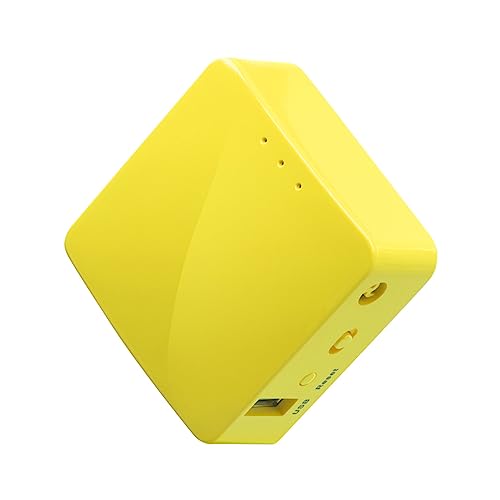
GL.iNet GL-MT300N-V2 (Mango)
The GL.iNet GL-MT300N-V2, nicknamed Mango, is a tiny travel router that can repeat a Wi Fi signal, create a hotspot from a wired Ethernet connection, or extend a public network. It has a built in OpenVPN client and supports multiple VPN protocols, making it a favorite among privacy focused travelers. Its USB port allows you to share files or connect a 4G modem. Owners report that the setup is straightforward using the web interface or mobile app, and the device runs cool even after hours of use.
Pros
- Compact and lightweight
- Supports OpenVPN client
- Can work as a repeater or router
Cons
- No 5 GHz support
- USB port limited to storage or 4G modem

TP-Link TL-WR902AC
The TP-Link TL-WR902AC is a pocket sized dual band travel router that offers speeds up to 433 Mbps on 5 GHz and 300 Mbps on 2.4 GHz. It includes multiple operation modes: router, access point, range extender, and WISP. The integrated Ethernet port can connect to a hotel wired internet, and the USB port allows charging or sharing a 4G dongle. Users appreciate the easy one click setup and the ability to create a personal hotspot from a public Wi Fi. The device is powered via micro USB, so you can use a power bank.
Pros
- Dual band for faster speeds
- Multiple modes for versatility
- Can be powered by power bank
Cons
- No built in VPN client
- Setup can be confusing for some
GL.iNet GL-AR150
The GL.iNet GL-AR150 is a mini travel router that runs on open source firmware, giving you full control over settings. It supports OpenVPN and WireGuard, and it can be flashed with custom firmware like DD-WRT. The device includes a USB port for storage sharing or 4G modem, and it has a 100 Mbps Ethernet port. It is slightly larger than the Mango but still fits in a pocket. Travelers who like to tweak their network will appreciate the SSH access and programmable button.
Pros
- Open source firmware
- Supports WireGuard and OpenVPN
- Programmable button for custom actions
Cons
- No 5 GHz Wi Fi
- Ethernet limited to 100 Mbps

Ravpower FileHub Plus
The Ravpower FileHub Plus is a multi purpose device that combines a travel router, a power bank, and a file sharing hub. It has a 6700 mAh battery that can charge your phone and power the device for up to 10 hours of use. It can read from SD cards and USB drives, allowing you to back up photos and stream media to your devices. As a router, it can repeat a Wi Fi signal or create a hotspot from a wired Ethernet connection. Owners report that the battery life is excellent and the file sharing feature is handy for camera users.
Pros
- Built in power bank
- SD card slot for photo backup
- Can stream media to devices
Cons
- Heavier than other travel routers
- 2.4 GHz only
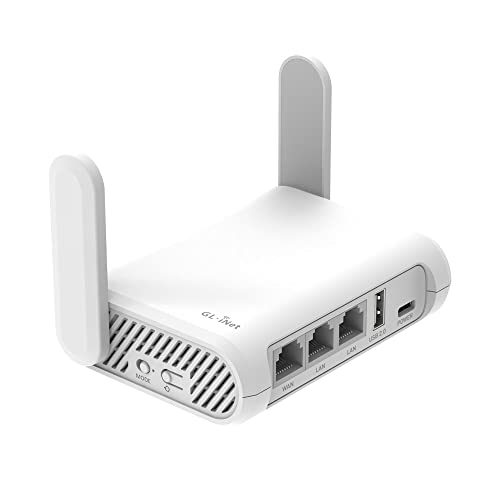
HooToo Wireless Travel Router
The HooToo Wireless Travel Router is an economical choice that still offers a variety of features. It can work as a router, range extender, and access point. It includes a USB port for sharing files or connecting a 4G modem, and it has a built in 3000 mAh battery that can charge your phone. The device supports up to 5 devices and provides a secure private network when using public Wi Fi. Users find it easy to set up and appreciate the low price point.
Pros
- Very affordable
- Battery backup for charging
- Multiple modes
Cons
- Slower speeds due to 2.4 GHz only
- Plastic build feels less sturdy
GL.iNet GL-SFT1200 (Opal)
The GL.iNet GL-SFT1200, also known as Opal, is a compact travel router that supports Wi Fi 6 (802.11ax), offering faster speeds and better efficiency. It has dual band capability with speeds up to 1200 Mbps. It includes a USB 2.0 port for storage or 4G modem, and it has a built in VPN client supporting OpenVPN and WireGuard. The device is powered by a USB Type C cable. Owners report that the signal range is impressive for its size, and the setup is simple using the mobile app.
Pros
- Wi Fi 6 for faster speeds
- Dual band
- Supports VPN clients
Cons
- More expensive than older models
- No built in battery
TP-Link AC750 Wireless Travel Router (TL-WR902AC)
The TP-Link AC750 is a very small travel router that provides dual band Wi Fi speeds up to 750 Mbps. It features a built in USB port that can be used for charging your devices or sharing a 4G connection. It supports multiple modes including router, access point, range extender, and WISP. The device is powered by a micro USB cable, so you can use a wall adapter or power bank. Users praise its portability and the ability to create a secure hotspot from a hotel’s wired Ethernet.
Pros
- Very compact and light
- Dual band speeds
- Can charge devices via USB
Cons
- No battery built in
- USB port limited to charging or 4G
Side by side
| # | Model | Wireless Standard | Best for | Score | Price |
|---|---|---|---|---|---|
| 1 | GL.iNet GL-MT300N-V2 (Mango) | Wi Fi 4 (802.11n) | Budget friendly travel router | 9.4 | Check price |
| 2 | TP-Link TL-WR902AC | Wi Fi 5 (802.11ac) | Travelers needing dual band speeds | 9.2 | Check price |
| 3 | GL.iNet GL-AR150 | Wi Fi 4 (802.11n) | Advanced customization | 9.0 | Check price |
| 4 | Ravpower FileHub Plus | Wi Fi 4 (802.11n) | All in one file sharing and router | 8.8 | Check price |
| 5 | HooToo Wireless Travel Router | Wi Fi 4 (802.11n) | Budget conscious travelers | 8.6 | Check price |
| 6 | GL.iNet GL-SFT1200 (Opal) | Wi Fi 6 (802.11ax) | Next gen Wi Fi 6 travel | 9.0 | Check price |
| 7 | TP-Link AC750 Wireless Travel Router (TL-WR902AC) | Wi Fi 5 (802.11ac) | Compact dual band with USB charging | 8.7 | Check price |
How to pick the right one
Questions worth asking
What is a travel access point?
A travel access point is a small device that creates a private Wi Fi network from a single wired or wireless internet connection. It allows multiple devices to connect securely, especially when you are in a hotel, airport, or other public place.
How do I connect a travel router to hotel Wi Fi?
Most travel routers have a repeater or range extender mode. You set the router to that mode, select the hotel network, and enter its password. The router then rebroadcasts a new network that you can connect your devices to.
Can I use a travel router with a wired Ethernet connection?
Yes, many travel routers have an Ethernet port. You plug the hotel’s Ethernet cable into the WAN port of the router, and it creates a Wi Fi network. This is often faster and more stable than using wireless.
What is the difference between a travel router and a portable hotspot?
A portable hotspot uses a cellular data connection to create Wi Fi. A travel router takes an existing internet connection, either wired or wireless, and shares it. Some travel routers can also connect to a 4G modem via USB, but they do not have built in cellular radios.
Do I need a dual band travel router?
Dual band routers broadcast on both 2.4 GHz and 5 GHz. The 5 GHz band offers faster speeds and less interference, but it has a shorter range. If you need high speed streaming or gaming, a dual band router is beneficial. For basic browsing, a 2.4 GHz router is sufficient.
Can I use a travel router to share a public Wi Fi securely?
Yes, a travel router with VPN support can encrypt your traffic before it leaves the router. This protects your data from eavesdroppers on the public network. Even without VPN, the router creates a private network between your devices, but your traffic is still visible to the ISP.
How many devices can connect to a travel router?
Most travel routers support up to 10 or more devices, but the actual number may be lower depending on the router’s processing power. If you have many devices, consider a router with stronger hardware and dual band support.
Are travel routers allowed on airplanes?
Yes, travel routers are allowed on airplanes as long as they are used in airplane mode or with wireless capabilities disabled. You cannot use them during takeoff and landing, but you can use them during the flight if the airline permits Wi Fi usage.
What is the typical range of a travel router?
The range depends on the router’s antennas and environment. In a hotel room, a travel router can cover the entire room. In open areas, it may extend up to 100 feet. Obstacles like walls reduce the range.
Can I use a travel router to share a 4G dongle?
Yes, many travel routers have a USB port that can accept a 4G dongle or modem. The router then shares the cellular internet over Wi Fi. Check the router’s specifications to ensure compatibility with your specific dongle.
The verdict
For most travelers, the best choice is the GL.iNet GL-MT300N-V2 because it balances cost, portability, and security with its OpenVPN support. If you need faster speeds and have a larger budget, the GL.iNet GL-SFT1200 Opal is worth the upgrade for its Wi Fi 6 capability. For those who want an all in one device with a battery, the Ravpower FileHub Plus is a solid pick. Avoid the HooToo if you need high performance, but it is fine for basic use on a budget.


