Adjustable Weight Benches Compared for Home Gyms
Rep Fitness AB-3000 tops the list, pairing a 1000 lb rating with a tight seat to back gap that supports heavy pressing. Bowflex 5.1S stows vertically for shared rooms. FLYBIRD folds flat and handles dumbbell work at the lowest outlay here.
Pressing heavy at home? Rep Fitness AB-3000 is the bench, with a 1000 lb rating and a ladder adjustment that does not shift under load. Bowflex 5.1S stows upright in a shared room. FLYBIRD folds away and covers dumbbell routines for far less.
Weight rating, the gap between seat and backrest, and whether the flat setting is genuinely level all change how a bench performs under a bar. None of those appear in a listing photo. We compared stated capacities, angle counts, frame materials and folding designs, then weighed owner reports on stability under load and long term pad wear.
The best picks, ranked

Rep Fitness AB-3000
Heavy gauge steel and a ladder style adjustment give this bench a 1000 lb rating that owners say holds without creak or shift. Seven backrest and three seat positions cover decline through overhead pressing. Its seat to back gap stays small, so the lower back has support through a full incline press.
Pros
- 1000 lb rating covers any home lifting load
- Ten combined angle settings across seat and back
- Small seat to back gap supports the lower spine
Cons
- Heavy enough that repositioning is a chore
- Takes more permanent floor space than folding benches

Bowflex 5.1S Stowable Bench
Folding vertically turns a floor hogging bench into something that stands in a corner, which is why shared rooms suit it. Six back positions run from decline to full military press. Its pad is wide and comfortable, and owners report enough stability for dumbbell work and moderate barbell pressing.
Pros
- Folds vertically into a corner
- Angle range runs decline to overhead
- Wide pad stays comfortable on long sets
Cons
- Seat angle does not adjust
- 600 lb rating limits maximal barbell work

FLYBIRD Adjustable Weight Bench
Setup takes minutes, adjustment needs no tools, and the whole frame folds flat for storage under a bed. That combination explains why it is so often a first bench. Its 700 lb rating suits dumbbell routines, though the narrower base feels less planted than a wide stance frame.
Pros
- Folds flat for storage under furniture
- Tool free adjustment between sets
- Seven back angles at an entry level cost
Cons
- Narrow base feels less planted than wide frames
- Suited to dumbbells rather than heavy barbell work
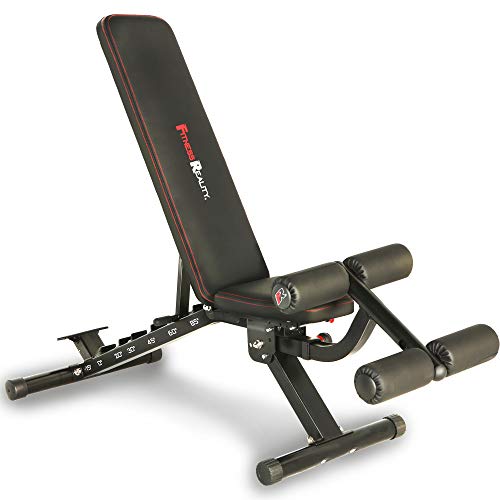
Fitness Reality 1000 Super Max
Twelve backrest positions give finer angle control than any other bench here, useful for dialling in upper chest work. A detachable leg hold down opens up decline pressing and sit ups. Its 800 lb rating beats most benches at similar cost, though the pad runs firm and assembly takes a while.
Pros
- Twelve back angles allow fine adjustment
- Removable leg hold down enables decline work
- 800 lb rating exceeds most benches at this level
Cons
- Pad is firm over long sessions
- Assembly runs longer than folding benches

Finer Form Multi-Functional Bench
Roller pads and a leg extension attachment turn this into a light strength station rather than a pure pressing bench. Decline sit ups and leg curls both become available without extra equipment. Those attachments add bulk, and the five back positions trail the angle range of dedicated press benches.
Pros
- Leg curl and extension built into the frame
- Decline sit up position included
- 800 lb rating for a multi function unit
Cons
- Attachments add bulk around the bench
- Only five pressing angles available

Marcy Adjustable Utility Bench SB-670
Marcy keeps this simple: flat, incline and decline on a 14 gauge steel frame with transport wheels at one end. Tilting and rolling beats lifting when floor space needs clearing between sessions. Its seat does not adjust and pad comfort is basic, which is the trade for the compact footprint.
Pros
- Transport wheels move it without lifting
- Flat, incline and decline all covered
- Compact enough for a tight training corner
Cons
- Seat angle is fixed
- Pad padding is thin by comparison

Yes4All Adjustable Weight Bench
Six incline positions, a folding steel tube frame and a short assembly make this an easy first bench. Home dumbbell circuits are where it belongs. Its 500 lb rating is the lowest here, so heavy barbell pressing should go on a sturdier frame.
Pros
- Lowest cost bench in the roundup
- Folds for storage in a closet
- Assembly takes well under an hour
Cons
- 500 lb rating is the lowest here
- Lighter frame flexes under heavy pressing
How they compare
| # | Model | Weight capacity | Best for | Score | Price |
|---|---|---|---|---|---|
| 1 | Rep Fitness AB-3000 | 1000 lb | Best overall | 9.4 | Check price |
| 2 | Bowflex 5.1S Stowable Bench | 600 lb | Best value | 9.2 | Check price |
| 3 | FLYBIRD Adjustable Weight Bench | 700 lb | Best budget | 9.0 | Check price |
| 4 | Fitness Reality 1000 Super Max | 800 lb | Best for versatility | 8.8 | Check price |
| 5 | Finer Form Multi-Functional Bench | 800 lb | Best for full body work | 8.6 | Check price |
| 6 | Marcy Adjustable Utility Bench SB-670 | 600 lb | Best compact pick | 8.3 | Check price |
| 7 | Yes4All Adjustable Weight Bench | 500 lb | Best lightweight starter | 8.0 | Check price |
How to pick the right one
What weight capacity does an adjustable bench need? Add your body weight to the heaviest load you press, then buy well above that number. Someone weighing 180 lb pressing 225 lb needs a bench rated far past 405 lb, because ratings are static figures and lifting adds dynamic load. Serious barbell lifters should target 1000 lb frames like the AB-3000. Dumbbell focused home users are safe in the 500 to 700 lb range with a wide base.
Why does the seat to back gap matter? That gap is the space between the seat pad and the backrest when the bench is inclined. A wide one leaves your lower back unsupported at exactly the point where an incline press loads it, and it pinches skin on the way up. Benches designed for pressing keep the gap under an inch or two. Check photos of the bench at 45 degrees rather than flat, since flat hides the problem entirely.
Which bench angles will you actually use? Twelve positions sound better than seven and rarely are. What matters is having a genuinely level flat setting, a 30 to 45 degree incline for upper chest, and a slight decline. Some budget benches sit a few degrees off level in the flat position, which ruins barbell bench pressing. Confirm the flat setting is truly horizontal before counting anything else, because that single position gets the most use.
How do you fit an adjustable bench into a small room? Vertical stowing benches like the Bowflex 5.1S stand upright against a wall and take roughly a square foot when parked. Flat folding designs such as the FLYBIRD slide under a bed. Heavier fixed frames trade all that portability for stability, and transport wheels are the compromise. Leave around two feet of clear space each side for dumbbell handling, since a bench pushed into a corner blocks its own use.
Questions worth asking
What weight capacity do I need in an adjustable bench?
Add your body weight to your heaviest load, then choose a bench rated well above that total. Most home lifters are well served between 600 and 1000 lb, which leaves a genuine safety margin.
Is an adjustable bench better than a flat bench?
An adjustable bench covers flat, incline and decline, which changes the muscle emphasis across pressing. A flat bench costs less and feels marginally more solid, but limits what you can train.
Why is the seat to back gap important on a bench?
A tight gap keeps the lower back and glutes supported during incline pressing. Wide gaps pinch skin and leave the spine unsupported exactly where the load peaks.
Can I use an adjustable bench with a barbell?
Yes, paired with a rack or stands for safety. Choose a high rated bench with a wide base for barbell work, and keep lighter folding benches for dumbbell training.
Are foldable weight benches stable enough?
Quality folding benches like the Bowflex 5.1S handle dumbbell work and moderate pressing without complaint. Fixed frames still feel more planted at maximal loads, so check base width and rating.
How much space does an adjustable bench need?
Most occupy roughly two feet by four feet in use, plus clearance each side for dumbbells. Folding and vertical stowing models drop to about a square foot when stored.
Do adjustable benches arrive assembled?
Most arrive partly assembled and take 20 to 40 minutes with the supplied hardware. Heavier commercial style frames like the AB-3000 take longer because of the fastener count.
What incline angle is best for chest pressing?
Around 30 to 45 degrees emphasises the upper chest, while flat works the mid chest. Steeper angles shift load onto the front deltoids instead.
Which adjustable bench is best for a small apartment?
The Bowflex 5.1S stows vertically against a wall, and the FLYBIRD folds flat to slide under a bed. Both free the floor between sessions.
How do I know if a bench flat setting is truly level?
Rest a spirit level along the pad in the flat position. A few degrees of tilt affects barbell bench pressing noticeably, and it is the most common shortcut on budget frames.
The bottom line
Rep Fitness AB-3000 is the bench to buy if you press heavy and want a frame that will not move for years. Bowflex 5.1S delivers most of the same angle range while stowing upright, which suits a shared room. FLYBIRD gets a dumbbell focused home gym started for the least money.


