Weight Plates Compared: Bumper, Cast Iron, Urethane
The Synergee Rubber Bumper Plates are our overall pick for their low bounce and accurate diameter. The BalanceFrom Olympic Bumper Plate Set is the best value for a home garage, and the CAP Barbell Olympic Grip Plate is the budget choice for racked lifting.
If you drop the bar, the Synergee Rubber Bumper Plates are the safest all round choice, the BalanceFrom Olympic Bumper Plate Set covers a home garage for less, and the CAP Barbell Olympic Grip Plate is the sensible pick when everything stays in a rack.
Weight plates are tricky because the right answer depends entirely on whether the bar ever touches the floor, and because thickness varies enough between brands that a bar which loads fine with one set runs out of sleeve with another. We compared seven current options on material, rebound, stated diameter tolerance, collar insert quality and what owners report after months of loading and unloading.
The top picks, ranked

Synergee Rubber Bumper Plates
Synergee plates use a dense rubber compound that absorbs a dropped bar without launching it back up, and the stainless steel insert stays tight in the hub rather than working loose. Diameter is consistent across weights, so the bar sits level when you mix denominations. Owners report they hold up to daily Olympic lifting without deforming.
Pros
- Minimal bounce on dropped lifts
- Steel insert stays secure over time
- Consistent diameter across weights
Cons
- Thicker than iron, limits bar loading
- New rubber has a strong smell initially

BalanceFrom Olympic Bumper Plate Set
This set covers the common denominations in one purchase, which usually costs less than assembling the same weights individually. The rubber is firm enough for repeated drops in a home garage. Based on specifications it is the most practical way to kit out a first home gym without buying plates piecemeal.
Pros
- Full set cheaper than buying pairs separately
- Suitable for dropping in a home gym
- Colour coded weights are easy to identify
Cons
- Thickness varies slightly between plates
- Rubber is softer than premium brands
Titan Fitness Urethane Olympic Plates
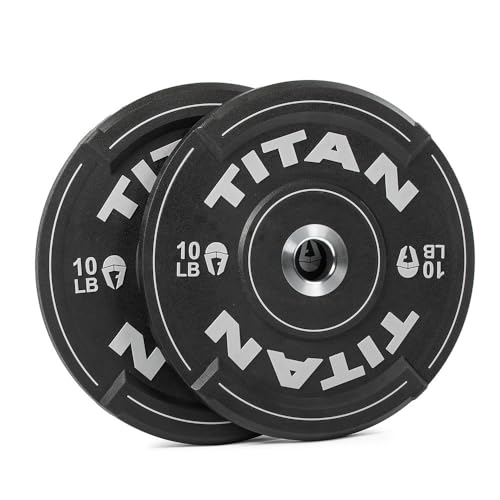
Urethane resists tearing and does not mark floors or racks the way rubber can, which is why commercial gyms use it. These plates are thinner than rubber bumpers of the same weight, so more fits on the bar. Owners report they look essentially unchanged after long periods of heavy use.
Pros
- Extremely durable and tear resistant
- Thinner profile allows heavier loading
- No rubber smell or floor marking
Cons
- Most expensive option here
- Firmer bounce than soft rubber bumpers

Yes4All Olympic Rubber Bumper Plates
Sold as pairs rather than full sets, which lets you build a collection gradually as your lifts increase instead of buying weights you cannot yet use. The rubber is drop rated and the insert is steel. Based on specifications it is the sensible path for someone starting out who does not yet know their end goal.
Pros
- Build a set gradually as strength grows
- Drop rated from the lightest pairs up
- Widely available for adding matching pairs later
Cons
- Costs more per pound bought piecemeal
- Thicker than iron for the same weight

papababe Bumper Plates
papababe plates are noticeably thinner than most rubber bumpers, which matters when you are loading heavy on a standard bar and running out of sleeve. The high density rubber still handles drops. Owners report the narrower profile is the difference between fitting the intended load and not.
Pros
- Thin profile fits more weight on the bar
- Dense rubber limits bounce
- Stainless insert resists wear
Cons
- Less forgiving on very heavy drops
- Finish scuffs more visibly

CAP Barbell Olympic Grip Plate
Traditional cast iron with moulded grip handles, which makes loading and carrying far easier than a flat disc. Iron is much thinner than rubber for the same weight, so you can load a bar heavily. Based on specifications these are for bench, squat and rack work rather than anything that gets dropped.
Pros
- Cheapest cost per pound of weight
- Grip handles make loading easy
- Thin profile for very heavy loads
Cons
- Cannot be dropped, damages floors
- Bare iron can rust in a damp garage

Amazon Basics Cast Iron Weight Plate
Plain cast iron plates with a hammertone finish, sold individually so you can buy exactly what you need. There are no grip handles, but the price per pound is the lowest here. Owners report they are perfectly adequate for machines, dumbbell handles and racked barbell work.
Pros
- Lowest cost per pound available
- Buy exactly the denominations you need
- Compact storage on a plate tree
Cons
- No grip handles for carrying
- Not suitable for dropping at all
How they compare
| # | Model | Material | Best for | Score | Price |
|---|---|---|---|---|---|
| 1 | Synergee Rubber Bumper Plates | Dense virgin rubber | Best overall | 9.4 | Check price |
| 2 | BalanceFrom Olympic Bumper Plate Set | Complete set, paired weights | Best value | 9.2 | Check price |
| 3 | Titan Fitness Urethane Olympic Plates | Urethane | Best durability | 9.0 | Check price |
| 4 | Yes4All Olympic Rubber Bumper Plates | Sold in pairs | Best for beginners | 8.7 | Check price |
| 5 | papababe Bumper Plates | High density rubber | Best for garage gyms | 8.5 | Check price |
| 6 | CAP Barbell Olympic Grip Plate | Cast iron | Best for racked lifting | 8.3 | Check price |
| 7 | Amazon Basics Cast Iron Weight Plate | Cast iron | Best budget | 8.0 | Check price |
Before you buy
Do you drop the bar? That is the whole decision If you do Olympic lifts, deadlifts from the floor without control, or train alone at your limit, you need bumper plates. They are rubber or urethane so the bar can be dropped safely, they protect the floor and the bar, and every drop rated plate shares the same diameter so the bar lands level. If everything happens inside a rack with safety arms, cast iron is thinner, cheaper and perfectly appropriate.
Bounce is the spec nobody lists Softer rubber absorbs a drop but rebounds more, sending the bar back up unpredictably. Denser compounds and urethane bounce less but transmit more shock to the floor. Dense rubber plates like the Synergee sit in the useful middle. If you train on an upper floor or in a garage above a room, add rubber matting regardless of which plates you choose.
Thickness decides how much fits on the bar A standard Olympic bar has a fixed sleeve length, and rubber bumpers are considerably thicker than iron for the same weight. Loading heavy with bumpers can literally run out of room, which is why thinner options like the papababe plates and Titan urethane matter to stronger lifters. Iron plates from CAP and Amazon Basics have no such problem, which is one reason they persist.
Buying, checking and storing plates Confirm the collar size matches your bar, two inches for Olympic and one inch for standard, because they are not interchangeable. On arrival, check that steel inserts sit flush and do not rotate in the hub, since a loose insert is the most common defect. Store plates on a vertical tree or horizontal pegs rather than stacked on the floor, keep bare iron dry and lightly oiled in a damp garage, and never leave plates loaded on a bar between sessions where the sleeve can take a set.
Questions worth asking
What is the difference between bumper plates and iron plates?
Bumper plates are rubber or urethane, share a common diameter and can be dropped safely from overhead. Iron plates are thinner and cheaper per pound but will damage floors, bars and themselves if dropped.
Do I need bumper plates for deadlifts?
If you lower the bar under control onto a mat, iron is workable. If you drop or partially drop the bar, which most people do at heavy loads, bumpers protect your floor, your bar and your neighbours’ patience.
Are urethane plates worth the extra?
In a commercial setting or for someone training daily for years, yes, since they resist tearing and do not mark floors. For a home gym used a few times a week, dense rubber bumpers give most of the benefit for considerably less.
What size collar do I need?
Olympic bars use a two inch sleeve and standard bars use one inch. Check your bar before ordering, because plates for one will not fit the other and adapters are an awkward compromise.
How much weight should I start with?
A common starting point is a pair of 45 pound plates, a pair of 25s, a pair of 10s and a pair of 5s, which covers a wide range of loading. Buying in pairs, as Yes4All allows, lets you extend the set as your lifts progress.
Will bumper plates damage my garage floor?
Far less than iron, but repeated dropping still transmits force through a concrete slab. Horse stall mats or dense rubber flooring under the lifting area is the standard solution and costs little relative to the plates.
Why do my plates smell?
New rubber outgasses noticeably, particularly recycled crumb rubber. It fades over several weeks. Airing the plates outdoors for a few days before bringing them into a closed garage speeds this up considerably.
Can I mix bumper and iron plates on the same bar?
Yes, provided the bumpers sit outermost so the bar still lands on rubber if dropped. Mixing is common when someone starts with bumpers and adds cheaper iron for incremental weight.
Our take
The Synergee Rubber Bumper Plates are the pick for anyone whose bar reaches the floor, combining low bounce with inserts that stay tight over time. The BalanceFrom Olympic Bumper Plate Set is the more economical route to a full home gym, and the CAP Barbell Olympic Grip Plate remains the sensible answer when all lifting happens inside a rack.