Quiet Air Pumps for Indoor Aquariums and Bedrooms
The Tetra Whisper Air Pump is our overall pick for reliable, genuinely quiet running in a living room. The Hygger Quiet Mini Air Pump offers better value for nano tanks, while the Fluval Q2 Air Pump suits larger indoor setups needing adjustable output.
For an indoor tank in a room people actually use, the Tetra Whisper Air Pump is the most reliable balance of quiet running and output, with the Hygger Quiet Mini Air Pump the better value for nano tanks and the Fluval Q2 Air Pump for larger indoor setups.
Air pumps are deceptively difficult to shop for because manufacturers advertise output, while the thing that ruins a pump indoors is noise, and the two are not listed on the same scale. Much of the sound you hear is vibration transmitted into the cabinet rather than the motor itself, so placement changes the result as much as the model does. We compared published tank ratings, outlet counts and noise claims alongside the noise complaints that recur in owner reviews.
The top picks, ranked
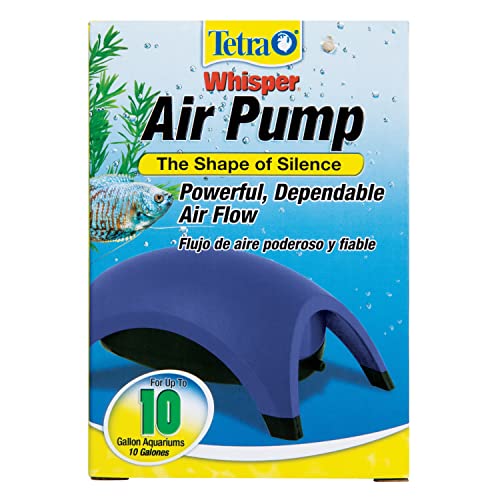
Tetra Whisper Air Pump
The Whisper has been the default recommendation for years because it does the boring things well, running quietly and lasting for years without attention. The rubber feet and internal damping handle most of the vibration that makes cheaper pumps buzz on a cabinet. Output is fixed, so match the model to your tank size at purchase.
Pros
- Genuinely quiet in a living room
- Long service life reported by owners
- Replacement diaphragms widely available
Cons
- No output adjustment
- Needs the right model for your tank size

hygger Quiet Mini Aquarium Air Pump
Built around small tanks and bedrooms, this compact pump uses a piston design that produces a lower pitched hum than typical diaphragm pumps. Owners report it is one of the few pumps they can sleep next to. It does not have the output for a large or deep tank.
Pros
- Lower pitched sound is easier to ignore
- Small enough to hide behind a nano tank
- Strong value at its size
Cons
- Not enough output for larger tanks
- Limited to shallow water depths

Fluval Q2 Air Pump
Fluval builds a heavier pump with a sound damping chamber and adjustable output, which lets you dial the flow down until it is quiet enough while still driving deeper water. That adjustability is the feature most fixed pumps lack. It is bulkier than the alternatives and needs cabinet space.
Pros
- Adjustable output lets you trade flow for quiet
- Two independently controlled outlets
- Enough pressure for deeper tanks
Cons
- Physically larger than rivals
- Costs more than basic pumps

Marina 200 Air Pump
A dependable mid range pump with a mounted rubber base that keeps vibration out of the stand. It sits between the nano pumps and the large adjustable units in both output and price. Owners report consistent performance with sponge filters, which is the most common use for a pump this size.
Pros
- Rubber base cuts transmitted vibration
- Reliable with sponge filters
- Simple with nothing to go wrong
Cons
- Only one outlet
- No output control
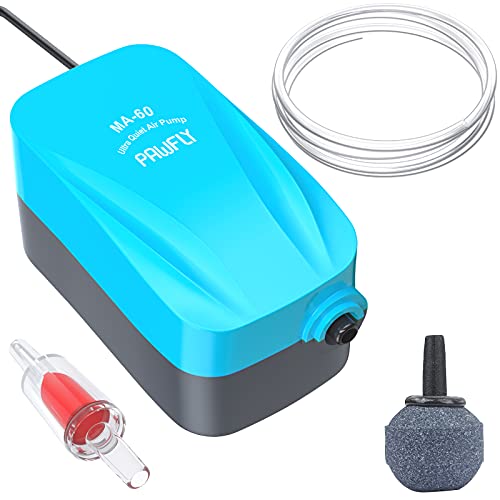
Pawfly MA-60 Aquarium Air Pump
A tiny, inexpensive pump for a small tank, a quarantine setup or a betta bowl where you need gentle movement rather than serious aeration. It comes with basic tubing and an air stone, so it works out of the box. Noise is acceptable rather than impressive.
Pros
- Complete starter kit in the box
- Very low cost for a spare or quarantine tank
- Gentle output suits bettas
Cons
- Audible hum in a quiet room
- Limited to small, shallow tanks
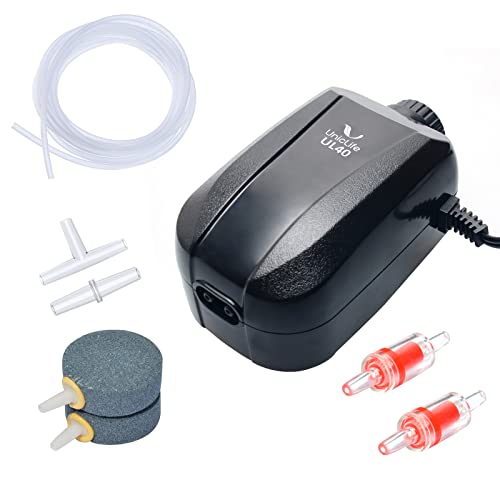
Uniclife Aquarium Air Pump
Two independently adjustable outlets let one pump serve two tanks or split between a sponge filter and an air stone. That flexibility is the main reason to choose it over single outlet rivals. It runs slightly louder than the Tetra Whisper, so cabinet placement matters.
Pros
- Runs two tanks from one pump
- Independent control per outlet
- Good value for the flexibility
Cons
- Louder than the quietest options
- Adjustment valves can stiffen over time

EHEIM Air Pump 400
EHEIM builds this for tanks deep enough that ordinary pumps struggle to push air to the bottom, and the sound insulated housing keeps that power reasonably quiet. It is a specialist choice rather than a general recommendation. For a standard indoor tank it is more pump than needed.
Pros
- Handles depth that defeats smaller pumps
- Insulated housing keeps noise controlled
- Solid long term build quality
Cons
- Overpowered for typical home tanks
- Priciest option we ranked
Before you buy
Noise indoors is mostly vibration, not motor sound A pump sitting directly on a wooden cabinet turns the whole cabinet into a sounding board. The single most effective fix costs nothing, which is to place the pump on a folded towel, a mousepad or a piece of foam. Owners consistently report this makes a bigger difference than upgrading to a supposedly quieter model.
Match output to tank volume and depth Air pumps are rated by tank volume, but water depth matters just as much because the pump has to overcome the pressure at the outlet. A pump that is fine on a shallow twenty gallon tank may barely bubble at the bottom of a tall one. If your tank is deeper than average, size up or choose an adjustable model.
Always fit a check valve If the power fails or you unplug the pump, water can siphon back down the airline and into the pump, which destroys it and can empty part of your tank onto the floor. A check valve costs very little and prevents this entirely. Position the pump above the water line as well where the layout allows.
Plan for diaphragm replacement Air pumps fail gradually as the rubber diaphragm hardens, so output drops and noise rises over a year or two. Established brands sell rebuild kits, which is a genuine advantage over cheap unbranded pumps that must be replaced entirely. Factor that into the real long term cost.
How they compare
| # | Model | Noise | Best for | Score | Price |
|---|---|---|---|---|---|
| 1 | Tetra Whisper Air Pump | Low noise damped design | Best overall | 9.4 | Check price |
| 2 | hygger Quiet Mini Aquarium Air Pump | Piston type | Best value | 9.2 | Check price |
| 3 | Fluval Q2 Air Pump | Two with independent control | Best for large tanks | 9.0 | Check price |
| 4 | Marina 200 Air Pump | Medium tanks | Best for medium tanks | 8.8 | Check price |
| 5 | Pawfly MA-60 Aquarium Air Pump | Small tanks up to around ten gallons | Best budget | 8.6 | Check price |
| 6 | Uniclife Aquarium Air Pump | Two, independently adjustable | Best for multiple tanks | 8.3 | Check price |
| 7 | EHEIM Air Pump 400 | Suited to deep tanks | Best for deep tanks | 8.0 | Check price |
Common questions
Do all fish tanks need an air pump?
Not all. Tanks with a filter that agitates the surface already exchange gas adequately. Air pumps matter most for sponge filters, heavily stocked tanks, warm water that holds less oxygen, and any setup where you want visible bubble movement.
How do I make my aquarium air pump quieter?
Sit it on foam or a folded cloth to stop vibration reaching the furniture, keep the airline free of sharp bends, and check the air stone is not clogged, since restriction makes a pump work harder and louder. Suspending the pump on a hook is another effective trick.
What size air pump do I need?
Start with the tank volume rating, then account for depth and how many outlets you are driving. Splitting one pump across two air stones roughly halves the flow at each, so size up if you plan to split.
Can an air pump run continuously?
Yes, they are designed for continuous operation and cycling them on and off gives no benefit. Constant running also keeps the diaphragm working at a steady temperature.
Where should the air pump be placed?
Above the water line where possible, on a soft surface, and somewhere with airflow so it does not overheat. If it must sit below the tank, a check valve is essential rather than optional.
Why has my air pump got weaker over time?
The rubber diaphragm hardens with age, and air stones clog with mineral deposits and biofilm. Replacing the air stone is the cheap first step; if that does not help, the pump needs a rebuild kit.
Are battery backup air pumps worth it?
In areas with frequent power cuts, yes, particularly for heavily stocked tanks where oxygen depletes within hours. They are a supplement to a mains pump rather than a replacement.
Do bubbles actually add oxygen to the water?
Only slightly from the bubbles themselves. Most of the benefit comes from the surface agitation the rising bubbles create, which is where gas exchange really happens.
Our take
The Tetra Whisper Air Pump remains the sensible default for an indoor tank because it is quiet, long lived and easy to service. Choose the hygger Quiet Mini for a nano tank in a bedroom, or the Fluval Q2 when you need adjustable output for something larger. Whatever you buy, sit it on foam and fit a check valve.