Quiet Aquarium Air Pumps That Keep Tanks Oxygenated
The Tetra Whisper Air Pump 40 Gallon is our overall pick for its quiet running and reliable output on mid sized tanks. Fluval’s Q1 is the stronger choice for deeper aquariums or multiple outlets, and the hygger Quiet Aquarium Air Pump is the value option for small setups.
For a typical community tank the Tetra Whisper Air Pump 40 Gallon does the job quietly and cheaply, with the Fluval Q1 better suited to deep tanks or several outlets and the hygger Quiet Aquarium Air Pump covering small setups for less.
Air pumps look like a commodity purchase and are not, because two pumps with identical stated ratings can differ enormously in how loud they are at two in the morning in a quiet room. Depth also matters more than tank volume, since a pump has to overcome the water pressure above the airstone before any bubbles appear. We compared stated output, rated tank sizes, outlet counts and damping design, then weighed those against what owners report about buzzing through furniture, diaphragms weakening over a year and back siphoning when the power cuts out.
Our top picks

Tetra Whisper Air Pump 40 Gallon
Tetra’s Whisper line earns its name through a suspended motor mount and a dome shape that damps vibration rather than transmitting it into the cabinet. Output is well judged for tanks around forty gallons running a sponge filter or airstone. It has no flow control of its own, so add an inline valve if you want to dial the bubbles back.
Pros
- Genuinely quiet in a living room
- Well matched output for mid sized tanks
- Widely stocked with cheap replacement parts
Cons
- No built in flow adjustment
- Check valve not included in the box

Fluval Q1 Air Pump
The Q1 uses a dual outlet design with individual flow controls, so you can run a sponge filter and an airstone at different rates from one pump. Its output is strong enough to push air down into taller tanks where weaker pumps stall. Fluval builds in sound damping chambers, though it is not as quiet as the Tetra Whisper at low output.
Pros
- Independent flow control per outlet
- Enough pressure for deep tanks
- Diaphragms can be replaced rather than binning the pump
Cons
- Louder than the quietest small pumps
- Larger footprint behind the tank
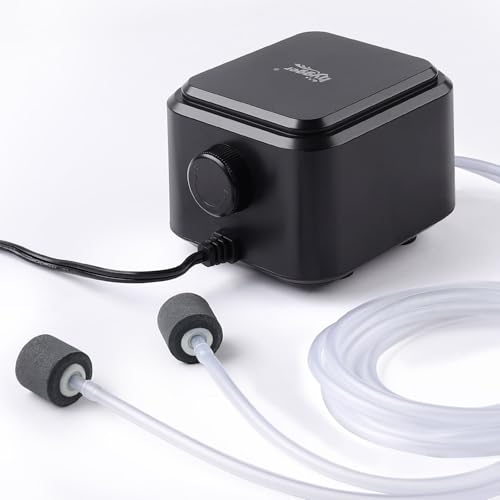
hygger Quiet Aquarium Air Pump
hygger includes an adjustable output dial and a rubber damping base, which together cover the two things people usually have to add to a budget pump. It comes with airline tubing, check valves and airstones, so it is genuinely ready to use out of the box. Long term durability is less proven than the established brands.
Pros
- Flow control built in rather than added
- Accessories included in the box
- Quiet on the lower output settings
Cons
- Long term reliability less established
- Struggles in tanks deeper than average

Aqueon Aquarium Air Pump 100
The Aqueon 100 is sized for bigger aquariums and runs two outlets comfortably, making it a sensible single pump for a tank with a sponge filter at each end. The rubber feet reduce vibration noticeably compared with hard plastic bases. It is a plain, functional pump with no flow adjustment of its own.
Pros
- Enough output for a large aquarium
- Runs two devices without a splitter compromise
- Simple and durable construction
Cons
- No output control on the pump
- Audible hum in a quiet room

Marina 200 Air Pump
Marina’s 200 is one of the quieter mid range pumps thanks to its internal damping and soft mounted motor, which matters if the tank is in a bedroom or home office. Output suits tanks around fifty five gallons on a single outlet. Airflow is modest, so it is not the pump for driving several airstones at once.
Pros
- Among the quietest at this output level
- Steady flow for sponge filters
- Simple to service
Cons
- Not enough output for multiple airstones
- No flow adjustment
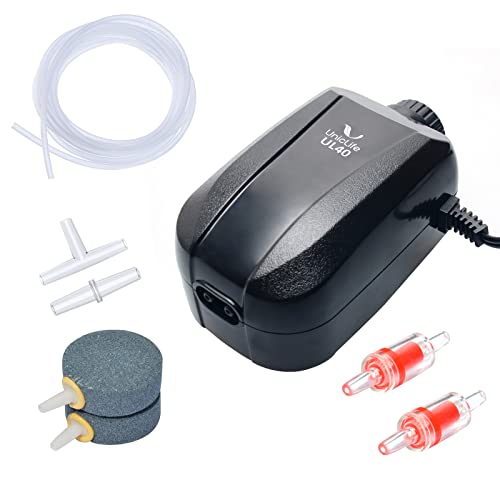
Uniclife Aquarium Air Pump AP20
The AP20 is sized for nano and shrimp tanks where a full size pump would blast the substrate around. It includes a control dial to trim the flow down to a slow trickle of bubbles, which is exactly what shrimp keepers and betta owners want. It comes with tubing and a check valve to get started.
Pros
- Gentle output suits shrimp and betta tanks
- Flow dial goes genuinely low
- Small enough to hide behind the tank
Cons
- Not enough output for tanks over about twenty gallons
- Light housing transmits vibration on hard surfaces

EHEIM Air Pump 400
EHEIM builds this pump with the same focus on longevity as its filters, using a heavy damped housing and serviceable internals that keep it running for years. Output is adjustable and the noise floor is low for the airflow produced. It costs more than comparable pumps, which only makes sense if you value long service life over initial outlay.
Pros
- Built to run for years with servicing
- Low noise for the output delivered
- Adjustable flow as standard
Cons
- Costs more than equivalent output rivals
- Heavier and bulkier than plastic pumps
The lineup, side by side
| # | Model | Rated for | Best for | Score | Price |
|---|---|---|---|---|---|
| 1 | Tetra Whisper Air Pump 40 Gallon | Tanks up to about 40 gallons | Best overall | 9.4 | Check price |
| 2 | Fluval Q1 Air Pump | Larger and deeper aquariums | Best for deep tanks | 9.2 | Check price |
| 3 | hygger Quiet Aquarium Air Pump | Small to mid sized tanks | Best value | 9.0 | Check price |
| 4 | Aqueon Aquarium Air Pump 100 | Tanks up to about 100 gallons | Best for large tanks | 8.8 | Check price |
| 5 | Marina 200 Air Pump | Tanks up to about 55 gallons | Best for quiet bedrooms | 8.6 | Check price |
| 6 | Uniclife Aquarium Air Pump AP20 | Nano and small aquariums | Best for nano tanks | 8.3 | Check price |
| 7 | EHEIM Air Pump 400 | Mid to large aquariums | Best build quality | 8.0 | Check price |
How to choose
Depth matters more than tank volume Air pumps are rated by tank size, but what they actually have to overcome is the water pressure above the airstone. A pump that runs happily on a wide shallow tank can stall completely in a tall one of the same volume. If your aquarium is deeper than about eighteen inches, size up beyond the stated rating or choose a pump like the Fluval Q1 that is specified for depth.
Noise comes from vibration, not the motor Most of the sound people complain about is the pump buzzing against whatever it sits on. A cabinet top acts as a soundboard and amplifies a quiet pump into a room filling hum. Rubber feet help, but hanging the pump from a hook or resting it on a folded towel or foam block usually does far more. Owners report this single change makes more difference than swapping to a supposedly quieter model.
Always fit a check valve If the power fails or you unplug the pump, water can siphon back up the airline and into the pump, which ruins it and can empty a surprising amount of water onto the floor. A one way check valve in the airline costs very little and prevents this entirely. Position the pump above the water line as well, as a second layer of protection.
Airstones, valves and maintenance Fine pored airstones make smaller bubbles and better gas exchange, but they clog over months and force the pump to work harder against the restriction. Replacing airstones periodically keeps output where it should be. Gang valves let one pump feed several tanks or devices, and diaphragms in serviceable pumps such as the Fluval and EHEIM units can be replaced when output starts to fade.
Questions worth asking
Does my aquarium actually need an air pump?
Not always. A filter that agitates the surface already handles gas exchange in many tanks. Air pumps become important for sponge filters, heavily stocked tanks, warm water that holds less oxygen and as backup during power or filter failures.
How do I pick the right size air pump?
Start with the rated tank size, then size up if your tank is deep, if you are running multiple airstones, or if the airline run is long. Depth is the factor most people underestimate.
Why is my air pump so loud?
Usually vibration transmitted into the surface it sits on. Try a foam pad, a folded towel or hanging the pump. A rattling diaphragm or a clogged airstone forcing the pump to strain are the other common causes.
What is a check valve and do I need one?
A one way valve in the airline that stops water siphoning back into the pump when power is lost. It costs very little and prevents an expensive failure, so fit one on every pump.
Can one pump run two tanks?
Yes, using a gang valve or a dual outlet pump such as the Fluval Q1 or Aqueon 100. Fit a check valve on each line, since otherwise water from one tank can travel to the other.
Do air pumps add oxygen directly?
Not really. The bubbles themselves contribute little. What actually oxygenates the water is the surface agitation the rising bubbles create, which is why an airstone near the bottom helps more than one near the top.
How often should airstones be replaced?
Every few months for fine pored stones, sooner if you notice output dropping. Clogged stones restrict flow and make the pump work harder, which shortens diaphragm life.
Will an air pump stress my fish?
Excessive flow can disturb bettas and shrimp. Use a pump with a flow dial such as the hygger or Uniclife AP20, or fit an inline valve to trim the bubble rate down to something gentle.
The bottom line
The Tetra Whisper Air Pump 40 Gallon covers what most aquarium owners need, running quietly enough for a living room and reliably enough that you stop thinking about it. Choose the Fluval Q1 if your tank is deep or you need two independently controlled outlets, and the hygger pump if you want flow control and accessories included for a small setup. Fit a check valve whichever you choose.


