Planted Tank Lights That Grow Carpets, Not Algae
The Fluval Plant 3.0 LED is our overall pick thanks to strong output and genuinely useful app scheduling. The NICREW ClassicLED Plus is the value choice for low tech tanks, and the Chihiros WRGB II delivers the richest colour rendering for planted display aquariums.
The Fluval Plant 3.0 LED is the fixture we would put over most planted tanks, combining enough output for demanding stems with per channel scheduling. For a low tech setup on a tighter budget the NICREW ClassicLED Plus is more than adequate, and if the tank is a display piece the Chihiros WRGB II makes plants and fish look noticeably better.
Choosing a planted tank light is tricky because manufacturers rarely publish comparable numbers, and the same fixture that grows a lush carpet in a shallow tank does very little at the bottom of a tall one. Light that overshoots your plants’ needs simply feeds algae. We compared published spectrum data, stated output, fixture length options, mounting hardware and what long term owners report about coverage and controller reliability.
The top picks, ranked

Fluval Plant 3.0 LED
The Plant 3.0 pairs high output diodes with an app that controls each colour channel independently across the day. That means you can ramp intensity gradually, run a lower midday period, and dial output back if algae appears rather than raising the fixture. Owners report the aluminium housing runs cool and the adjustable brackets fit a wide range of rimless and rimmed tanks.
Pros
- Precise per channel scheduling
- Strong output for demanding plants
- Solid adjustable mounting brackets
Cons
- App setup takes some patience
- Overkill for simple low tech tanks

NICREW ClassicLED Plus
A straightforward slim fixture that puts out enough light for anubias, java fern, crypts and most easy stems. There is no app, just a two channel switch and extendable brackets. For anyone running a low tech planted tank without carbon dioxide injection, it hits the level of light that grows plants without inviting an algae bloom.
Pros
- Well matched to low tech tanks
- Very easy to set up
- Wide range of sizes
Cons
- No built in dimming
- Not enough for carpeting plants at depth

Chihiros WRGB II
The WRGB II uses separate white, red, green and blue diodes, which makes reds and greens look considerably richer than a white heavy fixture. Output is high enough for carpeting plants in a properly fertilised tank. It is a fixture aimed at aquascapers who care about how the tank photographs as much as how it grows.
Pros
- Outstanding colour rendition
- High output for demanding plants
- Elegant low profile stand
Cons
- Easy to overdrive into algae
- Hanging kit sold separately

Finnex Planted+ 24/7 CC
The Planted+ 24/7 runs a full sunrise to moonlight cycle out of the box with no app required, which suits anyone who wants the tank to handle itself. Custom mode lets you set your own curve if the preset is too bright. Output sits in the moderate range, well matched to medium light plants.
Pros
- Automated cycle without a phone
- Custom curve option included
- Good spectrum for greens and reds
Cons
- Remote is easy to misplace
- Moderate output only
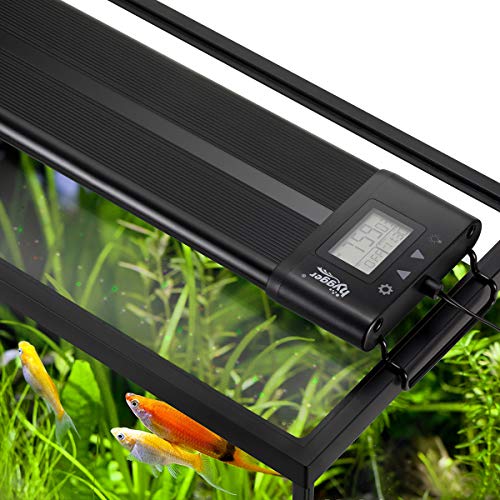
Hygger 957 Full Spectrum Aquarium Light
This fixture includes an external timer and dimming controller at a level where most rivals offer neither. Three light modes cover planted, general display and moonlight use. Owners report it is a solid choice for a first planted tank, though the coverage suits standard depth aquariums rather than tall ones.
Pros
- Timer and dimmer included
- Very easy to programme
- Good coverage in standard tanks
Cons
- Weaker in deep aquariums
- Controller cable is short

Current USA Satellite Freshwater LED Plus
The Satellite Plus offers a large wireless remote with dynamic effects, dimming and ramping, plus a colour palette you can tune to taste. Plant growth output is respectable for low to medium light species. It is the pick for community tanks where appearance matters as much as growth.
Pros
- Extensive colour and effect control
- Ramping avoids sudden light changes
- Easy remote programming
Cons
- Not strong enough for carpeting plants
- Effects are more novelty than useful
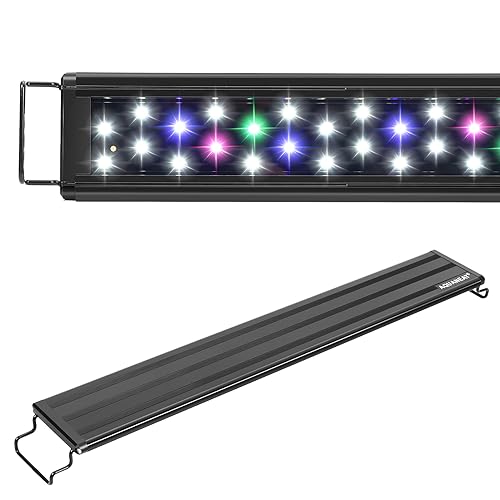
AQUANEAT Full Spectrum LED Aquarium Light
A simple clip on or bracket mounted fixture sized for nano and small community tanks. Output is modest, which is fine for low light species like anubias, moss and crypts. It is the least capable fixture here, but it is also the easiest to justify on a small tank that will never run injected carbon dioxide.
Pros
- Well suited to nano tanks
- Simple to install
- Low running cost
Cons
- Low output overall
- No dimming or scheduling
How to pick the right one
Match light level to your plants, not the tank size Low light plants such as anubias, java fern, cryptocoryne and mosses grow steadily under modest fixtures and rarely trigger algae. Carpeting plants and demanding red stems need far more light, and that extra light only pays off when you also supply carbon dioxide and fertiliser. Buying more light than your setup can support is the fastest route to an algae problem, so start from the plant list.
Depth changes everything Light falls off sharply with water depth, so a fixture that grows a carpet in a shallow tank may barely maintain plants at the bottom of a tall one. If your tank is taller than around eighteen inches, treat mid range fixtures with scepticism and look for models with published output at depth or a dimmable high output design you can run at reduced power.
Spectrum affects growth and how the tank looks Plants use light across the spectrum, but the balance of red, green and blue diodes changes how the tank appears to your eye. White heavy fixtures can wash out reds and make greens look flat. Fixtures with separate red and green channels make plants and fish look richer, and being able to tune those channels lets you compensate as plants fill in.
Scheduling and dimming are the real algae controls A dimmable fixture on a timer is the most useful algae tool you can own, because you can shorten the photoperiod or lower intensity without replacing anything. Start at around six hours a day at a moderate setting, then increase slowly over weeks while watching for algae on the glass and older leaves. Sudden increases in light almost always show up as algae first.
Compared at a glance
| # | Model | Control | Best for | Score | Price |
|---|---|---|---|---|---|
| 1 | Fluval Plant 3.0 LED | Bluetooth app per channel | Best overall | 9.4 | Check price |
| 2 | NICREW ClassicLED Plus | Manual switch, timer optional | Best value | 9.1 | Check price |
| 3 | Chihiros WRGB II | App with dimming and ramping | Best for colour rendering | 9.0 | Check price |
| 4 | Finnex Planted+ 24/7 CC | Remote with 24 hour cycle | Best for automation | 8.8 | Check price |
| 5 | Hygger 957 Full Spectrum Aquarium Light | External timer and dimmer | Best budget | 8.6 | Check price |
| 6 | Current USA Satellite Freshwater LED Plus | Wireless remote | Best for effects and colour tuning | 8.3 | Check price |
| 7 | AQUANEAT Full Spectrum LED Aquarium Light | Manual switch | Best for small starter tanks | 8.0 | Check price |
Good to know
How many hours a day should a planted tank light run?
Six to eight hours is a sensible range for most planted tanks. Start at the lower end when a tank is new, then extend gradually. Longer photoperiods favour algae before they favour plants, especially in tanks without carbon dioxide injection.
Do I need a special light for planted tanks?
You need one with a suitable spectrum and enough output at your tank’s depth. Many general aquarium lights are built for viewing rather than growth and put out too little usable light for anything beyond the hardiest species.
Will a stronger light grow plants faster?
Only if carbon dioxide and nutrients keep pace. When light exceeds what the rest of the system can support, the surplus energy tends to feed algae instead. Increasing light is the last adjustment to make, not the first.
What causes algae after upgrading a light?
Usually too much intensity or too long a photoperiod for the plant mass in the tank. Dim the fixture or cut an hour or two from the schedule, and give the plants a few weeks to catch up before changing anything else.
Can these lights grow carpeting plants?
High output fixtures such as the Chihiros WRGB II and Fluval Plant 3.0 can, provided the tank is shallow enough and you supply carbon dioxide and fertiliser. Low tech fixtures will keep carpet plants alive but they tend to grow tall and thin instead of spreading.
Do planted tank lights need a timer?
A consistent schedule matters more than the exact hours, so yes. Some fixtures include timers or app scheduling, and for the rest an inexpensive outlet timer does the job perfectly well.
Are RGB lights better than white LEDs for plants?
For growth the difference is smaller than marketing suggests, but for appearance it is significant. Separate red and green channels bring out plant colour and fish colour that white heavy fixtures flatten.
Should the light sit directly on the tank or be hung?
Either works. Bracket mounting is simpler and keeps the fixture stable, while hanging gives you an easy way to reduce intensity by raising the light and looks cleaner over a rimless aquascape.
Final word
The Fluval Plant 3.0 LED is the most broadly capable fixture here, with output for demanding plants and the scheduling control to rein it in when algae appears. For a low tech tank the NICREW ClassicLED Plus does the job at a fraction of the complexity, and aquascapers chasing colour should look at the Chihiros WRGB II. Whichever you choose, add a timer and increase light slowly.


