Airbrush Kits Compared by Nozzle Size and Compressor
Master Airbrush Cool Runner II Dual Fan Kit is the most complete first setup, pairing a tank compressor with usable brushes. Iwata-Medea Eclipse HP CS wins on control, its 0.35 mm nozzle handling thicker paint. Badger Patriot 105 survives the heaviest classroom and studio use.
Beginners should start with the Master Airbrush Cool Runner II Dual Fan Air Compressor Airbrush Kit, which arrives complete and cycles rather than running flat out. Detail painters want the Iwata-Medea Eclipse HP CS. Heavy daily users are better served by the Badger Air-Brush Co. Patriot 105.
Kits confuse people because the brush and the compressor are separate tools sold together. A precise brush on a pulsing tankless compressor still spatters. A large compressor cannot rescue a poorly machined needle and nozzle pair. We compared published nozzle diameters, feed layouts, compressor output and tank capacity, then weighed owner reports about clogging, needle replacement and spare parts availability.
The best picks, ranked

Master Airbrush Cool Runner II Dual Fan Air Compressor Airbrush Kit
Everything needed for a first setup arrives in one box: a piston compressor with an air tank, dual cooling fans, several gravity feed brushes, and a regulator with a moisture trap. Because the tank stores air, the motor cycles on and off instead of running continuously, so it stays cooler across a long painting session. Owners report the bundled brushes teach good habits before an upgrade.
Pros
- Tank holds pressure steady between cycles
- Runs cooler and quieter than direct drive units
- Regulator and moisture trap included
Cons
- Bundled brushes fall short of professional tolerances
- Compressor is heavy to shift between rooms

Iwata-Medea Eclipse HP CS
Illustrators and scale modellers treat the Eclipse HP CS as the reference gravity feed brush. Its 0.35 mm nozzle sprays thinned acrylics and heavier paints without the constant clogging that dogs finer nozzles. Needles, nozzles and seals are widely stocked, which matters the first time a tip bends.
Pros
- Holds a fine line with practice
- Tolerates paint thinned less than perfectly
- Spare parts stocked almost everywhere
Cons
- Ships without a compressor
- Costs more than starter brushes

Badger Air-Brush Co. Patriot 105
An internal mix design with few loose parts explains why the Patriot 105 survives classrooms and busy studios. One 0.5 mm needle covers everything from fine lines to broad coverage, so no head swapping interrupts a project. Chrome plated brass construction and American made spares keep it going for years.
Pros
- Forgiving with thicker paint viscosities
- Strips and reassembles in minutes
- Covers a wide spray range on one needle
Cons
- Will not match the finest lines here
- Trigger action feels firm at first

Paasche TG-3F Talon
Three head sizes ship in the box: 0.25, 0.38 and 0.66 mm. That range lets one brush handle fine panel lines and broad base coats without owning several airbrushes. Paasche uses a self centring nozzle, which forgives the reassembly mistakes that ruin tighter tolerance rivals.
Pros
- Three nozzle sizes included
- Self centring head forgives sloppy rebuilds
- Useful spread of cup capacities
Cons
- Airbrush only, no compressor supplied
- Head swaps break up a painting session
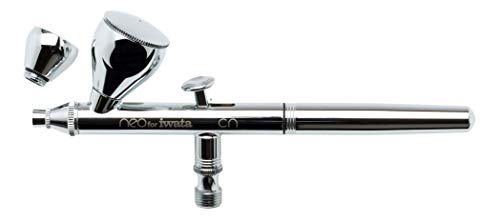
Iwata-Medea Neo CN Gravity Feed
Iwata design thinking arrives at a much lower entry point here, with a 0.35 mm nozzle and a comfortable trigger. Machining tolerances sit below the Eclipse, yet it sprays cleanly and builds correct technique. Two cups come in the box, making it a sensible first serious brush if you already own a compressor.
Pros
- Strong control for a low outlay
- Two cup sizes supplied
- Light in the hand during long sessions
Cons
- Tolerances trail the Eclipse HP CS
- Some parts do not interchange with the main Iwata range
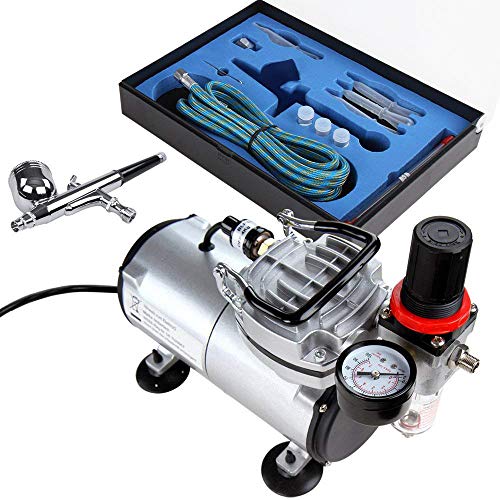
Timbertech Airbrush Kit ABPST05
A mini piston compressor, hose, gravity feed brush and cleaning tools cover the basics for occasional work. Cake decorating, nail art and casual model painting are the natural fit rather than production runs. Owners report it holds up fine when sessions stay short and the brush gets stripped afterwards.
Pros
- Cheapest complete route into airbrushing
- Small enough to leave on a desk
- Cleaning brushes included
Cons
- Tankless compressor pulses under sustained use
- Motor needs rest breaks on long sessions

Grex Tritium TG3 Pistol Grip Airbrush
Grex swaps the finger trigger for a pistol grip, which spreads load across the whole hand during multi hour sessions. An adjustable trigger stop locks a repeatable maximum paint flow, useful for consistent base coats across many parts. Its 0.3 mm nozzle suits detail work, though the grip is a specialist preference rather than a default.
Pros
- Far less hand fatigue over long sessions
- Trigger stop repeats a set flow exactly
- Precise machining on needle and nozzle
Cons
- Feels alien if you learned on a finger trigger
- Bulkier than a conventional body
What matters most
What should a first airbrush kit include? Four parts decide whether the setup works: brush, compressor, regulator and moisture trap. Look for a compressor with a tank, because the motor then cycles instead of running flat out, and stored air arrives without pulsing. A regulator lets you set working pressure rather than accepting whatever the pump delivers. Moisture traps matter in humid rooms, since compressed air condenses water that spits through the nozzle mid stroke.
Which airbrush nozzle size should you choose? Around 0.2 mm gives the finest line and clogs on anything less than perfectly thinned paint. Between 0.3 and 0.35 mm is the practical middle, detailed enough for miniatures yet tolerant of ordinary acrylics. Anything from 0.5 mm up moves into base coats, primers and textile work. Buying one brush? Take the middle ground, as the Eclipse HP CS and Neo CN both do.
Gravity feed or siphon feed for your work? Gravity feed puts the cup on top, so paint flows without suction and the brush sprays at lower pressure while wasting very little. That suits models, miniatures and illustration, and every brush in this roundup uses it. Siphon feed pulls from a jar underneath and shines when spraying one colour over a large area, such as murals or T shirts. Side feed splits the difference and keeps your sight line to the work clear.
How do you clean an airbrush so it lasts? Blocked, not broken, describes almost every dead airbrush. Flush with an appropriate cleaner at every colour change, then strip the brush fully at the end of a session. Dried paint in the nozzle threads is far harder to shift once cured. Keep a spare needle and nozzle on the bench, since a bent tip is the single most common failure and replacements cost little.
How they stack up
| # | Model | Compressor | Best for | Score | Price |
|---|---|---|---|---|---|
| 1 | Master Airbrush Cool Runner II Dual Fan Air Compressor Airbrush Kit | Piston with air tank | Best overall | 9.4 | Check price |
| 2 | Iwata-Medea Eclipse HP CS | Gravity | Best for fine detail | 9.2 | Check price |
| 3 | Badger Air-Brush Co. Patriot 105 | Gravity | Best for durability | 9.0 | Check price |
| 4 | Paasche TG-3F Talon | Gravity | Best for varied work | 8.8 | Check price |
| 5 | Iwata-Medea Neo CN Gravity Feed | Gravity | Best value | 8.6 | Check price |
| 6 | Timbertech Airbrush Kit ABPST05 | Mini piston | Best budget | 8.3 | Check price |
| 7 | Grex Tritium TG3 Pistol Grip Airbrush | Gravity | Best for hand comfort | 8.0 | Check price |
Common questions
What airbrush nozzle size should a beginner choose?
Around 0.3 to 0.35 mm. That range sprays fine enough lines for models and illustration while tolerating paint that has not been thinned perfectly, which is exactly where beginners struggle with 0.2 mm nozzles.
Do I need a compressor with an air tank?
Not strictly, but it helps a great deal. Stored air arrives without pulsing, the motor cycles instead of running continuously, and heat stays down. Tankless units like the Timbertech suit short nail art or cake sessions.
Can I use regular acrylic paint in an airbrush?
Yes, once thinned with a suitable medium. Craft acrylics need more thinning than dedicated airbrush paint. Aim for a milk like consistency and strain out lumps before filling the cup.
What pressure should I set for detail work?
Modellers commonly work between roughly 15 and 25 psi for general coverage, dropping lower for hairlines. Begin at the low end and raise pressure only when the paint spatters or refuses to atomise.
Is single action or dual action better?
Dual action separates air from paint, which is what makes controlled line work possible. Single action is simpler and adequate for even coverage jobs such as base coating or tanning solutions.
How often should an airbrush be cleaned?
Flush between colours and strip it fully after every session. Cured paint in the nozzle causes most performance complaints, and it becomes far harder to remove once dry.
Can one airbrush kit handle both models and nail art?
Yes. Both work at similar nozzle sizes and low pressures. Nail work needs less air volume, so a compact kit copes, while long modelling sessions benefit from a tank.
Why does my airbrush spatter?
Work through three causes in order: paint too thick, pressure too low, or a partly blocked nozzle. If it continues, check for a loose nozzle or a bent needle tip under magnification.
Which airbrush is best for miniatures?
A 0.3 to 0.35 mm gravity feed brush with dual action, such as the Iwata-Medea Eclipse HP CS or Neo CN. Very fine nozzles clog on primers and metallics, which miniature painting uses constantly.
Do airbrush needles wear out?
Yes. Tips bend on hard surfaces and blunt with repeated cleaning, which shows up as an uneven spray pattern. Keep a spare needle for whichever brush you use most and swap it rather than trying to straighten one.
The bottom line
For a first setup, the Master Airbrush Cool Runner II Dual Fan Kit removes the guesswork by matching a tank compressor to workable brushes. Already have air? Buy the Iwata-Medea Eclipse HP CS for control, or the Badger Air-Brush Co. Patriot 105 if the brush will take daily abuse. Occasional painters can start with the Timbertech ABPST05 and upgrade the brush later.


