Which All in One Printer Fits Your Home Office?
The Epson EcoTank ET-2850 is the smartest long term choice thanks to refillable tanks instead of cartridges. The HP OfficeJet Pro 9125e is the faster option for real office volume, and the Brother MFC-L2750DW is the one to buy if you mainly print text documents.
The Epson EcoTank ET-2850 is the all in one we would buy for a home office, with the HP OfficeJet Pro 9125e for higher volumes and the Brother MFC-L2750DW for anyone printing mostly black text. All three print, scan, copy and connect wirelessly, so the decision really comes down to running cost and volume.
All in one printers are tricky because the purchase price tells you almost nothing about what the machine will cost over three years. Cartridge models are cheap up front and expensive to feed, tank models reverse that, and laser sits somewhere else again depending on page count. We ranked these by comparing published page yields, print speeds, duplex and scanner specifications, and what owners report about clogging, driver support and long term reliability.
The shortlist, ranked

Epson EcoTank ET-2850
The EcoTank swaps cartridges for refillable tanks, and the included ink covers a huge number of pages before you buy more. That changes printing from something you ration to something you just do. It is slower than office grade machines and the scanner is a basic flatbed, but for a household it is the best value in the category.
Pros
- Dramatically lower cost per page than cartridges
- Large ink supply included in the box
- Automatic duplex printing
Cons
- Slower than office class printers
- Flatbed scanner with no document feeder
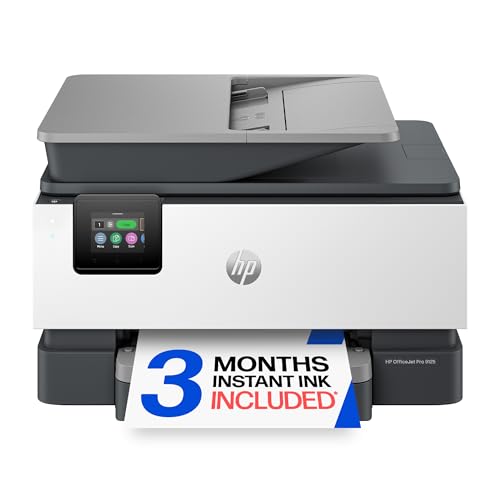
HP OfficeJet Pro 9125e
The 9125e is built for volume, with quick colour output, a duplexing automatic document feeder and a solid mobile app for scanning to cloud storage. It is the pick when several people share one machine. Owners report the running cost is only sensible on a subscription ink plan, so factor that into the decision.
Pros
- Genuinely fast for a home class machine
- Duplex feeder scans both sides unattended
- Strong mobile and cloud scanning app
Cons
- Cartridge costs add up without a plan
- Larger footprint than compact models

Brother MFC-L2750DW
If your printing is contracts, forms and school work rather than photos, a mono laser is the honest answer, and this Brother is the standard recommendation. It never clogs from disuse, which is the main failure mode of inkjets in occasional households. Toner yields are high and replacement cartridges are widely available.
Pros
- Cannot clog when left unused for weeks
- Low cost per page on text documents
- Fast, crisp text output
Cons
- No colour printing at all
- Photo scanning quality is functional rather than good

Canon PIXMA TR4720
The TR4720 is a small, inexpensive all in one that covers occasional home printing, scanning and copying without taking over a desk. It even includes a document feeder, which is unusual at this level. The catch is cartridge cost, so it makes sense for light use rather than steady weekly printing.
Pros
- Small footprint that fits a shelf
- Document feeder at a low price
- Simple setup for non technical users
Cons
- Expensive per page on cartridges
- Slower output and noisier operation

Brother MFC-J4335DW
This Brother inkjet ships with a large starting ink supply and prints colour at a reasonable pace, which suits households that need occasional colour but do not want to commit to a tank system. Paper handling is decent and duplex printing is included. It sits neatly between the cheap cartridge models and the EcoTank.
Pros
- Generous ink included at purchase
- Solid colour quality for documents
- Reliable wireless connection
Cons
- Photo output trails dedicated photo printers
- Still cartridge based long term
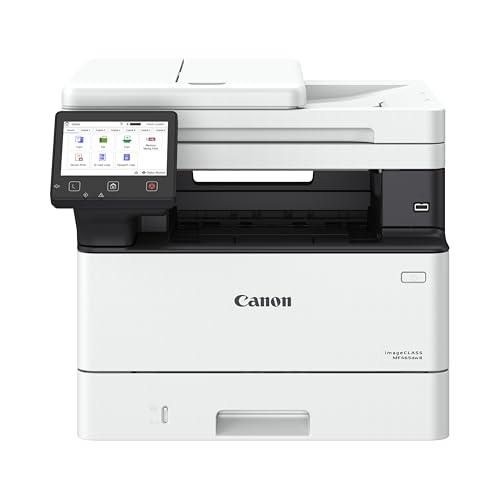
Canon imageCLASS MF453dw
This is a proper office laser scaled for a small business, with high monthly duty cycle, fast mono output and a large paper tray so you are not refilling constantly. It is more machine than a household needs. If you print hundreds of pages a month, the cost per page and the reduced hassle justify the size.
Pros
- Handles heavy monthly volume
- Large tray means fewer refills
- Very low cost per printed page
Cons
- Big and heavy for a home desk
- Mono only, no colour output

HP Envy Inspire 7955e
The Envy Inspire leans towards photo printing, with a separate photo tray and colour output that suits prints for the fridge or a scrapbook. It handles everyday documents fine too. Photo printing is inherently ink hungry, so this is a machine to buy knowing that colour cartridges will be a regular purchase.
Pros
- Best photo output in this roundup
- Separate photo tray avoids paper swapping
- Easy app based setup
Cons
- Photo printing burns through ink
- Document speed is average
The lineup, side by side
| # | Model | Ink system | Best for | Score | Price |
|---|---|---|---|---|---|
| 1 | Epson EcoTank ET-2850 | Refillable EcoTank bottles | Best overall | 9.4 | Check price |
| 2 | HP OfficeJet Pro 9125e | Print, scan, copy, fax | Best for busy offices | 9.2 | Check price |
| 3 | Brother MFC-L2750DW | Monochrome laser | Best for documents | 9.0 | Check price |
| 4 | Canon PIXMA TR4720 | Print, scan, copy, fax | Best budget | 8.8 | Check price |
| 5 | Brother MFC-J4335DW | Colour inkjet | Best for mixed use | 8.6 | Check price |
| 6 | Canon imageCLASS MF453dw | Monochrome laser | Best for high volume | 8.3 | Check price |
| 7 | HP Envy Inspire 7955e | Photo and everyday printing | Best for photos | 8.0 | Check price |
What matters most
Work out your real page count first Under roughly fifty pages a month, a cheap cartridge inkjet is fine and the running cost never becomes painful. Between fifty and three hundred pages, an ink tank model pays for itself quickly. Above that, or if the pages are nearly all text, a laser is the cheaper and more reliable answer.
Ink systems decide the true cost Cartridge machines are the cheapest to buy and by far the most expensive to feed. Tank systems cost more up front and then cost very little per page. Toner sits in between with the longest shelf life. Look up the page yield of the consumables before buying, not the price of the printer.
Inkjets punish being left unused If you print once a month, an inkjet head can dry and clog, and clearing it wastes more ink than the job would have used. A laser has no liquid ink and simply works after months of sitting idle. Occasional printers are almost always happier with a mono laser.
Look at the scanner, not just the printer A flatbed alone means feeding multi page documents one sheet at a time. An automatic document feeder handles a stack, and a duplexing feeder scans both sides in one pass. If you ever scan contracts, forms or receipts in bulk, this feature saves more time than any print speed figure.
Questions worth asking
Is an ink tank printer cheaper than cartridges?
Over any meaningful volume, yes. Tank systems cost more to buy and far less to refill, and the included ink typically covers thousands of pages. Below about fifty pages a month, the savings take a long time to arrive.
Should you buy inkjet or laser?
Choose laser if you print mostly black text, print irregularly, or print in volume. Choose inkjet if you need colour photos or graphics. Laser also avoids the clogging that comes with letting an inkjet sit unused.
Do all in one printers need a computer?
No. Most set up over Wi-Fi from a phone app and print from mobile devices directly. A computer is only needed for advanced scanning software and some driver level settings.
What is a duplex document feeder?
It is a feeder that scans or copies both sides of a stack of pages without you turning them over. For anyone digitising forms or contracts, it is the single most useful feature on the scanner side.
Why do inkjet printers clog?
Ink dries in the microscopic nozzles when the printer sits unused. Printing a page every week or two keeps the ink moving. Cleaning cycles clear most clogs but consume a surprising amount of ink each time.
Are third party cartridges safe to use?
They work in many machines but can trigger warnings, and some printers reject them after firmware updates. Ink tank and laser systems avoid the issue mostly by having much cheaper official consumables.
How much printer speed do you actually need?
For a household, anything above about ten pages per minute is plenty since the bottleneck is usually you walking to the printer. Speed matters when several people share one machine or you print long reports regularly.
Can these printers scan directly to cloud storage?
Most current models scan to email or to a cloud service through the manufacturer’s app. Feature depth varies, so check which services are supported if you rely on a specific one for document storage.
The bottom line
The Epson EcoTank ET-2850 is the all in one that makes the most financial sense for a home office, because refillable tanks remove the running cost that sours most printer purchases. Choose the HP OfficeJet Pro 9125e when several people share the machine and speed matters, or the Brother MFC-L2750DW if you print text and want something that never clogs.


