7 Angle Finders Worth Adding to Your Workshop Toolbox
Bosch GAM 220 MF is the most capable choice, since it measures a corner and calculates the miter and bevel in one step. GemRed 82305 covers most of that ground for far less. Wixey WR300 handles the separate job of setting a saw blade precisely.
Buy the Bosch GAM 220 MF if you fit trim regularly, because it turns a measured corner into a cut angle without arithmetic. GemRed 82305 does the measuring half at a fraction of the outlay. Wixey WR300 belongs beside the saw, not in the tool belt, and pairs well with either protractor.
Shopping here is harder than it looks because three unrelated tools share one name. A digital protractor with long arms reads a wall corner directly. A magnetic angle cube sits on a saw blade and reports its tilt. A traditional bevel gauge transfers an angle physically and never shows a number. We compared stated accuracy, measuring range, built in miter maths and magnet strength, then weighed owner reports about calibration drift after a year in a van.
How to choose
Which type of angle finder do you actually need? Three tools carry this name. A digital protractor with long arms reads a wall corner, a stair string or an existing frame. A magnetic angle cube reads the tilt of a saw blade or checks a machine table, and cannot measure a room at all. A bevel gauge transfers an angle physically without ever showing a figure. Most workshops end up owning a protractor and a cube, because each covers a different half of the same problem.
Why room corners are never the angle you expect Almost no wall corner in a real building sits at exactly ninety degrees. Cutting two 45 degree miters and hoping is why so many trim joints show a gap at the top. Measure the corner, halve it, or let a tool such as the Bosch GAM 220 MF do the maths. Measure every corner separately, since two corners in the same room rarely agree.
What does the stated accuracy figure really mean? A tenth of a degree matters when setting a saw blade, because a small error at the pivot multiplies across a long cut. A plastered wall is not flat to that precision, so a tool rated within a few tenths gives the same practical result on trim. Spend the accuracy budget on the tool that touches the machine. Stay pragmatic about the one that touches the wall.
How to keep a digital angle finder calibrated on site Digital gauges drift after a drop or a cold night in a van. Most carry a zeroing routine that takes under a minute, and running it before an important job is time well spent. Check the coin cell too, because a fading cell produces unstable readings rather than a clean failure. Site workers often keep an analogue tool such as the Johnson locator as backup, so a dead battery never stops the job.
Our top picks
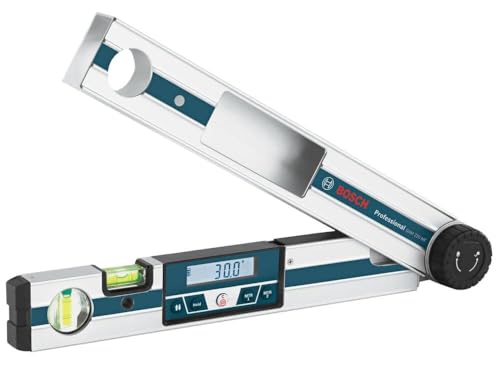
Bosch GAM 220 MF Digital Angle Finder
Measure a corner across the full range and the GAM 220 MF returns the miter and bevel needed to cut crown moulding. Removing that calculation removes the step where most mistakes happen. Long arms sit flat against a wall for a stable reference, and the backlit display stays readable in an unlit room.
Pros
- Works out miter and bevel angles for you
- Long arms bridge uneven plaster without rocking
- Backlit screen reads in a dim room
Cons
- Costs well above a plain digital protractor
- Too bulky for a tool belt pouch

GemRed 82305 Digital Angle Finder Ruler
Stainless steel rules double as the arms, so one tool reads both length and angle. Zero and hold buttons make transferring an angle to a saw a two step job. Home woodworkers and trim installers have made this the default recommendation for good reason.
Pros
- Measures length and angle without swapping tools
- Hold function survives the walk back to the saw
- Capability far exceeds what the outlay suggests
Cons
- No miter or bevel calculation like the Bosch
- Locking screw strips if overtightened

Wixey WR300 Type 2 Digital Angle Gauge
Zero the cube on the saw table, move it onto the blade, and it reports the true tilt. That workflow bypasses the printed scale on the machine, which is usually the least accurate part of it. Small enough to live in the drawer under the saw, and the display flips so it reads upside down.
Pros
- Bypasses the drifted scale on the machine
- Magnets grip a blade tilted past 45 degrees
- Reading flips automatically when inverted
Cons
- Cannot read a room corner at all
- Magnets collect steel swarf that needs wiping

Johnson Level & Tool 1888-0700 Angle Locator
Reading comes off a marked dial, with nothing to charge and nothing to recalibrate. A magnetic base clamps to steel and frees both hands during setup. Site work is where this earns its keep, since a dead coin cell cannot stop it.
Pros
- Nothing electronic to fail halfway through a job
- Magnetic base holds it while you work
- Shrugs off life in the bottom of a tool bag
Cons
- Dial resolution is far coarser than digital models
- Magnet restricts it to ferrous surfaces

Starrett 505A-12 Miter Protractor
A hardened steel blade pivots against a scale showing both the measured angle and the matching miter cut. Nothing charges, nothing calibrates, and the machining is a clear step above everything else here. Trim carpenters have worked this pattern of tool for decades.
Pros
- Shows measured angle and miter cut on one scale
- Survives decades with no electronics inside
- Steel blade works as a straight edge too
Cons
- Reading the vernier scale takes practice
- Sits above digital tools of similar accuracy on cost

General Tools 822 Digital Angle Finder Rule
Shorter stainless arms let this one fit a tool pouch rather than a tool box. Cabinet interiors and stair strings are where those short arms pay off, though long runs lose some stability. Zero, hold and reverse reading all sit on a three button layout with no menus.
Pros
- Fits a pouch where full size protractors will not
- Short arms suit cabinets and confined corners
- Three buttons cover every function
Cons
- Less stable against long straight runs
- Display area is smaller than the Bosch and GemRed

iGaging AngleCube Digital Angle Gauge
Same workflow as the Wixey at a lower outlay: zero on the table, read the blade. Magnet strength and display size are where the saving shows. Occasional blade setting on a home workshop saw is exactly the job this covers.
Pros
- Cheapest way to set a blade angle accurately
- Stores in the drawer beside the machine
- Auto off keeps the coin cell alive between projects
Cons
- Magnets slip on steep bevels where the Wixey holds
- Small display is harder to read across a bench
How they stack up
| # | Model | Range | Best for | Score | Price |
|---|---|---|---|---|---|
| 1 | Bosch GAM 220 MF Digital Angle Finder | 0 to 220 degrees | Best overall | 9.4 | Check price |
| 2 | GemRed 82305 Digital Angle Finder Ruler | 0 to 360 degrees | Best value | 9.2 | Check price |
| 3 | Wixey WR300 Type 2 Digital Angle Gauge | Magnetic angle gauge | Best for setting saw blades | 9.0 | Check price |
| 4 | Johnson Level & Tool 1888-0700 Angle Locator | Magnetic dial angle locator | Best analogue option | 8.8 | Check price |
| 5 | Starrett 505A-12 Miter Protractor | Analogue miter protractor | Best for professional trim work | 8.6 | Check price |
| 6 | General Tools 822 Digital Angle Finder Rule | 0 to 360 degrees | Best compact digital | 8.3 | Check price |
| 7 | iGaging AngleCube Digital Angle Gauge | Magnetic angle cube | Best budget | 8.0 | Check price |
Frequently asked questions
What is the difference between an angle finder and a protractor?
Usage overlaps in the listings. Angle finder is the broad label for anything that measures an angle, while protractor usually means the two armed type that reads a corner directly. Magnetic angle cubes get sold as angle finders even though they read tilt, so check the product type before ordering.
How do I work out the miter cut from a measured corner?
Halve the measured angle for a simple flat miter. A corner reading 92 degrees needs two cuts at 46 degrees rather than 45. Crown moulding is different because it sits at a spring angle, which is why the Bosch GAM 220 MF calculates both miter and bevel.
Do I need a digital angle finder or will a bevel gauge do?
Bevel gauges transfer an angle straight to the saw without any number involved, and never need power. Digital tools win when you need a figure to dial into a machine, calculate a miter or write down for later. Plenty of workshops keep both on the wall.
Are angle cubes better than the scale on my saw?
Almost always. Factory scales are stamped or printed, and they drift out of alignment after transport or a heavy cut. Zeroing a cube on the table and reading the blade removes that error entirely. That is why so many woodworkers leave one permanently beside the machine.
How well do angle cubes hold accuracy over time?
They stay reliable as long as you zero against the reference surface before each use, which takes seconds. Drops and big temperature swings cause most drift. Check against a known square occasionally, and run the manufacturer’s calibration routine if readings look wrong.
Can I use an angle finder on aluminium or stainless steel?
Magnetic types will not hold, so you either clamp them or switch to an armed protractor. This catches people out on aluminium extrusion jigs. Several stainless grades are only weakly magnetic, which produces the same problem.
Are angle finders useful for tiling and laminate flooring?
Very much so. Corners in older properties are frequently out of square, and reading the real angle before cutting a border tile saves repeated trimming. A digital protractor with long arms handles this best, since it spans an uneven surface.
What battery do digital angle finders use?
Most run a common coin cell such as a CR2032, and many include auto power off to stretch it. Keep a spare in the case. A fading cell produces erratic readings before it dies, which is easy to mistake for a broken tool.
Bosch GAM 220 MF vs GemRed 82305: which should I buy?
Choose the Bosch when crown moulding and compound cuts are part of the work, since it removes the maths. Choose the GemRed when you mainly need an accurate corner reading plus a steel rule. Both hold their zero well according to owner reports.
Our take
Bosch GAM 220 MF is the strongest single purchase for anyone fitting trim, because it measures the corner and works out the cut in one operation. GemRed 82305 delivers most of that capability for far less outlay. Add a Wixey WR300 for blade setting and the pair covers nearly every angle problem a workshop throws up.


