Aquarium Chillers Compared: Titanium vs Thermoelectric
The JBJ Arctica DBA-075 leads for reliable compressor cooling with a titanium coil, while the Active Aqua AACH10HP delivers similar capacity for less outlay. Nano keepers are better served by the Coolworks IceProbe Thermoelectric Chiller, which drops a few degrees without a full compressor unit.
The JBJ Arctica DBA-075 is our overall pick, with the Active Aqua AACH10HP as the strongest value in compressor chillers and the Coolworks IceProbe Thermoelectric Chiller as the sensible choice for small nano tanks.
Sizing a chiller is where most buyers go wrong, because the rating on the box assumes ideal flow, ambient room temperature and a clean coil. Lights, pumps and closed cabinets all add heat that the rating does not account for. We compared published cooling capacity, coil material, required flow rate and thermostat accuracy, then weighed what owners report about noise, condensation and compressor life.
What matters most
Size up, never down Manufacturer ratings assume good flow and a cool room. Lights, return pumps and powerheads all pump heat into the water, and a closed cabinet traps it. If your tank sits at the top of a chiller rated range, choose the next size up, since a unit that runs constantly wears out far faster than one that cycles.
Titanium matters for saltwater Stainless steel coils corrode in saltwater and can leach metals that harm invertebrates. Titanium heat exchangers are standard on aquarium chillers for that reason and are worth insisting on for any marine or reef system. Freshwater keepers have more flexibility but still benefit from the corrosion resistance.
Get the flow rate right Chillers cool water passing through them, so too little flow means poor heat transfer and too much flow means the water does not linger long enough. Check the flow range in the specifications and choose a pump inside that band, allowing for head height and tubing losses. Feeding from a sump is usually simpler than plumbing into a display.
Plan for heat, noise and condensation A compressor chiller dumps the heat it removes into the room, so a sealed cabinet will slowly cook it. Leave clearance on the vented sides and consider a cabinet fan. Owners report condensation forming on cool tubing in humid rooms, so insulate the lines and check the floor under the unit during the first hot spell.
The top picks, ranked

JBJ Arctica DBA-075 Titanium Chiller
A compressor chiller built around a titanium heat exchanger, so it is safe for both fresh and saltwater without corrosion worries. The digital controller holds a tight temperature band, which matters for reef tanks. Owners report long service life when the filter screen is kept clean.
Pros
- Titanium coil is reef and saltwater safe
- Accurate, stable temperature control
- Solid reputation for longevity
Cons
- Needs clearance and ventilation around the unit
- Compressor noise is noticeable in a quiet room

Active Aqua AACH10HP Water Chiller
Originally aimed at hydroponics, this chiller is widely used on aquariums because it delivers full compressor cooling for noticeably less than aquarium branded rivals. The titanium evaporator suits saltwater use. Setup expects you to supply your own pump and tubing.
Pros
- Strong cooling for the money
- Titanium exchanger resists salt corrosion
- Simple controls that are easy to set
Cons
- Pump and fittings sold separately
- Fan is louder than premium units

Hailea HC-150A Aquarium Chiller
A step up in capacity for tanks that a 1/10 HP unit cannot hold in a warm room. The titanium coil and reasonably quiet compressor make it a common pick for larger reef systems. It needs a strong feed pump to hit its rated performance.
Pros
- Handles bigger systems and warm rooms
- Quieter than expected for the class
- Reliable thermostat accuracy
Cons
- Heavy and needs a dedicated space
- Higher running cost

Coolworks IceProbe Thermoelectric Aquarium Chiller
A thermoelectric probe that mounts through a sump lid or hangs in the tank, drawing a few degrees out of small volumes without a compressor. There is no refrigerant and no plumbing, which makes it far simpler to fit. Expect a modest temperature drop rather than dramatic cooling.
Pros
- No plumbing or external pump needed
- Very compact and quiet
- Simple to fit to a nano setup
Cons
- Only a few degrees of cooling
- Needs a separate temperature controller
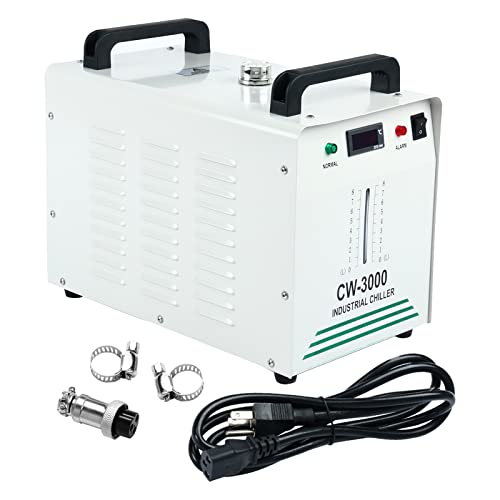
BAOSHISHAN CW-3000 Industrial Water Chiller
A thermolysis style circulating chiller built for laser and industrial cooling that aquarists adapt for tank use. It moves a lot of water and runs continuously without complaint. Check materials carefully before using it on saltwater, since it is not designed for marine chemistry.
Pros
- Built for continuous running
- High flow rate
- Costs less than aquarium branded units
Cons
- Not intended for saltwater systems
- Industrial styling looks out of place in a living room

Aqua Euro USA Max Chill Aquarium Chiller
A reef focused compressor chiller with a heavy titanium coil and a controller that resists drift. It is aimed at keepers who want the unit to sit under a display cabinet and be forgotten. Owners report solid customer support when parts are needed.
Pros
- Heavy duty titanium exchanger
- Controller holds settings after power loss
- Good parts support
Cons
- Premium price bracket
- Large footprint under a cabinet

Poafamx Aquarium Water Chiller
A small compressor chiller sized for shrimp tanks, planted nanos and axolotl setups where a couple of degrees matter. It includes basic tubing and a simple digital controller. Cooling is modest, so it suits small volumes rather than large reefs.
Pros
- Real compressor cooling at a low price
- Small enough to hide in a cabinet
- Includes basic fittings
Cons
- Limited capacity for larger tanks
- Fan noise at close range
Compared at a glance
| # | Model | Cooling | Best for | Score | Price |
|---|---|---|---|---|---|
| 1 | JBJ Arctica DBA-075 Titanium Chiller | 1/10 HP compressor | Best overall | 9.4 | Check price |
| 2 | Active Aqua AACH10HP Water Chiller | 1/10 HP compressor | Best value | 9.2 | Check price |
| 3 | Hailea HC-150A Aquarium Chiller | Around 1/4 HP class | Best for larger tanks | 9.0 | Check price |
| 4 | Coolworks IceProbe Thermoelectric Aquarium Chiller | Thermoelectric probe | Best for nano tanks | 8.8 | Check price |
| 5 | BAOSHISHAN CW-3000 Industrial Water Chiller | Circulating thermolysis chiller | Best for continuous duty | 8.6 | Check price |
| 6 | Aqua Euro USA Max Chill Aquarium Chiller | 1/4 HP class compressor | Best build quality | 8.3 | Check price |
| 7 | Poafamx Aquarium Water Chiller | Compact compressor | Best budget compressor unit | 8.0 | Check price |
Good to know
What size chiller do I need for my tank?
Add up your total water volume, then choose a unit rated above it rather than exactly at it. Strong lighting, pumps and a warm room all push the real requirement higher.
Are thermoelectric chillers strong enough?
They typically pull a few degrees out of small volumes only. For nano tanks and shrimp setups they can be enough, but larger tanks need a compressor unit.
Do I need a separate pump?
Most compressor chillers do not include one. Check the required flow range in the specifications and pick a pump that lands inside it once head height is accounted for.
Can a chiller be used with saltwater?
Yes, provided the heat exchanger is titanium. Stainless coils corrode in saltwater and can release metals that harm corals and invertebrates.
How noisy are aquarium chillers?
Compressor units make a fridge like hum plus fan noise. Owners report they are noticeable in a quiet living room, which is why many keepers site them in a cabinet with ventilation or an adjacent room.
Where should the chiller be installed?
On a level surface with clear space around the vents, ideally below the tank and fed from a sump. Never seal it inside an airtight cabinet.
Can I run a chiller and a heater together?
Yes, and many keepers do, with the heater set a degree or so below the chiller cut in point. Set a dead band between them so they never fight each other.
What maintenance does a chiller need?
Clean the intake filter or condenser fins regularly, since dust is the main cause of lost cooling capacity. Flush the coil periodically and check tubing for algae buildup.
Our pick
For most reef and tropical tanks the JBJ Arctica DBA-075 is the safest choice, combining a titanium coil with a controller that holds temperature tightly. The Active Aqua AACH10HP delivers much the same cooling for less if you can supply your own pump. Nano keepers should look at the Coolworks IceProbe before committing to a full compressor setup.


