What Should You Look for in an Aquarium Gravel Vacuum?
Python No Spill Clean and Fill leads for tanks past 20 gallons, since tap suction drains and refills through one hose. Aqueon Siphon Vacuum Gravel Cleaner covers ordinary community tanks with a primer bulb. Nano keepers get more from the hygger battery cleaner.
Python No Spill Clean and Fill is the pick for medium and large aquariums, because waste runs to a sink and clean water returns down the same hose. Aqueon Siphon Vacuum Gravel Cleaner handles everyday community tanks with a squeeze primer and a bucket. Desktop and nano tanks suit the battery powered hygger cleaner instead.
Gravel vacuums look interchangeable, yet siphon strength depends on tank height, tube bore and substrate weight. A tube sized for coarse gravel will lift sand straight up the pipe. We compared priming methods, tube diameters, hose lengths and manufacturer tank guidance, then weighed owner reports on clogging, kinking and lost suction.
What matters most
What does an aquarium gravel vacuum actually do? Detritus settles into the top inch of substrate, where it breaks down into ammonia and then nitrate. Pushing a tube into that layer lifts waste out while heavier grains fall back. Most keepers do this during a partial water change, so one job handles both tasks. Skip it and nitrate climbs faster than water changes can correct.
How to match tube bore to your substrate Wide bore tubes suit coarse gravel and larger tanks, moving debris quickly without clogging. Narrow tubes give control in nano setups and around plant roots. Sand needs the gentlest approach of all, hovering the mouth just above the bed so detritus lifts and grains drop. Getting this wrong sends substrate down the hose within seconds.
Best gravel vacuum for large tanks Past about 50 gallons, bucket carrying becomes the limiting factor rather than suction. Tap driven systems such as the Python route waste straight to a drain, then refill through the same hose. Measure the run from tank to tap before ordering, including detours around furniture. A hose a few feet short makes the whole system unusable.
Best gravel vacuum for nano and planted tanks Small volumes lose a quarter of their water in seconds through a standard siphon. Battery spot cleaners such as the hygger unit keep water in the tank entirely, which suits midweek tidying. For planted beds, a shaped intake like the Fluval design lifts waste without stripping aquasoil from around root feeders.
The shortlist, ranked

Python No Spill Clean and Fill
Running water through a tap adapter creates the suction, so waste travels to a drain instead of a bucket. Flip the valve and the same hose refills the aquarium. Extension sections are sold separately for tanks placed far from plumbing.
Pros
- Removes bucket carrying entirely
- Drains and refills through one hose
- Extension hoses available for long runs
Cons
- Needs a threaded tap to attach to
- Excessive for tanks under 10 gallons
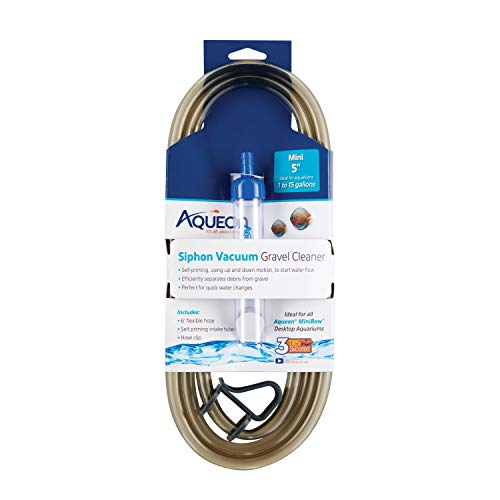
Aqueon Siphon Vacuum Gravel Cleaner
A primer bulb starts flow in two or three squeezes, so nobody has to draw on the hose by mouth. Rigid tube widths are matched to common community tank depths. Waste goes to a bucket, which stays practical up to roughly 40 gallons.
Pros
- Primer bulb starts flow in seconds
- Sized for standard community tanks
- Replacement tubes widely stocked
Cons
- Bucket work is unavoidable
- Standard hose is short for distant drains
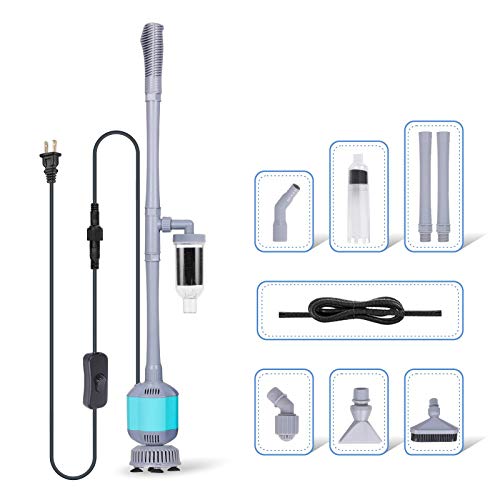
hygger Aquarium Gravel Cleaner
Battery power drives an internal impeller that pulls debris into a mesh bag and returns the water. Nothing leaves the tank, which makes it useful for a midweek tidy in a desktop setup. Full water changes still need a siphon.
Pros
- No priming or hose routing needed
- Handy for midweek debris removal
- Compact enough for shallow tanks
Cons
- Does not perform a water change
- Battery life limits session length

Laifoo Aquarium Siphon
A 25 foot hose ships as standard, which reaches a bathroom or a floor drain in most flats. Squeezing the inline bulb pulls the column over without any tap connection. Gravity does the rest, so the outlet has to sit below tank level.
Pros
- Reaches drains in another room
- Squeeze primer needs no tap fitting
- Light enough to store in a cupboard
Cons
- Long hose kinks if coiled tightly
- Drains only, refilling is manual

Fluval Gravel Vac
A shaped intake slows water at the mouth, lifting detritus while heavier grains drop back. That behaviour matters around carpeting plants and nutrient substrate. Flow is deliberately modest, so a large tank takes longer to work through.
Pros
- Leaves sand and aquasoil in place
- Works around plant roots safely
- Bulb primes without mouth suction
Cons
- Slower flow lengthens each session
- Bucket still required for refill

TERA PUMP Aquarium Gravel Cleaner
A rigid hand pump sits between tube and hose, moving enough volume to start flow on the first stroke. Wide bore tubing clears coarse gravel debris quickly. Owners report the pump body adds bulk to store between water changes.
Pros
- Pump starts flow on the first stroke
- Wide bore clears coarse gravel fast
- No electrical connection required
Cons
- Pump body is awkward to store
- Wide bore lifts sand too readily
NICREW Automatic Gravel Cleaner
Mains power drives a pump that vacuums, changes water and circulates through swappable nozzles. Flow rate beats any hand siphon, which shortens the job on a stocked tank. Based on specifications it needs a minimum water depth before the pump will prime.
Pros
- Moves water faster than a hand siphon
- Swappable nozzles for different substrates
- No manual priming step
Cons
- Requires a minimum water depth
- Mains cable near water needs care
How they stack up
| # | Model | Type | Best for | Score | Price |
|---|---|---|---|---|---|
| 1 | Python No Spill Clean and Fill | Faucet-powered siphon | Best overall | 9.4 | Check price |
| 2 | Aqueon Siphon Vacuum Gravel Cleaner | Manual siphon | Best value | 9.2 | Check price |
| 3 | hygger Aquarium Gravel Cleaner | Electric spot cleaner | Best for nano tanks | 9.0 | Check price |
| 4 | Laifoo Aquarium Siphon | Manual siphon | Best for long hose runs | 8.8 | Check price |
| 5 | Fluval Gravel Vac | Manual siphon | Best for sand and planted beds | 8.6 | Check price |
| 6 | TERA PUMP Aquarium Gravel Cleaner | Manual siphon | Best priming action | 8.3 | Check price |
| 7 | NICREW Automatic Gravel Cleaner | Electric multi-function | Best all-in-one electric | 8.0 | Check price |
Questions worth asking
How often should I vacuum aquarium gravel?
Weekly during a water change suits most stocked freshwater tanks. Lightly stocked planted tanks can go fortnightly. Rising nitrate readings are the clearest sign the interval has stretched too far.
Will a gravel vacuum hurt my fish?
Healthy adult fish simply swim away from the intake. Fry, shrimp and small snails can be drawn up the tube. Covering the mouth with mesh solves that in a shrimp tank, and anything pulled into a bucket can be returned.
Can you use a gravel vacuum on sand?
Yes, with technique rather than a different tool. Hold the tube an inch above the bed so waste lifts while sand falls back. Pinching the hose reduces flow further if grains still travel.
Do I still need a water change if I vacuum?
Vacuuming is part of a water change rather than an alternative. Siphoning removes tank water along with the waste, so the volume you pull out is the volume you replace.
Why will my siphon not start?
Air trapped in the tube is the usual reason. Submerge the gravel tube fully, keep the outlet below the water line, and give the primer bulb several firm squeezes. A drain higher than the tank will never flow.
Are electric gravel cleaners worth it?
For midweek spot cleaning in a small tank, yes. They leave water in the aquarium and need no hose. For a full change on anything past 30 gallons, a siphon or tap system finishes faster.
What size gravel tube should I choose?
Match it to depth and grain size. Coarse gravel in a deep tank wants a wide bore. Sand, aquasoil and nano tanks want the narrowest tube you can find.
Can one gravel vacuum serve several tanks?
Yes, and many keepers do. Rinse the tube between tanks to limit cross contamination, and size the kit for your largest aquarium. Quarantine tanks deserve their own equipment.
Should I vacuum the whole gravel bed at once?
Better not to. Nitrifying bacteria colonise the substrate, so most keepers clean a third to a half each session and rotate sections. That keeps the biological filter stable.
Final word
Python No Spill Clean and Fill earns the top spot because it removes buckets from the routine entirely on medium and large tanks. Everyday community setups are served just as well by the Aqueon Siphon Vacuum Gravel Cleaner and a bucket. Nano and planted keepers should look at the hygger spot cleaner and the Fluval Gravel Vac instead.