Aquarium Dosing Pumps That Keep Reef Levels Steady
The Kamoer F4 Pro leads for calibration accuracy and app control across four channels, while the Jebao DP-4 covers the same job for far less if you are happy with onboard programming. Single element dosing is handled neatly by the Kamoer X1 Pro among the pumps we ranked.
The Kamoer F4 Pro is our overall pick, with the Jebao DP-4 as the best value multi channel option and the Kamoer X1 Pro as the tidiest single channel solution.
Dosing pumps only earn their place when they deliver the same small volume every time, which comes down to head design, calibration and how quickly the peristaltic tubing wears. A pump that drifts by a few millilitres a day will swing alkalinity more than manual dosing did. We compared channel counts, calibration procedures, control interfaces and published dose ranges, alongside what owners report about tubing life, noise and long term accuracy.
Our top picks

Kamoer F4 Pro Dosing Pump
Four independent peristaltic channels with app control, per channel calibration and scheduling down to very small individual doses. The stepper motors hold accuracy well between calibrations, which is the whole point of a dosing pump. Owners report the app is the main learning curve rather than the hardware.
Pros
- Holds calibration well over months
- Fine control over dose size and timing
- Four channels in one compact unit
Cons
- App setup takes patience
- Premium price for the class
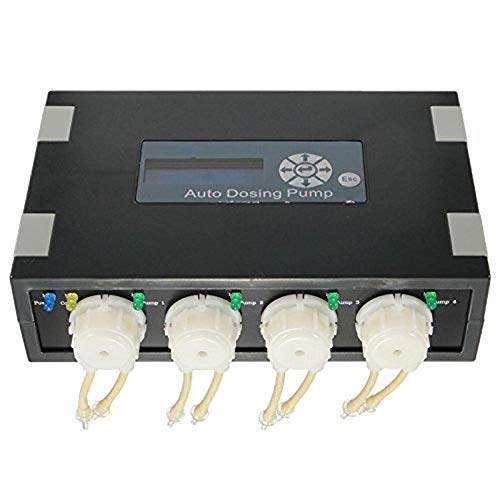
Jebao DP-4 Auto Dosing Pump
A long established four channel doser programmed entirely from the front panel, with no app required. Accuracy is good once calibrated, and the low cost makes it easy to justify for a first automated dosing setup. Owners report the tubing should be checked and replaced periodically to hold accuracy.
Pros
- Strong value for four channels
- No app or network needed
- Simple to program once learned
Cons
- Tubing wears faster than premium pumps
- Interface feels dated
Kamoer X1 Pro Dosing Pump
A compact single channel pump with Wi-Fi control, useful when you only dose one supplement or want to add a channel to an existing setup. The small footprint fits inside a cabinet easily. Stacking several units gives you flexibility a fixed four channel box cannot.
Pros
- Small enough to hide anywhere
- Add channels one at a time
- Clean app scheduling
Cons
- Costs more per channel than multi head units
- Relies on a working network connection

Neptune Systems DOS Dosing Pump
A two head fluid metering pump designed to work as part of the Apex controller ecosystem, which unlocks automated water changes and reactive dosing based on probe readings. Accuracy is high and the pump can be driven by logic rather than a fixed schedule. It makes little sense without the controller.
Pros
- Reacts to probe data rather than a fixed clock
- Doubles as a water change pump
- Very accurate once calibrated
Cons
- Requires an Apex controller
- Highest cost per channel here
Bubble Magus T11 Dosing Pump
A straightforward three channel doser with front panel programming, sized for the classic two part plus trace element routine. It runs quietly enough to sit in a display cabinet. Bubble Magus pumps are known for being easy to service when tubing needs replacing.
Pros
- Quiet enough for a living room
- Easy tubing replacement
- Right channel count for two part dosing
Cons
- No app or remote control
- Display is small and dim
hygger Aquarium Dosing Pump
A four channel doser pitched at planted tank fertiliser routines rather than reef chemistry, with simple daily scheduling and a clear display. Dose volumes suit liquid ferts, which are usually dosed in larger amounts than reef supplements. Setup is quick with the included tubing and holders.
Pros
- Well suited to fertiliser routines
- Everything needed is in the box
- Clear, readable display
Cons
- Less precise than reef focused pumps
- Limited scheduling options per day

Poafamx 4 Channel Aquarium Dosing Pump
An inexpensive four channel doser that covers basic scheduled dosing for smaller tanks. Accuracy is acceptable for trace elements and fertilisers but demands regular calibration checks. A reasonable way to test whether automated dosing suits your routine before investing more.
Pros
- Lowest cost route to four channels
- Simple to set up
- Compact case
Cons
- Needs frequent recalibration
- Tubing quality is basic
What matters most
Split doses across the day A single large dose swings alkalinity and pH noticeably, which is exactly what automation should prevent. Dividing the daily requirement into many small doses keeps parameters flat and lets corals grow steadily. Look at how many separate doses per day a pump can schedule, since some budget units are limited.
Calibrate, then recalibrate Peristaltic tubing compresses and wears, so a pump calibrated in January will not deliver the same volume by summer. Calibrate each channel with a measuring cylinder when new, then repeat every couple of months. Owners report tubing replacement is the single most effective fix for accuracy drift.
Plan the plumbing to avoid siphons Mount the pump above the water line and loop the outlet tubing up before it drops into the sump, so it cannot siphon between doses. Keep the two part supplements dripping into different areas of high flow, since dosing them at the same point causes precipitation. Rigid tubing holders make this far easier.
Match channel count to your routine Two part dosing needs two channels, and adding trace elements or a magnesium supplement takes you to three or four. Single channel pumps let you build up gradually and replace one unit if it fails, while four channel boxes are tidier and cheaper per channel. Consider whether you might later automate water changes, which needs different hardware.
Side by side
| # | Model | Channels | Best for | Score | Price |
|---|---|---|---|---|---|
| 1 | Kamoer F4 Pro Dosing Pump | Four | Best overall | 9.4 | Check price |
| 2 | Jebao DP-4 Auto Dosing Pump | Four | Best value | 9.2 | Check price |
| 3 | Kamoer X1 Pro Dosing Pump | One | Best single channel | 9.0 | Check price |
| 4 | Neptune Systems DOS Dosing Pump | Two heads | Best for controller integration | 8.8 | Check price |
| 5 | Bubble Magus T11 Dosing Pump | Three | Best simple three channel | 8.6 | Check price |
| 6 | hygger Aquarium Dosing Pump | Four | Best for planted tanks | 8.3 | Check price |
| 7 | Poafamx 4 Channel Aquarium Dosing Pump | Four | Best budget | 8.0 | Check price |
Frequently asked questions
How many channels do I need?
Two for basic two part alkalinity and calcium dosing, three or four if you add magnesium or trace elements. Buying one spare channel is common since routines tend to expand.
How accurate are dosing pumps?
Good units hold within a small percentage of the set volume when properly calibrated. Accuracy drifts as the peristaltic tubing wears, which is why periodic recalibration matters.
How often should I calibrate?
Every couple of months is a reasonable rhythm, and always after replacing tubing. Owners report drift becomes noticeable well before the tubing actually fails.
Can I dose two part supplements together?
Use separate channels and separate entry points in high flow areas. Dosing calcium and alkalinity supplements at the same spot causes precipitation.
Do I need an aquarium controller?
Not for scheduled dosing, since most pumps run their own timers. A controller adds reactive dosing based on probe readings, which is useful on larger or more demanding systems.
Why is my pump dosing more than programmed?
Check for a siphon effect if the pump sits below the water line, and inspect the tubing for wear. Recalibrate after ruling out both.
How long does dosing tubing last?
It varies with use, but planning on replacement once or twice a year is sensible for a pump running many doses per day. Keep a spare set on hand.
Are dosing pumps noisy?
Most produce a short whirring sound during each dose. Owners report the noise is easy to ignore inside a cabinet, though frequent small doses mean it happens often.
Our take
The Kamoer F4 Pro is the pump to buy if you want set and forget accuracy across four channels, and it holds calibration better than anything else here. The Jebao DP-4 does the same core job for much less if you can live with onboard programming and more frequent tubing changes. Apex owners should go straight to the Neptune Systems DOS for reactive dosing and automated water changes.


