Aquarium Air Pumps Built for Large Tanks and Ponds
The Tetra Whisper AP300 is the most reliable choice for heavily stocked large aquariums. The Fluval Q2 handles deep water better than its size suggests, and the Active Aqua AAPA45L is the pick when you need to run many outlets or a stock tank without stacking multiple small pumps.
For large aquariums, stock tanks and small ponds, the Tetra Whisper AP300, Fluval Q2 and Active Aqua AAPA45L cover almost every situation. They differ mainly in how much back pressure they can push against and how many outlets they can feed at once.
Sizing an air pump is trickier than the box implies, because the rating usually assumes a shallow tank with one airstone. Add water depth, a long airline run, a sponge filter and a fine pore stone and the real output drops sharply. We compared published output figures, depth ratings, outlet counts and what owners report about noise and diaphragm life over long running periods.
The shortlist, ranked

Tetra Whisper AP300 Air Pump
Rated for aquariums up to around three hundred gallons, this is the workhorse most large tank keepers settle on. A sound damping chamber and rubber feet keep it quieter than the output suggests. Owners report it drives multiple sponge filters at depth without needing a linear piston pump.
Pros
- Strong output against deep water pressure
- Quiet for its power class
- Rebuild kits are widely available
Cons
- Large physical footprint
- Needs a check valve on any below rim placement

Fluval Q2 Air Pump
A twin outlet pump with an unusually good pressure to noise ratio, designed for tall aquariums where cheaper pumps stall. Independent flow control on each outlet lets you balance a sponge filter against an airstone. Owners report it stays quiet even mounted on a wooden cabinet.
Pros
- Holds output at depth
- Per outlet flow control
- Very low vibration transfer
Cons
- Lower total volume than piston pumps
- Replacement parts are less common

Active Aqua Air Pump AAPA45L
A commercial style pump with eight outlets and a high total air volume, popular for fish rooms and stock tanks. It is built to run continuously rather than to hide in a cabinet. Based on specifications it replaces four or five hobby pumps in a rack setup.
Pros
- Feeds a whole rack from one unit
- Continuous duty construction
- Very high total air volume
Cons
- Audible in a living room
- Overkill for a single display tank

EcoPlus Commercial Air Pump 5
A sealed commercial pump intended for large water volumes and continuous aeration duty. It pushes hard enough for pond depth and long airline runs. Owners report it runs for years with only periodic diaphragm replacement, which is the main reason it appears in pond builds.
Pros
- Handles pond depth and long tubing runs
- Built for round the clock operation
- Serviceable rather than disposable
Cons
- Loud enough to need a housing box
- Heavy and awkward to reposition
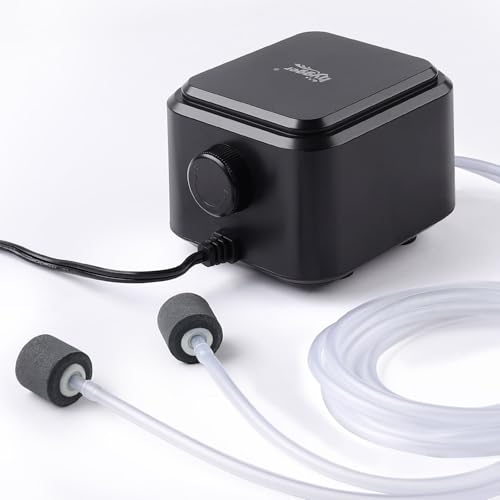
hygger Quiet Aquarium Air Pump
A dual outlet pump with adjustable output that covers most tanks in the hundred gallon range. The rubber suspended motor keeps vibration off the stand. Owners report it is one of the few affordable pumps that stays quiet after several months of use.
Pros
- Adjustable output avoids over aerating
- Genuinely quiet at moderate settings
- Includes airline and stones
Cons
- Output drops noticeably in very deep tanks
- Plastic body feels less durable

VIVOSUN Commercial Air Pump
A multi outlet commercial pump aimed at hydroponic reservoirs that works equally well for large livestock and grow out tanks. Total air volume is the selling point rather than refinement. Based on specifications it suits utility spaces rather than living rooms.
Pros
- Very high total output
- Distributes across many airstones
- Robust metal housing
Cons
- Noisy without isolation
- No fine output adjustment

Tetra Whisper AP150 Air Pump
The smaller sibling of the AP300, rated for tanks up to around a hundred and fifty gallons. It uses the same damping approach so it stays reasonably quiet. Owners report it is the sensible starting point for a single large tank with one or two sponge filters.
Pros
- Good output for the size
- Quiet running
- Shares parts with the larger model
Cons
- Struggles with several deep water stones
- One outlet needs a splitter for multiple devices
Compared at a glance
| # | Model | Rated for | Best for | Score | Price |
|---|---|---|---|---|---|
| 1 | Tetra Whisper AP300 Air Pump | Up to about 300 gallons | Best overall | 9.4 | Check price |
| 2 | Fluval Q2 Air Pump | Up to about 160 gallons | Best for deep tanks | 9.2 | Check price |
| 3 | Active Aqua Air Pump AAPA45L | Eight | Best for many outlets | 9.0 | Check price |
| 4 | EcoPlus Commercial Air Pump 5 | Ponds and large reservoirs | Best for ponds | 8.8 | Check price |
| 5 | hygger Quiet Aquarium Air Pump | Large freshwater and marine tanks | Best value | 8.6 | Check price |
| 6 | VIVOSUN Commercial Air Pump | Multiple, valve controlled | Best for stock tanks | 8.3 | Check price |
| 7 | Tetra Whisper AP150 Air Pump | Up to about 150 gallons | Best budget | 8.0 | Check price |
How to pick the right one
Volume rating and pressure are not the same thing Most pump listings quote a tank volume, which assumes a shallow tank and a coarse airstone. What actually stops a pump is back pressure, and back pressure comes from water depth, airline length, fittings and how fine the stone pores are. A pump rated for a large tank can still fail to bubble at the bottom of a tall one. If your tank is deeper than about two feet, or you are running a pond, prioritise pumps that mention depth or pressure explicitly.
Count your outlets before you count gallons Every sponge filter, airstone, air driven skimmer and undergravel lift consumes output. Splitting one outlet six ways with gang valves rarely works well, because the airline with the least resistance takes most of the air. A pump with several native outlets and individual valves gives you far better control, and it is the reason multi outlet commercial pumps show up in fish rooms.
Noise comes from vibration, not just the motor A pump sitting directly on a wooden cabinet turns that cabinet into a sound board. Placing it on a folded towel, a rubber mat or a foam block usually cuts perceived noise more than upgrading to a quieter model. Hanging the pump from a hook so nothing touches a hard surface is the classic fish room fix, and it costs nothing.
Always fit a check valve If the pump sits below the water line and power is lost, water can siphon back down the airline and into the pump body, which destroys it and can drain part of the tank onto the floor. A one way check valve on each line prevents this. Loop the airline above the rim as a second line of defence, and replace check valves when they start to stick.
Good to know
How do I know if my large tank needs more aeration?
Fish holding at the surface and gulping, sluggish behaviour in the early morning, and heavy surface film all point to low dissolved oxygen. Warm water and heavy stocking make it worse, since warm water holds less oxygen.
Can an air pump be too strong for a big tank?
It can create more current and surface agitation than some species like, and in a planted tank heavy agitation drives off carbon dioxide. Use an adjustable pump or a valve to dial output back rather than buying an undersized pump.
Should the pump sit above or below the tank?
Above the water line is safest because it removes any back siphon risk. If it must sit below, fit a check valve on every line and route the airline up over the tank rim first.
How often do diaphragms need replacing?
Owners report roughly one to two years of continuous running on hobby pumps, less on commercial units run hard. Falling output with no visible leak is the usual sign. Rebuild kits are inexpensive for the major brands.
Do air pumps actually oxygenate water?
Mostly indirectly. The bubbles themselves transfer some oxygen, but the bigger effect is the surface disturbance they create, which is where most gas exchange happens. That is why a pump aimed at the surface can outperform a deeper diffuser.
Can I run a pond with an aquarium air pump?
Only a very small one. Pond depth and long tubing runs create far more back pressure than aquarium pumps are built for, which is why the commercial units in this list exist.
Will a battery backup keep my pump running?
Some pumps have built in battery backup, and separate battery powered pumps are available for outages. For a heavily stocked large tank, a backup is worth having, since oxygen crashes fastest in warm, crowded water.
Why did my pump get louder over time?
Usually a hardened diaphragm, a loose rubber foot, or the pump having shifted so its housing touches the cabinet. Check the mounting first, then replace the diaphragm if output has also dropped.
Our take
For a single large display aquarium the Tetra Whisper AP300 is the sensible default, with enough pressure for depth and a quiet enough running note for a living room. The Fluval Q2 is the better choice for tall tanks where noise matters most. If you are aerating a fish room, stock tank or pond, step up to the Active Aqua AAPA45L and give it somewhere isolated to sit.