Aquarium Lights That Keep Indoor Plants Growing
The Fluval Plant 3.0 is our top pick for its full spectrum output and app based ramping. The Finnex Planted Plus 24/7 CC is the strongest alternative for automated day cycles, and the NICREW ClassicLED Plus is the sensible value option for low light planted tanks.
For a planted indoor tank, the Fluval Plant 3.0 is the pick because it combines genuinely strong output with per channel control and sunrise ramping. The Finnex Planted Plus 24/7 CC automates a full day cycle out of the box, and the NICREW ClassicLED Plus covers low light plants at a much lower outlay.
Aquarium lighting is confusing because brightness figures rarely tell you what plants will actually do. Lumens describe what your eye sees, while plants respond to usable light at depth, and too much of it in an indoor tank means algae rather than growth. We compared spectrum coverage, manufacturer output figures, dimming and timer control, mounting hardware and fixture build, then weighed those against what owners report about algae and plant response.
The best picks, ranked

Fluval Plant 3.0 LED Aquarium Light
The Plant 3.0 is one of the few consumer fixtures with enough output for demanding plants and the control to keep that output from causing an algae bloom. Bluetooth app control handles per channel colour, sunrise and sunset ramping, cloud effects and a full schedule. The aluminium body doubles as a heatsink, and the adjustable brackets fit a wide range of rimless and rimmed tanks.
Pros
- Enough output for demanding plants
- Detailed per channel scheduling
- Solid aluminium heatsink body
Cons
- App setup takes some patience
- Easy to overdrive into algae

Finnex Planted Plus 24/7 CC LED
Finnex builds a complete day cycle into the fixture, moving from dawn colours through midday intensity to dusk and a low moonlight period without any external timer. The CC version adds custom channel control for people who want to override the preset. Output suits low to medium light plants comfortably, and the slim profile sits neatly on most rimmed tanks.
Pros
- Complete day cycle with no timer needed
- Custom mode for manual control
- Slim, tidy fixture
Cons
- Remote is easy to misplace
- Output limited for high light plants

NICREW ClassicLED Plus Aquarium Light
NICREW covers the entry level thoroughly, and the ClassicLED Plus gives enough usable light for anubias, java fern, cryptocoryne and similar undemanding plants. Extendable brackets fit a range of tank widths, and the two brightness levels cover most needs. There is no built in timer, so plan on an outlet timer to keep the photoperiod consistent.
Pros
- Low cost entry to planted lighting
- Brackets fit varied tank widths
- Adequate for undemanding plants
Cons
- No built in timer
- Not enough output for carpet plants

Current USA Satellite Freshwater LED Plus
The Satellite Plus is built around a wireless remote that mixes colour channels freely, so you can dial in a warm planted look or a cooler display look at will. Weather effects add cloud cover and lightning if you want them. Output sits in the low to medium range, which suits community tanks with easy plants rather than high demand setups.
Pros
- Wide colour adjustment range
- Built in timing presets
- Attractive display effects
Cons
- Moderate output for plant growth
- Remote dependent for most functions
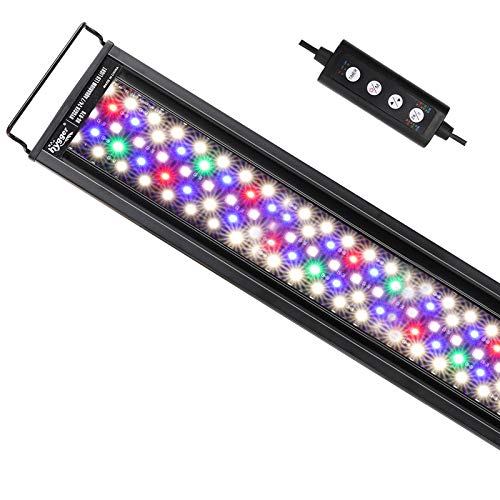
Hygger Full Spectrum Aquarium Light
Hygger includes a timer and dimming in a fixture priced near the entry level, which removes the need for a separate outlet timer. Several light modes cover white, blue and mixed spectra, and the extendable legs fit common tank sizes. Build is plastic rather than aluminium, so heat management is less refined than on premium fixtures.
Pros
- Timer included at a low price
- Multiple spectrum modes
- Dimmable output
Cons
- Plastic body sheds heat less well
- Timer resets after a power cut

Aqueon OptiBright Plus LED Fixture
Aqueon aims this at standard community tanks where good colour rendition matters more than plant growth. Fish colours pop under the mix, and the remote handles dimming and a simple colour blend. Plants with modest needs will hold their own beneath it, but this is a display light first and a growing light second.
Pros
- Flattering colour rendition
- Straightforward remote control
- Fits standard tank rims neatly
Cons
- Limited plant growing output
- No built in scheduling
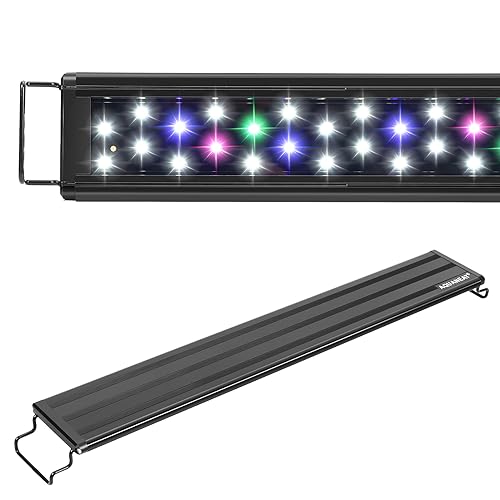
AQUANEAT LED Aquarium Light
AQUANEAT makes a simple clip on and bracket fixture aimed at nano and small community tanks where a full sized fixture would overwhelm the setup. Output is modest, which is appropriate for a shallow tank with easy plants. It is a practical choice for a small desk tank or a quarantine setup where cost matters more than control.
Pros
- Sized for small and nano tanks
- Very low cost
- Simple to install
Cons
- No dimming or timer
- Not suitable for deeper tanks
How they stack up
| # | Model | Spectrum | Best for | Score | Price |
|---|---|---|---|---|---|
| 1 | Fluval Plant 3.0 LED Aquarium Light | Full spectrum with per channel control | Best overall | 9.4 | Check price |
| 2 | Finnex Planted Plus 24/7 CC LED | Full spectrum with red and blue emphasis | Best automation | 9.2 | Check price |
| 3 | NICREW ClassicLED Plus Aquarium Light | White with blue accent | Best value | 9.0 | Check price |
| 4 | Current USA Satellite Freshwater LED Plus | Adjustable RGB plus white | Best for effects | 8.8 | Check price |
| 5 | Hygger Full Spectrum Aquarium Light | Full spectrum with mode presets | Best budget timer | 8.6 | Check price |
| 6 | Aqueon OptiBright Plus LED Fixture | White, blue and RGB accent | Best for community tanks | 8.3 | Check price |
| 7 | AQUANEAT LED Aquarium Light | White and blue | Best for small tanks | 8.0 | Check price |
Before you buy
Match light output to the plants, not the tank Plants are usually sorted into low, medium and high light categories, and that is the figure to shop against. Anubias, java fern, most cryptocoryne and mosses thrive under modest output and will actually suffer from too much. Carpeting plants and red stem species need considerably more light plus carbon dioxide supplementation to keep up. Buying a powerful fixture for a low light tank is the most common route to an algae problem rather than a lush one.
Photoperiod and why a timer matters Plants respond to consistent day length. Six to eight hours is a sensible starting photoperiod for a new planted tank, extended slowly if plants look healthy and algae stays under control. Manually switching a light on and off produces wildly inconsistent days, which favours algae. Either buy a fixture with a built in timer or put a simple outlet timer behind it, and keep the schedule stable for weeks at a time before adjusting.
Spectrum, colour rendition and how the tank looks Plants use light across the spectrum, with peaks in the red and blue ranges, but a light heavy in blue can make a tank look sterile and encourage certain algae. Full spectrum fixtures with adjustable channels let you balance growth against how the tank looks in a living room. A little extra red brings out fish colour and plant tones, while heavy blue is more at home over a marine tank than a freshwater planted one.
Fixture build, heat and mounting Aluminium bodied fixtures dissipate heat better and generally last longer than plastic ones, which matters because heat shortens LED life. Check the mounting method against your tank, since rimless tanks need different brackets from rimmed ones, and a hood restricts what will fit at all. Look for splash resistance rather than full waterproofing on most hanging fixtures, and keep the power adapter above water level with a drip loop in the cable.
Good to know
How many hours a day should the aquarium light be on?
Six to eight hours is a good starting point for a planted tank. Extend gradually only if plants are healthy and algae is not increasing. Longer days do not compensate for a light that lacks output, they mostly grow algae.
Will a stronger light grow plants faster?
Only up to a point, and only if nutrients and carbon dioxide keep pace. Once light exceeds what the plants can use, the surplus feeds algae instead. Matching output to your plant selection matters more than maximising it.
Do fish need light at night?
No. Fish need a genuine dark period to rest, so leave the light off overnight. Low intensity moonlight modes are for viewing rather than for the fish, and running them all night is best avoided.
Why am I getting algae after upgrading my light?
Almost always because output or photoperiod now exceeds what the plants can use. Reduce the day length first, then dim the fixture if it supports it, and give the tank a few weeks to settle before changing anything else.
Can I use a regular LED strip instead?
Household strips are not built for the humidity above a tank and rarely have a spectrum suited to plants. Aquarium fixtures include splash resistance, appropriate spectra and mounting hardware designed for the environment.
What is the difference between lumens and PAR?
Lumens describe brightness as human eyes perceive it. PAR measures the light plants can actually use for photosynthesis at a given depth. For planted tanks, PAR figures at your substrate depth are far more informative than a lumen number.
Do I need a light with a timer built in?
Not necessarily, but consistency matters and an inexpensive outlet timer achieves the same thing. Built in timers are more convenient and often add sunrise and sunset ramping, which reduces the startle response when a light snaps on.
Will an aquarium light heat the water?
Modern LED fixtures add very little heat compared with older fluorescent and metal halide lighting. In a small nano tank sitting under a closed hood it can contribute slightly, so check temperatures during the first few days after fitting a new light.
The verdict
The Fluval Plant 3.0 is the fixture to buy if you are serious about plants, because it offers both the output and the fine control needed to stay on the right side of algae. The Finnex Planted Plus 24/7 CC is the easier life if you want a full day cycle without configuring anything. For a low light tank with hardy plants, the NICREW ClassicLED Plus does the job for a fraction of the outlay.


