Aquarium Powerheads: How Much Flow Does a Tank Need?
Hydor Koralia Nano 425 leads for small tanks, spreading 425 gallons per hour across a wide arc instead of firing a jet. Hygger 1600 GPH Wavemaker gives reef keepers ramped, controllable circulation. AquaClear Powerhead 20 remains the durable freshwater workhorse.
Hydor Koralia Nano 425 is the powerhead to fit in a nano or planted tank, since its output arrives soft and wide. Reef keepers wanting programmable circulation should look at the Hygger 1600 GPH Wavemaker. AquaClear Powerhead 20 stays the reliable freshwater choice, and it can drive accessories as well as circulate.
Flow numbers mislead because a rated figure never tells you whether water leaves as a tight stream or a broad push. The same 500 gallons per hour can either stir a tank evenly or excavate a sand bed. We compared published flow rates, outlet cage design, mounting hardware and manufacturer tank guidance, then weighed owner reports on impeller noise and magnet slippage.
What we recommend

Hydor Koralia Nano 425
A wide outlet cage spreads 425 gallons per hour into a diffused push rather than a stream. Nano reefs and planted tanks get circulation without a sandstorm. The magnet and suction mount pivots, so output can be aimed along the back glass or across the surface.
Pros
- Broad output avoids substrate scouring
- Pivoting mount aims flow precisely
- Runs quietly in normal operation
Cons
- Fixed speed with no controller
- Body is visible in a small tank
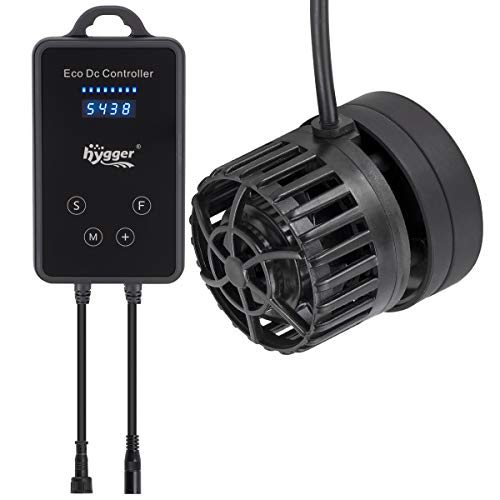
Hygger 1600 GPH Wavemaker
An external controller ramps output up and down instead of holding one speed, which shifts dead spots around a reef. Peak output reaches 1600 gallons per hour, enough for a medium display. A strong magnet base holds through the speed changes.
Pros
- Ramped modes prevent fixed dead spots
- Wide dispersion at every speed
- Magnet base holds on thicker glass
Cons
- Far too strong for tanks under 30 gallons
- Controller adds another box to mount

AquaClear Powerhead 20
Beyond circulation, this unit drives undergravel filters, sponge attachments and other accessories through its outlet. An epoxy sealed motor is the reason so many have run for a decade. Output arrives as a directed stream, so aim it at the glass rather than the substrate.
Pros
- Epoxy sealed motor lasts years
- Drives undergravel and sponge accessories
- Strips down easily for impeller cleaning
Cons
- Narrow stream needs careful aiming
- Suction cups lose grip over time

Jebao SOW-9
Speed control plus several wave patterns let circulation be tuned as a reef matures. Peak output reaches 2600 gallons per hour, which covers larger displays. Owners report the controller menu takes a session to learn, though flow quality holds up well.
Pros
- Speed and pattern both adjustable
- High peak output for large reefs
- Wide cage spreads flow rather than jetting
Cons
- Controller interface is unintuitive
- Lowest setting still suits medium tanks

Fluval Sea CP2 Circulation Pump
A narrow body tucks against the back glass of a marine tank without drawing the eye. Steady 500 gallons per hour circulation runs quietly for the output. Nothing is programmable, so treat it as a fixed speed circulation pump.
Pros
- Slim body hides against the glass
- Quiet at its rated output
- Magnet mount repositions easily
Cons
- Fixed speed with no controller
- Modest output for larger displays

Aqueon Circulation Pump 500
Plug it in and 500 gallons per hour starts moving, with no controller to configure. Freshwater and marine tanks both suit it. Output is directional rather than diffused, which makes placement more important than on a Koralia.
Pros
- Working within a minute of unboxing
- Compact enough for mid size tanks
- Combined magnet and suction mount
Cons
- Output cannot be adjusted
- Directional flow needs careful aiming
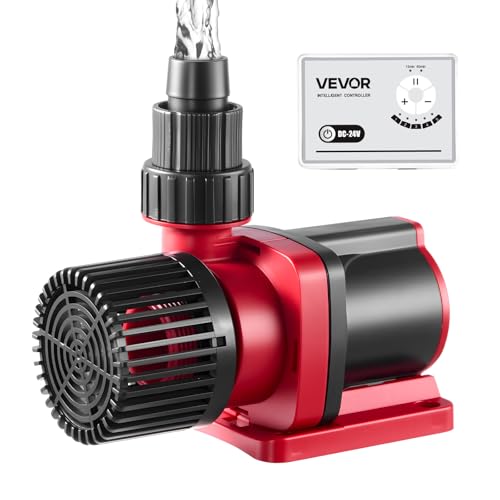
VIVOSUN Wavemaker 800 GPH
Entry level pricing brings 800 gallons per hour to small and medium tanks. Circulation is usable, though the impeller runs louder than premium pumps. Adjustment is minimal, so match the model size to the tank rather than planning to dial it back.
Pros
- Lowest outlay for the flow rate
- Magnet mount fits standard glass
- Enough output for a first circulation pump
Cons
- Impeller noise is noticeable
- Little adjustment available
What matters most
What does a powerhead do in an aquarium? Circulation carries waste to the filter intake, spreads heat evenly and keeps the surface moving for gas exchange. Filters alone rarely reach every corner of a tank longer than two feet. Dead spots collect detritus, which breaks down into nitrate exactly where nobody notices. Adding a powerhead solves that without any plumbing.
How to calculate the flow rate your tank needs Total turnover of roughly 10 to 20 times tank volume per hour suits freshwater. Reef systems want far more, often 20 to 40 times, spread across two pumps. Count your filter output as part of that total before choosing a powerhead. Overshooting is easier than undershooting and harder to undo.
Wide dispersion versus a narrow jet A diffused outlet like the Koralia design pushes water across a broad face, which fish and plants tolerate well. A narrow stream moves the same volume down a line, scouring substrate and flattening stems. In small tanks especially, choose the widest cage available and aim it at the back glass rather than the bed.
Mounting, glass thickness and impeller maintenance Magnet mounts hold on thicker panes and reposition in seconds, while suction cups slowly lose grip. Check the rated glass thickness before ordering, since an underrated magnet slides down the pane over weeks. Every pump needs periodic impeller cleaning, because calcium scale and algae reduce output and make a healthy pump sound like a failing one.
Compared at a glance
| # | Model | Flow | Best for | Score | Price |
|---|---|---|---|---|---|
| 1 | Hydor Koralia Nano 425 | 425 GPH | Best for small tanks | 9.4 | Check price |
| 2 | Hygger 1600 GPH Wavemaker | Up to 1600 GPH | Best for reef tanks | 9.2 | Check price |
| 3 | AquaClear Powerhead 20 | 270 GPH | Best value | 9.0 | Check price |
| 4 | Jebao SOW-9 | Up to 2600 GPH | Best programmable reef pump | 8.8 | Check price |
| 5 | Fluval Sea CP2 Circulation Pump | 500 GPH | Best slim profile | 8.6 | Check price |
| 6 | Aqueon Circulation Pump 500 | 500 GPH | Best plug and play | 8.3 | Check price |
| 7 | VIVOSUN Wavemaker 800 GPH | 800 GPH | Best budget | 8.0 | Check price |
Questions worth asking
How many powerheads do I need?
Tank size and shape decide it. Short tanks often manage with one, while four foot and reef tanks usually want two placed to remove dead corners. Aim for even movement with no stagnant areas and no scoured substrate.
What flow rate should I choose for a freshwater tank?
Total turnover of around 10 to 20 times tank volume per hour is the usual target. Add your filter output first, then size a powerhead to make up the difference.
Will a powerhead stress my fish?
It can if output is too strong or badly aimed. Fish struggling against a current or hiding constantly are telling you to reduce it. Diffused outlets, surface aiming and adjustable pumps all help.
Can I use a powerhead in a planted tank?
Yes, and gentle circulation spreads nutrients and carbon dioxide evenly. Avoid a direct jet that flattens stems or lifts substrate. A wide outlet on a low setting works best.
Do powerheads add oxygen to the water?
Indirectly, by rippling the surface and improving gas exchange. Aim some flow upward, particularly in warm tanks where water holds less oxygen.
Is a magnet mount better than a suction cup?
Magnets hold more securely and reposition easily, provided your glass sits within the rated thickness. Suction cups cost less and suit lighter pumps, but they need resetting as they age.
Why has my powerhead become noisy?
Trapped air, calcium buildup or a worn impeller shaft. Tilt the pump to release bubbles, strip and clean the housing, and replace the impeller if the shaft shows wear.
Are powerheads safe for saltwater reef tanks?
Many are built for exactly that. Controllable models suit corals because varied flow lifts detritus into the water column. Confirm the marine rating and rinse the unit during maintenance to prevent salt creep.
What is the difference between a powerhead and a wavemaker?
A powerhead runs at one speed and often drives accessories such as undergravel plates. A wavemaker varies output on a schedule to create changing currents. Reef tanks favour the second, freshwater tanks usually need only the first.
Our pick
Hydor Koralia Nano 425 is our pick for gentle circulation in small and planted tanks, because dispersion matters more than raw output at that scale. Reef keepers who want adjustable, ramped flow should choose the Hygger 1600 GPH Wavemaker. Freshwater owners after proven durability and accessory compatibility are well served by the AquaClear Powerhead 20.


