Artificial Aquarium Plants That Look Convincingly Real
The Marina Ecoscaper Silk Aquarium Plant is our top pick because silk moves in the current and will not tear fins. The QUMY Large Aquarium Plants set is the value choice for filling tall tanks, and the Lantian Grass Cluster mat is the easiest way to green up a bare substrate.
The Marina Ecoscaper Silk Aquarium Plant tops this roundup because silk leaves drift with the filter flow the way living stems do, and they carry no hard edges to catch a betta or fancy guppy fin. The QUMY Large Aquarium Plants set is the value pick when you need height across the back wall of a tall tank, and the Lantian Grass Cluster mat is the simplest way to cover bare gravel without planting anything individually.
Artificial aquarium plants are easy to buy badly, because the two things that make a tank look alive, movement and depth, come from different products, and the cheapest moulded plastic delivers neither while quietly shredding fins. Silk and fabric plants sway convincingly but flatten if the base is too light; plastic holds a defined shape and resists algae but has seams and edges that need checking with a fingertip. We compared construction material, edge finish, base weight and stability in gravel, how colours hold up under aquarium lighting over time, and what owners report about cleaning and algae after several months in a stocked tank.
The shortlist, ranked

Marina Ecoscaper Silk Aquarium Plant
Marina builds these to mimic specific aquatic species rather than a generic green frond, and the silk leaves respond to filter flow in a way moulded plastic simply cannot. The weighted base holds in gravel without needing burial. Owners report the colours staying true far longer than budget sets, which is where most of the price difference sits.
Pros
- Leaves sway naturally in filter current
- Safe for long finned bettas and guppies
- Colours hold up under aquarium lighting
Cons
- Costs more per plant than plastic sets
- Silk collects algae faster than smooth plastic

QUMY Large Aquarium Plants Silk Set
QUMY sells these in sets sized for the back of a tall tank, which is exactly where aquascapes tend to look thin. The stems are silk on a ceramic base, so they stand up in a strong current and sway rather than bend permanently. Buying a set rather than individual plants is where the value comes from.
Pros
- Enough height to screen equipment at the back
- Ceramic bases stay put in gravel and sand
- Set pricing covers a whole background cheaply
Cons
- Colour tones are brighter than natural species
- Needs rinsing before first use to clear dye residue

Lantian Grass Cluster Aquarium Plant Mat
A carpeting mat solves the hardest part of a planted look, since real foreground carpets need high light and patience. This one drops onto the substrate and gets weighted down with a thin layer of gravel at the edges. It reads convincingly from a normal viewing distance and less so up close.
Pros
- Creates a carpeted look with no lighting demands
- Trims with scissors to fit around hardscape
- Very inexpensive for the area it covers
Cons
- Obvious as artificial at close range
- Traps debris that needs siphoning off
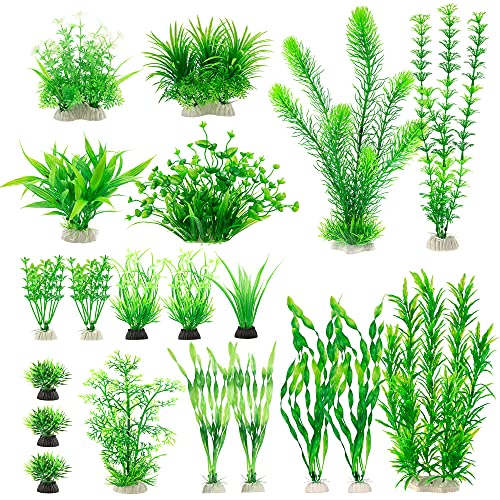
MyLifeUNIT Artificial Aquarium Plants Set
This set mixes heights, leaf shapes and colours, which is the fastest route to a tank that looks composed rather than uniform. The plastic construction holds shape in strong flow and wipes clean easily. Check the leaf edges with a fingertip before adding them to a tank with long finned fish, as with any moulded plant.
Pros
- Mixed sizes make layering straightforward
- Holds shape in strong filter output
- Cleans without fraying or matting
Cons
- Plastic does not move in the current
- Edges need checking for finned species

CNZ Aquarium Decor Plastic Plants
In a tank with a canister filter or a powerhead, silk plants can end up lying flat all day. CNZ plastic plants keep their silhouette regardless of flow, so the aquascape looks the same at every hour. They also resist algae better than fabric, since a smooth surface scrubs clean in seconds.
Pros
- Silhouette unaffected by powerful filtration
- Algae wipes off a smooth surface quickly
- Durable through repeated tank teardowns
Cons
- Static look with no movement
- Some seams need smoothing before use

Fedour Aquarium Plastic Plants Set
Fedour sells these in larger counts, which is what a fifty five gallon or bigger tank actually needs before it stops looking sparse. Heights vary across the set so you can build depth from front to back. Individual plants are unremarkable, but the aggregate effect in a big tank is what you are buying.
Pros
- Enough plants to fill a large tank in one order
- Height range supports front to back layering
- Bases hold in gravel without floating
Cons
- Individual plants look generic up close
- Colour saturation is stronger than natural

Otterly Pets Artificial Aquarium Plants
For a first tank this is a reasonable starting point, with a small mixed set that covers a ten to twenty gallon setup without overthinking placement. The plants are plastic with weighted bases and need only a rinse before going in. Expect them to be a stepping stone toward better plants rather than a permanent aquascape.
Pros
- Right quantity for a first small tank
- No preparation beyond a rinse
- Cheap enough to experiment with layout
Cons
- Not convincing at close viewing distance
- Bases are light enough to shift in strong flow
What to look for
Silk versus plastic, and why it matters for your fish Silk and fabric plants have soft edges and drift in the current, which is why they are the standard recommendation for bettas, fancy guppies, angelfish and anything else with trailing fins. Moulded plastic holds a defined shape and resists algae, but injection seams can leave edges sharp enough to tear delicate fins. The reliable test is the pantyhose test, which is dragging a stocking across each leaf edge before the plant goes in the tank. If it snags, so will a fin.
Prepare every plant before it enters the tank Rinse new plants in dechlorinated water and let them soak for an hour or two, since new plastic and fabric can carry manufacturing residue and loose dye. Avoid soap of any kind, because residue is difficult to rinse fully out of fabric and is genuinely harmful in a closed system. If a plant still colours the soak water after a couple of changes, keep soaking until it runs clear.
Anchoring and layout Most artificial plants come on a weighted base designed to sit under an inch or two of substrate rather than on top of it. Bury the base fully, both so it stays put and so it is not visible. Put the tallest plants along the back wall to hide heaters and filter intakes, mid heights at the sides, and low growth or a carpet mat at the front. Leaving open swimming space in the centre looks more natural than filling every inch.
Cleaning and long term care Artificial plants collect the same algae and detritus as real ones, and the difference is that you can remove and scrub them without harm. During a water change, pull anything visibly coated, rinse it in the bucket of old tank water and use a soft brush on stubborn spots. For heavier algae, a soak in a diluted bleach solution followed by very thorough rinsing and a dechlorinator soak is the standard approach, though fabric plants tolerate it less well than plastic. Never return a plant to the tank while it still smells of bleach.
Side by side
| # | Model | Material | Best for | Score | Price |
|---|---|---|---|---|---|
| 1 | Marina Ecoscaper Silk Aquarium Plant | Silk fabric leaves | Best overall | 9.4 | Check price |
| 2 | QUMY Large Aquarium Plants Silk Set | Silk on ceramic base | Best value | 9.2 | Check price |
| 3 | Lantian Grass Cluster Aquarium Plant Mat | Mat, cut to fit | Best budget | 9.0 | Check price |
| 4 | MyLifeUNIT Artificial Aquarium Plants Set | Moulded plastic | Best variety pack | 8.8 | Check price |
| 5 | CNZ Aquarium Decor Plastic Plants | Rigid plastic | Best for high flow tanks | 8.6 | Check price |
| 6 | Fedour Aquarium Plastic Plants Set | Plastic | Best for larger tanks | 8.3 | Check price |
| 7 | Otterly Pets Artificial Aquarium Plants | Plastic | Best for beginners | 8.0 | Check price |
Good to know
Are artificial plants safe for betta fish?
Silk and fabric plants are, and they are the usual recommendation for bettas specifically. Hard plastic can be safe too, but only after you check every leaf edge, since a betta’s long fins tear easily on injection seams. Run a stocking or a piece of pantyhose over the plant first; anything that snags will snag a fin.
Do artificial plants help water quality like real ones?
No. Live plants consume nitrate and compete with algae for nutrients, and artificial plants do neither. They provide cover, territory boundaries and visual security for shy fish, which are real benefits, but filtration and water changes carry the entire chemical load in a tank with fake plants.
How do I clean artificial aquarium plants?
Remove them during a water change and rinse in the old tank water with a soft brush. For heavy algae, soak in a heavily diluted bleach solution for a few minutes, rinse very thoroughly under running water, then soak in dechlorinated water before returning them. Never use soap or detergent.
Why do my artificial plants keep floating up?
The base is not buried deeply enough, or the substrate is too light. Push the weighted base under at least an inch of gravel or sand. Some plants ship with hollow bases that trap air, so squeeze or tilt them underwater to release trapped bubbles before planting.
Will artificial plants fade over time?
Cheaper dyes fade under strong aquarium lighting within a year, particularly reds and purples. Better quality silk and plastic from established brands holds colour considerably longer. Fading is cosmetic rather than a safety issue, and it happens faster on tanks running high output LED lighting for long photoperiods.
Can I mix artificial and live plants in the same tank?
Yes, and it often looks better than either alone. A common approach is using easy live plants like anubias and java fern on hardscape, then filling the background with artificial stems that would otherwise need high light. The fish do not mind, and it reduces the maintenance load.
How many plants does a twenty gallon tank need?
Somewhere between six and ten depending on plant size, with the tallest along the back. Aim to cover roughly half to two thirds of the footprint while leaving open swimming lanes. Shy species like tetras and rasboras behave more naturally with denser cover than most new keepers provide.
Do artificial plants trap more waste than live ones?
Slightly, because the leaves are static and detritus settles on them rather than being disturbed by growth. Fabric plants and carpet mats collect the most. Siphoning around and over the plants during water changes handles it, and pulling plants out for a rinse every couple of months keeps the tank looking clean.
The bottom line
The Marina Ecoscaper Silk Aquarium Plant is the one to buy if you want a tank that looks alive, because movement is what sells the illusion and silk is also the safe choice for long finned fish. For covering a tall tank cheaply, the QUMY Large Aquarium Plants set does the background work for a fraction of the cost per plant. If the substrate is the part that looks bare, the Lantian Grass Cluster mat fixes it in a single afternoon.