Which Terrarium Background Suits Your Reptile Setup?
The Exo Terra Rock Background is the strongest all round choice, giving climbing texture and depth in one panel. The Zoo Med Repti Backer Cork Tile suits humid bioactive builds and plant anchoring, while the REPTI ZOO Reptile Terrarium Background is the easiest low cost way to cover a plain glass wall.
For most vivariums the Exo Terra Rock Background is the background worth buying, with the Zoo Med Repti Backer Cork Tile the better choice for humid bioactive setups and the REPTI ZOO panel the simplest way to cover glass without a build project.
Choosing is tricky because a background has to do three unrelated jobs at once, providing climbing grip, hiding cords and heaters, and surviving whatever humidity the species needs. We compared current options on materials, published dimensions and what keepers report about mould, adhesion failure and animals wedging themselves behind loose panels.
Before you buy
Start with your species, not the look A background is functional furniture before it is decoration. Arboreal geckos and tree frogs need vertical grip and crevices, so relief depth matters most. Terrestrial snakes and heavy bodied lizards mainly need a visual barrier that they cannot wedge behind. Choosing for the animal first prevents the common outcome of a beautiful panel that gets destroyed or ignored.
Humidity decides the material Dry desert enclosures tolerate almost any material, but tropical setups running high humidity punish the wrong choice quickly. Cork and sealed resin handle constant moisture. Unsealed foam, paper backed sheets and anything with a printed surface tend to peel, bubble or grow mould. If your species needs regular misting, treat mould resistance as the first filter rather than an afterthought.
Fit it so nothing can get behind it The most common problem keepers report is not appearance, it is an animal squeezing into the gap between the panel and the glass. Silicone the full perimeter rather than tacking corners, let it cure completely with the enclosure empty and well ventilated, and check the seal again after the first few weeks of humidity cycling. A gap of even a finger width is enough for a small gecko.
Plan for cleaning before you install Deeply textured panels look best and clean worst. Shed skin, waste and substrate collect in crevices, so decide up front whether you can remove and rinse the panel or will be spot cleaning it in place. Bioactive setups with a healthy clean up crew handle this largely on their own, which is one of the strongest arguments for cork and planted backgrounds in humid enclosures.
What we recommend

Exo Terra Rock Background
Exo Terra’s moulded rock panel is the default for a reason, giving real three dimensional relief that geckos and anoles actually climb rather than a printed picture. It is sized to drop into matching Exo Terra enclosures with minimal trimming. Keepers report it hides heat cables and cords convincingly once seated against the back glass.
Pros
- Genuine climbing texture, not printed
- Hides cords and heating equipment
- Cuts cleanly with a serrated knife
Cons
- Steals a noticeable slice of floor depth
- Needs sealing at edges in very wet setups

Zoo Med Repti Backer Cork Tile Background
Natural cork handles constant humidity better than almost anything else, which is why it dominates tropical bioactive builds. The bark surface grips claws well and gives moss and small plants something to root into. Keepers report it darkens with age rather than degrading, and it resists the mould that ruins painted or foam surfaces in wet enclosures.
Pros
- Excellent humidity and mould resistance
- Plants and moss anchor readily
- Natural texture suits climbing species
Cons
- Tiles need arranging to cover a whole wall
- Thickness varies piece to piece
REPTI ZOO Reptile Terrarium Background
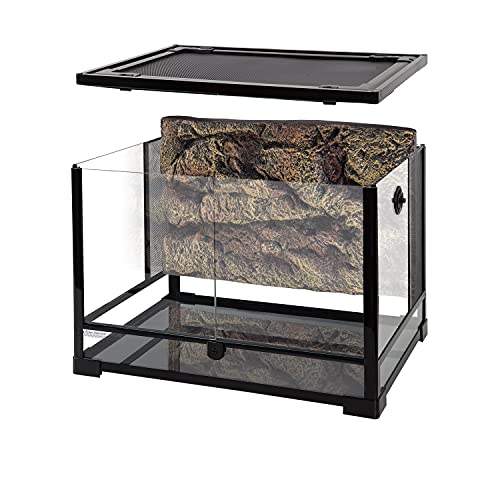
REPTI ZOO’s background covers a lot of glass for very little effort, arriving as a flexible sheet you trim and attach. It is the pragmatic answer when the goal is simply to stop a nervous animal seeing straight through the back of the enclosure. Based on specifications it wipes clean easily, though it offers depth rather than true climbing relief.
Pros
- Fast to fit with scissors
- Reduces stress from a see through back
- Takes almost no interior space
Cons
- Limited climbing texture
- Edges can lift in humid enclosures

Exo Terra Rainforest Terrarium Background
The rainforest version trades bare rock for root and vine relief, which suits crested geckos, tree frogs and anything that spends its life off the floor. The deeper crevices give small animals genuine hiding options rather than just visual interest. Keepers report the varied surface holds misting droplets, which arboreal species drink from.
Pros
- Deep crevices give real hiding spots
- Holds misting droplets for drinking
- Strong visual depth in planted tanks
Cons
- Crevices trap debris and need rinsing
- Bulkier than flat panel options
Universal Rocks Reptile Background
Universal Rocks builds heavier, more sculptural panels aimed at large custom enclosures where a thin sheet would look lost. The castings are deeper and the rock detail reads convincingly even at a distance. Keepers report they are best planned into a build rather than retrofitted, since fitting one to an existing enclosure usually means removing the animal first.
Pros
- Convincing depth in big enclosures
- Durable coated surface
- Holds up to heavy bodied species
Cons
- Heavy and awkward to retrofit
- Takes significant enclosure depth

Jungle Bob 3D Terrarium Background
Jungle Bob’s panels include ledges and pockets designed to hold substrate and small plants, turning the back wall into usable growing space. That suits keepers building living vivariums rather than simple decorated tanks. Based on specifications the pockets drain rather than pooling, though they still need occasional clearing of shed skin and debris.
Pros
- Built in pockets for live plants
- Adds usable vertical surface area
- Ledges double as basking shelves
Cons
- Pockets collect shed and debris
- Trimming to size takes patience
Hygger 3D Rock Aquarium Background
Made for aquariums, this panel is genuinely useful in paludariums and semi aquatic setups where part of the background sits underwater. The resin surface tolerates permanent submersion in a way foam terrarium panels are not designed for. Keepers report it works best in the water section with a terrestrial background above it.
Pros
- Handles permanent submersion
- Non porous surface resists algae buildup
- Blends with terrestrial panels above waterline
Cons
- Sized for aquariums, not reptile enclosures
- Rigid panel needs careful measuring
How they compare
| # | Model | Material | Best for | Score | Price |
|---|---|---|---|---|---|
| 1 | Exo Terra Rock Background | Moulded polyurethane foam | Best overall | 9.4 | Check price |
| 2 | Zoo Med Repti Backer Cork Tile Background | Natural cork bark tile | Best for bioactive setups | 9.2 | Check price |
| 3 | REPTI ZOO Reptile Terrarium Background | Flexible textured sheet | Best value | 9.0 | Check price |
| 4 | Exo Terra Rainforest Terrarium Background | Moulded foam with root relief | Best for tropical species | 8.7 | Check price |
| 5 | Universal Rocks Reptile Background | Cast resin coated foam | Best for large enclosures | 8.5 | Check price |
| 6 | Jungle Bob 3D Terrarium Background | Sculpted foam panel | Best for planted vivariums | 8.2 | Check price |
| 7 | Hygger 3D Rock Aquarium Background | Resin rock panel | Best for paludariums | 8.0 | Check price |
Common questions
Do reptiles actually need a background?
It is not mandatory, but most keepers find animals settle faster when they cannot see through the back and sides of the enclosure. A background also hides heating cables and cords, and adds climbing surface for arboreal species.
What adhesive is safe inside a terrarium?
Aquarium grade silicone is the standard choice because it cures inert. Let it cure fully with the enclosure empty and ventilated until there is no smell at all, which usually takes several days rather than hours.
Will a foam background mould in a humid setup?
Sealed foam panels resist mould reasonably well, but exposed cut edges are the weak point. Sealing those edges and maintaining airflow prevents most problems. For permanently wet enclosures, cork or resin is a safer starting material.
How much space does a background take up?
Moulded three dimensional panels typically consume one to two inches of depth, which is significant in a shallow enclosure. Flexible sheet backgrounds take almost none. Measure your usable floor area before committing to a deep sculpted panel.
Can I put a background on the sides too?
Yes, and many keepers do it for shy species. Just leave the front and at least part of one side clear for viewing and ventilation, and make sure side panels do not block vents or the path of a heat source.
How do I clean a textured background?
Spot clean with warm water and a soft brush, and avoid household cleaners that leave residue. Removable panels can be taken out and rinsed. In bioactive enclosures, springtails and isopods handle much of the routine cleaning themselves.
Are cork backgrounds worth the extra effort?
For humid tropical setups, yes. Cork tolerates moisture indefinitely, gives excellent grip and lets you anchor moss and epiphytes. The trade off is that tiles need arranging to cover a wall, so installation takes longer than a single panel.
Can I use an aquarium background in a reptile tank?
In the dry section it is usually just a visual barrier with no climbing value. Resin aquarium panels come into their own in paludariums where part of the background sits underwater and foam terrarium panels would not survive.
The verdict
The Exo Terra Rock Background remains the safest recommendation for most glass terrariums, balancing real climbing texture with a straightforward fit. Humid bioactive builders should start with Zoo Med Repti Backer cork instead, since it shrugs off moisture and gives plants something to grip. If the goal is simply covering plain glass on a modest outlay, the REPTI ZOO panel does that job without a build project.