What Makes a Balance Board Safe for Daily Use?
Revolution 101 v2 Balance Board handles the widest range of uses, from core drills to standing desk movement. Indo Board Original Training Package suits surfers and skaters building off season reaction speed. StrongTek Wooden Wobble Balance Board gives beginners and ankle rehab a controlled place to start.
Revolution 101 v2 Balance Board is the pick for anyone wanting one board that covers training and desk use. Indo Board Original Training Package earns its place for board sport athletes who need unpredictable, reactive balance. StrongTek Wooden Wobble Balance Board is where beginners and anyone rebuilding an ankle should begin.
This category hides two very different products behind one name, since a wobble disc and a roller deck share almost nothing beyond the word balance. We compared motion type, difficulty progression, deck construction and the floor space each design needs, then matched them to distinct training goals. Owner reports on durability and how quickly each board stops feeling challenging shaped the ranking.
The best picks, ranked

Revolution 101 v2 Balance Board
Raised stop rails under the deck limit how far the roller can travel, which cuts the odds of the board firing across the room. A grip coated top holds bare feet or trainers during faster shifts of weight. That combination makes it usable for sport conditioning in the morning and standing desk movement all afternoon.
Pros
- Stop rails keep the roller under control
- Grip coating holds feet during fast weight shifts
- Same board covers training and desk use
Cons
- Roller boards need a week or two to learn
- Requires clear floor space in every direction

Indo Board Original Training Package
Surfers, skaters and snowboarders have used this deck for off season work for decades, and the shape reflects that. A roller and an inflatable cushion both ship in the package, so difficulty scales from stable to genuinely unpredictable. Layered wood construction takes years of aggressive use without delaminating.
Pros
- Cushion and roller give two difficulty levels
- Built for the reactive balance board sports demand
- Layered deck survives years of heavy training
Cons
- Roller setup is too advanced for a first board
- Long deck needs more floor than a wobble board
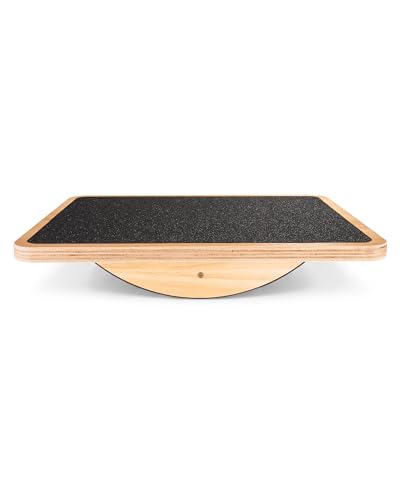
StrongTek Wooden Wobble Balance Board
A half round base under a wooden deck allows tilt in every direction without the board ever escaping underfoot. Anti slip surfacing means it works barefoot on a hard floor or in socks on carpet. Physiotherapy routines, warm up drills and light desk movement all fit within what this board does well.
Pros
- Tilt motion stays controlled and predictable
- Anti slip surface works barefoot or in socks
- Wooden build holds up better than moulded plastic
Cons
- Stops challenging trained athletes quickly
- Tilt only, so no rolling drills possible

URBNFit Wooden Balance Board
A rounded rocker base restricts movement to one plane, which makes the first sessions far less intimidating. Textured wood keeps feet planted through squats and single leg holds. Difficulty stays fixed, so this is a board you outgrow rather than progress on.
Pros
- Rocker motion is the gentlest starting point
- Textured deck keeps feet planted during squats
- Wooden construction at an entry level
Cons
- Fixed difficulty with nowhere to progress
- Finish is plainer than premium boards

Yes4All Wobble Balance Board
A compact round disc with a shallow tilt angle keeps early rehab sessions within a safe range of motion. Seated ankle circles work as well as standing drills, which matters in the first weeks after an injury. Small footprint means it stores under a sofa rather than leaning against a wall.
Pros
- Shallow tilt suits early recovery work
- Usable seated as well as standing
- Stores in almost no space
Cons
- Offers little challenge to trained athletes
- Small platform restricts foot placement

Simply Fit Board Balance Board
Twisting on a curved base recruits obliques, hip rotators and quads through a low impact range. Moulded plastic keeps the weight low enough to move around a room one handed. Treat it as a movement tool rather than a balance trainer, because the motion stays largely predictable.
Pros
- Twisting motion recruits obliques and hip rotators
- Low impact and easy to start with
- Light enough to carry between rooms
Cons
- Trains rotation more than true balance
- Plastic flexes more than a wooden deck

Whirly Board Spinning Balance Board
Spin joins tilt and rock here, adding a rotational axis the other boards leave out. Coordination work through play suits children and adults alike, and sessions tend to run longer because it stays interesting. Rotation also means the deck can turn under you before you expect it.
Pros
- Adds a rotational axis the others lack
- Holds attention across a range of ages
- Grip coating keeps feet placed during spins
Cons
- Spin takes practice before it feels controlled
- Too unpredictable for structured rehab work
How they stack up
| # | Model | Type | Best for | Score | Price |
|---|---|---|---|---|---|
| 1 | Revolution 101 v2 Balance Board | Roller board | Best overall | 9.4 | Check price |
| 2 | Indo Board Original Training Package | Roller board | Best for surf and skate training | 9.2 | Check price |
| 3 | StrongTek Wooden Wobble Balance Board | Wobble board | Best value | 9.0 | Check price |
| 4 | URBNFit Wooden Balance Board | Rocker board | Best budget | 8.8 | Check price |
| 5 | Yes4All Wobble Balance Board | Wobble disc | Best for ankle rehab | 8.6 | Check price |
| 6 | Simply Fit Board Balance Board | Twist board | Best for core workouts | 8.3 | Check price |
| 7 | Whirly Board Spinning Balance Board | Spinning board | Best for kids and play | 8.0 | Check price |
How to choose
What are the main types of balance board? Wobble and rocker boards sit on a fixed curved base, so movement stays within a known range and nothing slides away. Roller boards place a free deck on a loose cylinder, creating the unpredictable side to side motion board sports need. Twist boards add rotation on a curved base, working the core more than balance. Spinning boards combine tilt, rock and rotation, which is the widest motion and the hardest to control at first.
Which balance board is best for beginners? A rocker or wobble design like the URBNFit or StrongTek boards keeps the base attached, which removes the biggest failure mode. Progress there for a few weeks before the board stops feeling difficult. Roller boards such as the Revolution 101 v2 make more sense once you can hold a wobble board steady for a minute. Starting on a roller deck is possible with a wall nearby, though it discourages plenty of people early.
Can you use a balance board at a standing desk? Firm rocker and roller boards both work under a desk, encouraging small constant shifts instead of locked knees. Revolution 101 v2 handles this well because its stop rails prevent the roller travelling far. Start with ten or fifteen minutes and build up, since calves and ankles fatigue faster than expected. Wobble discs are less useful here, as their tilt asks for more attention than typing allows.
How do you use a balance board safely? Put the board on a flat non slip floor with a wall, doorframe or heavy chair within arm’s reach. Clear roughly two metres in every direction for roller and spinning boards, which can travel when a foot slips. Short sessions repeated often build stability faster than one long tiring block. Check deck grip and roller condition periodically, and supervise children on any board that spins.
Questions worth asking
What is the easiest balance board for beginners?
Rocker boards like the URBNFit move in one plane only, which makes them the gentlest entry point. Wobble boards such as the StrongTek come next, tilting in every direction from a fixed base. Both keep the base attached to the deck, so nothing can slide out from under you.
Are balance boards good for physical therapy?
Wobble discs and rocker boards appear regularly in ankle rehab and proprioception programmes. Yes4All’s low tilt disc works seated as well as standing, which suits the earliest stages of recovery. Follow the protocol your physiotherapist sets rather than progressing on feel alone.
Can a balance board replace a standing desk mat?
Firm rocker and roller boards do this job well, keeping you shifting rather than standing locked in place. Revolution 101 v2 is the pick here thanks to its roller stop rails. Build up from short sessions, because standing on any board all day fatigues the calves.
Do balance boards help with surfing or skating?
Roller boards train the reactive, unpredictable balance those sports demand, which fixed base boards cannot reproduce. Indo Board Original Training Package has been the off season standard for surfers and skaters for years. The included cushion lets you build up before switching to the roller.
Wood or plastic: which balance board lasts longer?
Layered wood decks such as the Indo Board and StrongTek hold up better under repeated heavy use. Moulded plastic like the Simply Fit Board is fine for twisting and light work but flexes more over time. Body weight and session intensity decide how much that difference matters.
How much space does a balance board need?
Wobble discs need barely more than the board itself, which suits a small flat or a desk side. Roller and spinning boards want around two metres of clear floor in each direction. Indo Board Original has the largest footprint here because of its long deck.
Are balance boards safe for kids?
Spinning and rocking boards build coordination through play and suit supervised use. Whirly Board Spinning Balance Board is the most engaging option here for children. Keep sessions supervised, choose a soft floor, and skip roller decks until they can hold a wobble board comfortably.
How long should a balance board session last?
Five to ten minutes at a time suits beginners, repeated through the day rather than done in one block. Ankles and stabilising muscles fatigue quickly, and tired balance training teaches poor patterns. Extend the sessions as holds become steady rather than by fixed schedule.
Wobble board vs roller board: which should you buy?
Buy a wobble board for rehab, general stability and anyone new to balance work, since the base cannot escape. Choose a roller board for sport conditioning and desk use, where unpredictable motion is the point. Several people start with a wobble board and add a roller deck later rather than choosing once.
The bottom line
Revolution 101 v2 Balance Board is the one to buy if you want a single board covering training, conditioning and standing desk use, with stop rails keeping the roller manageable. Surfers, skaters and snowboarders will progress faster on the Indo Board Original Training Package and its two difficulty settings. Beginners and anyone rebuilding an ankle should start on the StrongTek wobble board and move up later.


