What Makes a Golf Bag Practical for Indoor Storage?
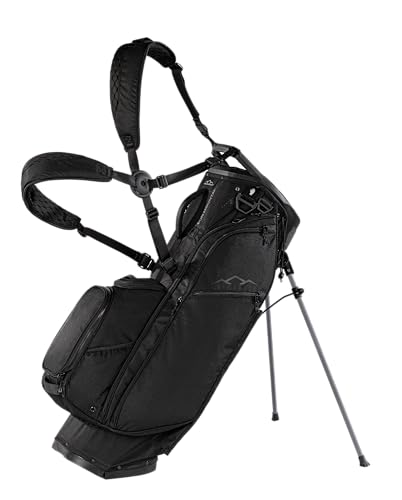
Sun Mountain 2.5+ stands securely on hard flooring without sprawling into the hitting area. Titleist Players 4 gives the cleanest club access in a bay. Callaway Hyper Lite Zero takes up the least space of the three for tight rooms.
Sun Mountain 2.5+ is the pick for indoor use, since it stands securely on hard flooring without sprawling into the hitting area. Titleist Players 4 gives the cleanest club access in a simulator bay. Callaway Hyper Lite Zero takes up the least space of all seven.
Choosing a bag for indoor use flips the usual priorities. Carry comfort and rain hoods matter far less than whether legs grip a hard floor and how much of a small room the bag occupies. We compared base footprint, leg behavior on tile and mat rather than turf, divider layout, overall weight, and how easily each bag stands beside a hitting net without tipping over.
The top picks, ranked

Sun Mountain 2.5+ Stand Bag
Sun Mountain’s leg mechanism deploys at a wide enough angle to stay stable on a hard floor, where many stand bags slide. The narrow body stays out of a simulator hitting zone, yet the bag still holds a full set with room for a rangefinder. Owners consistently rate the build and leg reliability as best in class.
Pros
- Legs stay planted on hard indoor flooring
- Compact body suits small bays
- Excellent long term build reputation
Cons
- Fewer pockets than cart bags
- Higher price than budget stand bags

Titleist Players 4 Stand Bag
Wide spacing on the four way top lets clubs come out cleanly instead of catching on neighbors, which is the difference between a smooth session and constant fiddling. The bag sits upright with a low center of gravity. Storage stays deliberately minimal, which suits indoor use where rain gear and a full round’s supplies stay home.
Pros
- Clubs come out without snagging
- Sits stably with a low center of gravity
- Clean minimal design
Cons
- Limited pocket storage
- Premium pricing
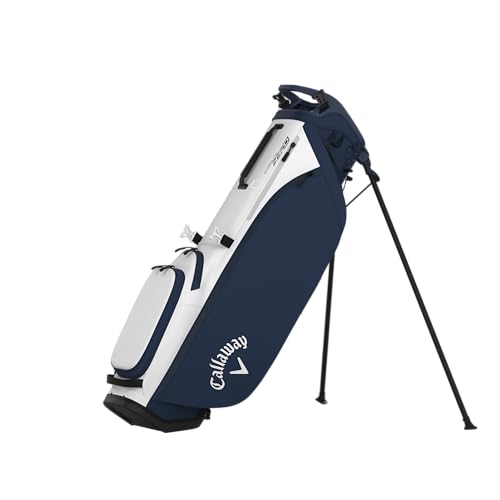
Callaway Golf Hyper Lite Zero Stand Bag
A minimal frame makes this the smallest and lightest bag here, taking up very little floor in a converted garage or spare room. It holds a working set comfortably, though a full fourteen clubs plus accessories is a squeeze. For a home setup where space is the binding constraint, that trade often makes sense.
Pros
- Takes up minimal floor space
- Very light to move around a room
- Simple reliable stand mechanism
Cons
- Tight with a full fourteen club set
- Minimal storage pockets

Ping Hoofer Lite Stand Bag
Ping’s divider layout keeps irons in order, avoiding the shuffle that happens in bags with fewer sections. That speeds up a session where clubs switch constantly. Pocket layout suits storing training aids and alignment sticks well. It runs slightly wider than the minimal bags, so measure the bay before committing.
Pros
- Divider layout keeps clubs in order
- Good pocket organisation for training aids
- Stable wide leg stance
Cons
- Wider body than minimal bags
- Heavier than ultralight options

TaylorMade FlexTech Carry Stand Bag
TaylorMade’s FlexTech leg system deploys smoothly and holds firm, and the price sits well below the premium models while covering the same indoor requirements. A generous top opening keeps clubs from jamming. Materials fall a step below the Titleist and Ping bags, which shows in the pocket zips over time.
Pros
- Reliable leg mechanism at a lower price
- Generous top opening
- Good balance of storage and size
Cons
- Zips are the weak point over time
- Fabric feels less premium

Cobra Golf Ultralight Pro Stand Bag
Weight becomes the deciding factor when a bag shares a room and gets moved daily, and this one shifts easily with one hand. A five way top keeps clubs organised despite the minimal build. Stability on very smooth flooring is the tradeoff, since a light body resists a knock less than a heavier one.
Pros
- Easy to move one handed every day
- Five way top for a light bag
- Compact when stored against a wall
Cons
- Easier to knock over on smooth floors
- Limited storage capacity

Jones Sports Utility Trouper Stand Bag
Jones uses a classic canvas look that suits a converted room far better than the technical fabrics on most modern bags, which matters when the setup shares a living space. Construction holds up well, and a simple divider layout keeps clubs accessible. It skips the feature list of the sports brands, which is largely the point.
Pros
- Looks appropriate in a home or office space
- Well made with durable fabric
- Simple uncluttered layout
Cons
- Fewer technical features than sports brands
- Heavier than ultralight bags
How they stack up
| # | Model | Type | Best for | Score | Price |
|---|---|---|---|---|---|
| 1 | Sun Mountain 2.5+ Stand Bag | Stand bag | Best overall | 9.4 | Check price |
| 2 | Titleist Players 4 Stand Bag | Stand bag | Best club access | 9.2 | Check price |
| 3 | Callaway Golf Hyper Lite Zero Stand Bag | Ultralight stand bag | Best for tight spaces | 9.0 | Check price |
| 4 | Ping Hoofer Lite Stand Bag | Stand bag | Best for organisation | 8.8 | Check price |
| 5 | TaylorMade FlexTech Carry Stand Bag | Stand bag | Best value | 8.6 | Check price |
| 6 | Cobra Golf Ultralight Pro Stand Bag | Ultralight stand bag | Best for quick moves | 8.3 | Check price |
| 7 | Jones Sports Utility Trouper Stand Bag | Stand bag | Best looking in a home | 8.0 | Check price |
How to choose
Indoor priorities differ from outdoor ones A bag chosen for walking eighteen holes optimizes for shoulder comfort, weather protection, and carrying a round’s worth of supplies. None of that matters in a simulator bay. Indoors, the real questions are whether the legs grip a hard floor, how much of a small room the bag occupies, and whether a club comes out and goes back without turning around. That favors a narrow body with a wide leg spread over a feature packed bag.
How legs behave on hard floors Stand bag legs use rubber feet designed for turf, and some designs slide on tile, laminate, or a smooth garage floor as the bag settles. A wider leg spread distributes load better and resists this far more. A small rubber mat under the bag fixes a slippery floor entirely and costs almost nothing. Check that legs deploy fully when set down at an angle, since a partial deploy is what tips a bag into a hitting zone.
Why divider layout matters more indoors Club changes can happen thirty times an hour during practice, far more often than during a round. That makes generously spaced, full length dividers genuinely valuable, since clubs slide out clean instead of catching grips on their neighbors. Four way tops with full length separators hit the sweet spot for most indoor setups. Fourteen way tops organize everything perfectly but add width, the exact dimension a small bay cannot spare.
Measure the bay before you order Simulator bays and home setups run tighter than people expect. Clearance is needed for a full swing, space for the screen or net, and somewhere the bag can sit without being struck. Measure the floor area available with the mat in position, then compare it to the bag’s base dimensions and leg spread rather than its listed height. Where clearance is genuinely tight, an ultralight bag like the Callaway Hyper Lite Zero paired with a reduced club set beats forcing a full size bag into the room.
Good to know
Do I need a special golf bag for indoor use?
Not a dedicated one, but priorities differ. Indoors, a narrow footprint, legs that stay planted on hard flooring, and well spaced dividers for frequent club changes favor compact stand bags over large cart bags.
Will stand bag legs slip on a hard floor?
Some designs can, since rubber feet are made for turf. Bags with a wide leg spread such as the Sun Mountain 2.5+ stay far more stable, and a small rubber mat under the bag solves it entirely on a very smooth floor.
Is a stand bag or a cart bag better for a simulator?
A stand bag, in almost every case. Cart bags run wider, do not stand on their own, and are built to sit on a trolley. In a confined bay, extra width is the last thing you want.
How many dividers should an indoor golf bag have?
Four to five full length dividers is the practical sweet spot, keeping clubs organized without adding width. Fourteen way tops separate perfectly but add bulk that works against a small room.
Can I store a golf bag in a garage?
Yes, though avoid leaving clubs against a damp exterior wall and keep the bag off a floor that gets wet. Grips deteriorate faster in heat and damp extremes, so an insulated space works better where possible.
Do I need a full fourteen club set for indoor practice?
Most people do not. A driver, a few irons, a wedge, and a putter cover the bulk of useful simulator practice, which is why ultralight bags like the Callaway Hyper Lite Zero work well indoors despite tighter capacity.
What should I look for in club access on a stand bag?
Generously spaced top openings and full length dividers, so grips do not tangle on the pull. Titleist Players 4 stands out here, which matters more indoors where clubs change constantly.
Should a golf bag sit in front of or beside the hitting mat?
Beside it, slightly behind the stance, out of the swing arc but within reach. A bag placed in front of the mat sits in the ball flight path, risking damage to the bag and whatever is inside it.
Are stand bags or carry bags the same thing for indoor use?
Yes, the terms overlap. A stand bag is a carry bag with folding legs, and that leg mechanism is exactly what needs testing on a hard indoor floor before buying.
Our pick
Sun Mountain 2.5+ is the strongest indoor choice, since its legs stay planted on hard flooring and it does not sprawl into the hitting area. Titleist Players 4 has the cleanest access of any bag here for constant club changes, and where floor space runs tight, Callaway Hyper Lite Zero paired with a reduced set is the pragmatic answer. Measure the bay before ordering, since footprint decides this more than any other spec.