Banana Plugs That Won’t Work Loose From Your Speakers
Sewell’s Deadbolt Banana Plugs suit most home setups, combining a locking collar with a 10 to 18 AWG range. Monoprice’s Gold Plated Closed Screw Type plugs deliver similar performance for less money. Kohree’s 24K Gold bulk pack fits multi-room wiring on a budget. Wire thickness and how often speakers move should guide the final pick.
A banana plug swaps bare speaker wire for a single connector that slides into a binding post. Grip and gauge compatibility matter more than brand name once the plug is behind a cabinet or wall mount.
Push a thick 10 AWG subwoofer cable into a plug rated only for 18 AWG and the collar won’t clamp evenly. We lined up plating material, gauge range, locking mechanism, and owner feedback across seven current listings to find where the differences actually show up.
The shortlist, ranked

Sewell Deadbolt Banana Plugs
A brass collar threads directly onto the binding post here instead of relying on spring tension alone. Contacts carry 24K gold plating for corrosion resistance. The 10 to 18 AWG range covers nearly any cable sold for home theater use.
Pros
- Deadbolt collar resists pull-out on wall-mounted speakers
- Color-coded red and black caps prevent polarity mix-ups
- Wide gauge range skips the need for an adapter
Cons
- Collar assembly takes longer to install than push-type plugs
- Bulkier body can crowd tightly spaced binding posts

Monoprice Gold Plated Closed Screw Type Banana Plugs
A closed-barrel shell hides the bare wire end once the set screw clamps down. Gold plating matches pricier competitors at a lower per-plug cost. Coverage runs 12 to 18 AWG, enough for most bookshelf and tower speaker wiring.
Pros
- Closed barrel keeps stray wire strands from shorting against the post
- Gold plating resists tarnish for the price point
- Compact body fits closely spaced binding posts
Cons
- Set screws are small and fiddly with thicker 10 AWG cable
- No locking collar for extra grip on moved speakers

Kohree 24K Gold-Plated Banana Plugs
Twenty-four plugs ship per set, enough to wire a full surround system with spares left over. Contacts use 24K gold plating over a closed screw barrel. Coverage spans thin in-wall wire up to heavier runs.
Pros
- High plug count lowers the cost per connector for large installs
- Wide gauge range fits most speaker wire already on hand
- Color-coded caps speed up wiring a multi-channel system
Cons
- Owners report occasional stripped screw threads if overtightened
- Plating consistency reportedly varies between production batches

Pangea Audio Banana Plugs
Machined copper replaces the die-cast alloy found in most banana plugs, a design audiophile forums credit for lower contact resistance. Rhodium plating resists tarnish better than standard nickel. Coverage runs 10 to 16 AWG, the range typical of high-end speaker wire.
Pros
- Copper body reduces resistance compared to zinc or brass alternatives
- Rhodium plating holds up better than nickel over years of use
- Set-screw design avoids solder for a cleaner install
Cons
- Smaller 4-pair pack means fewer spares for larger systems
- Costs more per plug than mass-market screw-type options

Postta Banana Plugs
This set also totals 24 plugs, aimed at buyers wiring several rooms in one order. A closed screw barrel covers 10 to 18 AWG wire. Gold-plated contacts match the finish of smaller, pricier kits.
Pros
- Bulk 24-plug count suits multi-room and whole-house installs
- Gold plating adds corrosion resistance for the price
- Closed barrel design keeps installation tidy
Cons
- Body plastic feels less rigid than metal-shelled competitors
- Bulk packaging offers fewer color-coding options than smaller sets
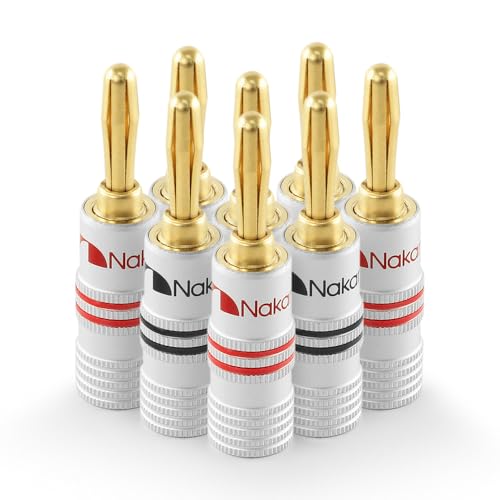
Nakamichi Banana Plugs
A spring-loaded collar releases with a simple push, skipping screwdrivers entirely. Gold-plated contacts cover 12 to 18 AWG wire, the range typical of bookshelf speaker cable. Twenty-four plugs ship per set for a full multi-channel setup.
Pros
- Push-button spring release installs faster than any screw type here
- No tools required for wiring or swapping speakers
- Consistent spring tension keeps contact steady
Cons
- Spring tension reportedly weakens after repeated years of use
- Less secure than a locking collar for speakers that move often
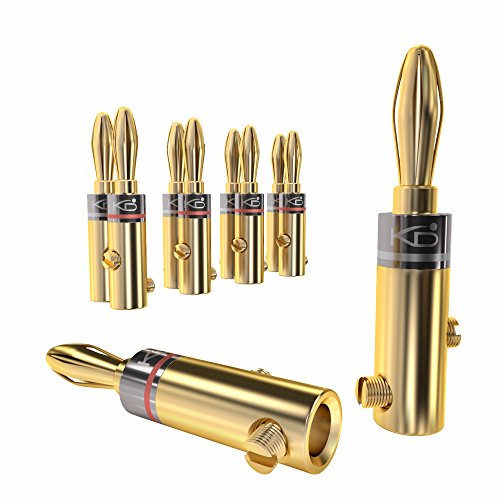
KabelDirekt Banana Plugs
Thicker 10 AWG runs common on subwoofer cable clamp here just as well as standard 18 AWG speaker wire. The closed screw barrel keeps bare strands contained. A 24-plug set covers larger installs without buying multiple kits.
Pros
- Wide gauge range handles subwoofer cable and standard speaker wire alike
- 24-plug count reduces cost for larger installations
- Simple closed screw design is easy to learn for first-time installers
Cons
- Plating reportedly thinner than premium audiophile brands
- Housing relies more on plastic than metal-bodied competitors
The lineup, side by side
| # | Model | Wire gauge compatibility | Best for | Score | Price |
|---|---|---|---|---|---|
| 1 | Sewell Deadbolt Banana Plugs | 10 AWG to 18 AWG | Best overall | 9.4 | Check price |
| 2 | Monoprice Gold Plated Closed Screw Type Banana Plugs | 12 AWG to 18 AWG | Best value | 9.2 | Check price |
| 3 | Kohree 24K Gold-Plated Banana Plugs | 10 AWG to 18 AWG | Best budget | 9.0 | Check price |
| 4 | Pangea Audio Banana Plugs | 10 AWG to 16 AWG | Best for high-end audio setups | 8.7 | Check price |
| 5 | Postta Banana Plugs | 10 AWG to 18 AWG | Best for multi-room installs | 8.5 | Check price |
| 6 | Nakamichi Banana Plugs | 12 AWG to 18 AWG | Best for tool-free installation | 8.2 | Check price |
| 7 | KabelDirekt Banana Plugs | 10 AWG to 18 AWG | Best for heavy-gauge subwoofer wiring | 8.0 | Check price |
What matters most
What to look for in banana plugs Plating material drives long-term corrosion resistance, with gold and rhodium outlasting bare copper or nickel. Locking mechanism decides how firmly the plug grips the binding post. Wire gauge compatibility matters just as much, since a plug rated for 18 AWG won’t clamp evenly on thick 10 AWG subwoofer cable. Pack quantity changes the cost per connector once a full system needs wiring.
Matching wire gauge to your speaker cable Bookshelf speakers typically ship with 16 or 18 AWG wire. Tower speakers and subwoofers often run 12 or 10 AWG cable to keep resistance low over longer distances. A plug rated only down to 14 AWG struggles to clamp thinner wire securely. Checking the gauge printed on the cable jacket before buying avoids a mismatch.
Screw-type, spring-loaded, and closed-barrel locking explained Closed screw types clamp a set screw against bare wire inside a covered barrel, hiding stray strands. Spring-loaded designs use a push-button collar for tool-free swaps, handy for speakers that move often. Deadbolt-style collars thread directly onto the binding post for the firmest grip. Open screw types expose the wire and cost less, but leave more room for shorts.
Banana plugs for high-end audio vs everyday multi-room setups Audiophile setups benefit from copper or rhodium-plated contacts that lower resistance at the connection point. Multi-room installs favor bulk packs with 20 or more plugs to cover several zones without reordering. A subwoofer-equipped home theater needs plugs rated for thicker 10 or 12 AWG cable. Everyday stereo setups rarely need anything beyond a standard gold-plated screw type.
Good to know
What are banana plugs used for?
Banana plugs connect speaker wire to binding posts on amplifiers, receivers, and speakers without exposing bare copper strands. Swapping cables gets faster and stray-wire shorts become less likely.
Are gold-plated banana plugs worth it?
Gold resists corrosion better than bare copper or nickel, which matters in humid rooms or systems left wired for years. Dry indoor use narrows the gap, though reliability still improves over time.
How do I install banana plugs on speaker wire?
Strip about half an inch of wire, insert it into the plug’s screw terminal or spring clip, then tighten or clamp it down. Closed-barrel designs cover the connection afterward for a cleaner finish.
What wire gauge works with banana plugs?
Most banana plugs accept a range like 10 to 18 AWG, though some spring-loaded types top out around 12 AWG. Checking the gauge rating printed on the packaging avoids a bad fit.
Can banana plugs damage my speakers or amplifier?
Properly installed plugs don’t damage equipment, since they’re built to fit standard binding posts. Loose connections or stray wire strands touching adjacent posts cause most problems, not the plugs themselves.
Which banana plugs work best for thick speaker wire?
Plugs rated down to 10 AWG, like the closed screw types from KabelDirekt or Kohree, handle thicker subwoofer and tower speaker cable without stripping the terminal.
Is a screw-type or spring-loaded banana plug better?
Screw types generally grip more securely for speakers that stay put. Spring-loaded plugs install faster and suit systems where cables get swapped or moved often.
Do all speakers and amplifiers accept banana plugs?
Most modern receivers and speakers with binding post terminals accept banana plugs. Older gear with only spring-clip terminals may need bare wire or pin connectors instead.
How many banana plugs do I need for a home theater setup?
A 5.1 system needs at least 12 plugs, two per channel, while whole-house or multi-room wiring often calls for bulk packs of 24 or more.
Banana plugs vs bare wire, which connects better?
Banana plugs make a more consistent contact and skip the risk of stray strands shorting against a neighboring post. Bare wire still works fine on older gear without binding posts.
Final word
Sewell’s Deadbolt design offers the strongest balance of gauge range and secure locking for most living rooms and home theaters. Audiophiles chasing lower contact resistance should look at Pangea’s copper-bodied plugs instead. Budget multi-room installs are better served by Kohree’s or Postta’s bulk 24-plug packs.


