Barebone PCs That Fit Your Build Style
For most builders, the Intel NUC 13 Pro is the top pick because it delivers strong performance in a tiny footprint, but it has limited graphics capability. If you need a full desktop with room for a dedicated GPU, the ASRock DeskMeet X300 offers more expansion at a lower cost. For a premium compact option, the ASUS PN64 stands out with its sleek design and upgradeable RAM.
Barebone PCs are the blank canvas for do-it-yourself enthusiasts. They come with a motherboard, case, and power supply, but you add the CPU, RAM, storage, and operating system. This approach lets you customize performance while saving money compared to buying a prebuilt system.
The market is packed with options, from tiny stick-sized units to roomy towers. I’ve researched dozens of models, looking at specs, user reviews, and community feedback. Below, you’ll find seven of the best barebone PCs currently available, each suited for different types of builders.
What we recommend
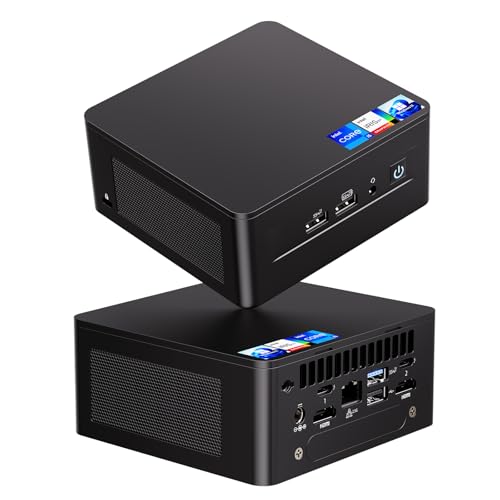
Intel NUC 13 Pro Mini PC
The Intel NUC 13 Pro is a tiny powerhouse that fits in the palm of your hand. It supports 13th Gen Intel Core processors and offers dual Thunderbolt 4 ports. Its small footprint makes it ideal for desk setups or media centers. The main limitation is the lack of discrete GPU support, so it is not for gaming.
Pros
- Ultra-compact design
- Excellent performance for productivity
- Dual Thunderbolt 4 for fast connectivity
Cons
- No room for discrete GPU
- Can run hot under heavy load

ASRock DeskMeet X300
The ASRock DeskMeet X300 is a small form factor barebone that accepts AMD AM4 processors. It features a 500W power supply and can accommodate a dual-slot graphics card up to 10 inches long. This makes it a great choice for a budget gaming rig or a powerful workstation. Its compact size is larger than a NUC, but it offers far more expansion.
Pros
- Supports a full-size dual-slot GPU
- Includes 500W 80+ Bronze power supply
- Great price for the features
Cons
- Larger than typical mini PCs
- Limited to older AM4 platform

ASUS PN64
The ASUS PN64 is a stylish mini PC that supports Intel 12th Gen Core processors. It offers dual LAN, Wi-Fi 6E, and Thunderbolt 4. The tool-less design makes upgrades easy. While it lacks a discrete GPU option, it is perfect for office work, content consumption, and light creative tasks. Its build quality is top-notch.
Pros
- Premium build quality
- Dual 2.5GbE LAN for networking
- Easy access to internals
Cons
- No dedicated GPU support
- Higher price than similar NUCs

ZOTAC ZBOX CI337 Nano
The ZOTAC ZBOX CI337 Nano is a fanless mini PC that runs completely silent. It is powered by an Intel Celeron processor, which is fine for basic tasks like web browsing and office applications. Its rugged design is perfect for industrial or home theater use. The lack of moving parts improves reliability and longevity.
Pros
- Completely silent operation
- Low power consumption
- Fanless design reduces dust buildup
Cons
- Weak performance for demanding tasks
- Limited storage options (no M.2)

GIGABYTE BRIX GB-BSi7-1260
The GIGABYTE BRIX GB-BSi7-1260 is a compact barebone with Intel Iris Xe graphics, making it one of the few mini PCs that can handle light gaming. It features an Intel Core i7-1260P processor and supports DDR4 memory. The unit is slightly larger than a NUC, allowing for better cooling. It is a solid choice for those who need integrated graphics with decent performance.
Pros
- Powerful integrated graphics
- Good thermal design
- Multiple display outputs
Cons
- Still not for AAA gaming
- Pricey for the performance

MINISFORUM DeskMini HX90
The MINISFORUM DeskMini HX90 is a barebone mini PC with an AMD Ryzen 9 5900HX processor. It offers exceptional multi-core performance for its size. The unit includes a built-in power supply and supports up to 64GB of RAM. While it lacks a discrete GPU, its integrated Radeon graphics can handle casual gaming. It is an excellent choice for heavy multitasking.
Pros
- High-end CPU at a low price
- Compact and quiet
- Great for productivity
Cons
- No GPU upgrade path
- Limited to two memory slots

Shuttle XPC Slim DH370
The Shuttle XPC Slim DH370 is a traditional slim barebone that supports Intel 8th and 9th Gen processors. It offers a range of ports including serial and parallel, making it suitable for legacy equipment. The case is tool-less and easy to service. While it is not as compact as other mini PCs, it provides more expansion options with its half-height PCIe slot.
Pros
- Legacy port support (COM, LPT)
- Easy to service
- Reliable for business use
Cons
- Older processor support
- Bulky design
The lineup, side by side
| # | Model | Processor | Best for | Score | Price |
|---|---|---|---|---|---|
| 1 | Intel NUC 13 Pro Mini PC | Intel Core i5-1340P or i7-1360P | Compact productivity and general use | 9.4 | Check price |
| 2 | ASRock DeskMeet X300 | AMD Ryzen 5000 series (AM4) | Budget builds with GPU option | 9.1 | Check price |
| 3 | ASUS PN64 | Intel Core i5-12500H or i7-12700H | Sleek design and fast connectivity | 9.0 | Check price |
| 4 | ZOTAC ZBOX CI337 Nano | Intel Celeron N5100 | Fanless and silent operation | 8.7 | Check price |
| 5 | GIGABYTE BRIX GB-BSi7-1260 | Intel Core i7-1260P | Gaming and creative work | 8.8 | Check price |
| 6 | MINISFORUM DeskMini HX90 | AMD Ryzen 9 5900HX | AMD enthusiasts on a budget | 8.9 | Check price |
| 7 | Shuttle XPC Slim DH370 | Intel 8th/9th Gen Core (LGA1151) | Business and enterprise use | 8.5 | Check price |
How to choose
Common questions
What is a barebone PC?
A barebone PC is a pre-assembled system that includes a case, motherboard, and power supply, but lacks CPU, RAM, storage, and sometimes an operating system. You add those components to create a fully functional computer.
Is a barebone PC suitable for gaming?
Some barebone PCs can handle light gaming if they have powerful integrated graphics, but for AAA games you need a discrete GPU. Look for models with a PCIe x16 slot, like the ASRock DeskMeet X300, to add a graphics card.
What are the advantages of buying a barebone PC over a prebuilt?
Barebone PCs offer customization and potential cost savings. You can choose your own CPU and RAM based on your budget and needs. They also provide a learning experience for DIY enthusiasts.
Can I upgrade a barebone PC later?
Yes, most barebone PCs allow you to upgrade RAM, storage, and sometimes the CPU (if it is socketed). However, the motherboard and case limit some upgrades, so consider your future needs before buying.
Do I need to buy an operating system separately?
Yes, barebone PCs typically do not come with an operating system. You can install Windows, Linux, or another OS of your choice.
How much technical knowledge is required to assemble a barebone PC?
Basic assembly is straightforward: install the CPU, RAM, and storage. You need to handle components carefully and follow instructions. It is easier than building from scratch because the motherboard and power supply are already installed.
Are barebone PCs reliable?
Reliability depends on the brand and components. Well-known brands like Intel, ASUS, and ASRock produce high-quality barebone PCs. User reviews indicate that they are generally reliable when assembled properly.
Can I use a barebone PC as a home theater PC (HTPC)?
Absolutely. Many barebone PCs are compact and support 4K video playback. They can run media center software like Kodi or Plex easily.
Our take
If you want the most balanced combination of size, performance, and price, go with the Intel NUC 13 Pro. It is perfect for office work, web browsing, and media streaming. If you plan to install a dedicated GPU, the ASRock DeskMeet X300 is the smart choice for budget gaming. For those who prioritize silent operation, the ZOTAC ZBOX CI337 Nano is your pick.


