Baseboard Heater Picks for Every Room and Circuit
Cadet F Series 4F1000W leads for a typical bedroom or office, running 1000 watts on a 240V circuit. Fahrenheat FBE15002 covers larger rooms with 1500 watts across six feet. For gentle, lingering warmth, pick the Fahrenheat PLF1004 SoftHeat hydronic unit. All three hardwire in rather than plugging into an outlet.
Cadet’s F Series 4F1000W handles a standard bedroom or home office on 1000 watts. Bigger spaces want the Fahrenheat FBE15002, which spreads 1500 watts over six feet of element. Anyone bothered by dry, fast cycling heat should look at the PLF1004 SoftHeat hydronic model instead.
Three details trip up most buyers: the voltage a circuit actually supplies, the wattage a room genuinely needs, and whether a thermostat comes in the box. We compared published wattage, element length, voltage rating and heat delivery method across current listings. Owner feedback filled in the rest, including first use paint smell, expansion ticking and how long elements hold up.
What matters most
How many watts does your room need? Budget roughly 10 watts per square foot in a reasonably insulated room with eight foot ceilings. A 150 square foot bedroom therefore lands near 1500 watts. Large windows, two exterior walls or older insulation push that figure up. Interior rooms with heated neighbours on both sides need less. Two shorter heaters spread warmth more evenly than one very long unit.
What voltage does your circuit actually supply? 120V and 240V models look alike on the shelf and are not interchangeable. Run a 240V heater on 120V and output drops to roughly a quarter of its rating. Wire a 120V heater to 240V and you have built a fire risk. Check the breaker and the existing cable before ordering. New dedicated circuits belong to a licensed electrician, and most jurisdictions require a permit.
Convection vs hydronic: which heat feels better? Fin convection heats bare metal, so a room warms quickly and cools just as fast. Surfaces run hot and settled dust can smell scorched. Hydronic units heat sealed fluid instead, taking longer to come up but coasting through the off cycle. Bedrooms and nurseries favour hydronic. Bathrooms and workshops, where you want heat within minutes, favour convection.
Where should a baseboard heater be mounted? Under a window on an exterior wall remains the classic position, because falling cold air meets the element first. Leave at least one inch below the unit so air can enter underneath. Furniture, curtains and bedding must stay clear of the front grille. Control matters too. A line voltage wall thermostat on an interior wall reads the room far more accurately than a thermostat sitting inside the heater’s own rising warm air.
Our top picks
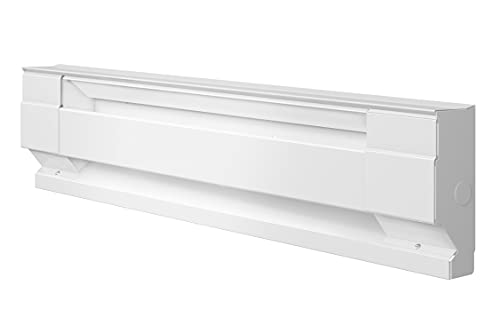
Cadet F Series 4F1000W Baseboard Heater
Aluminium fins inside a steel enclosure describe most of what the F Series does, and that design has barely changed in decades. Four feet of element at 1000 watts suits a bedroom of roughly 100 square feet. Cadet parts stay stocked at hardware stores years after purchase, which matters when an element or end cap fails.
Pros
- Replacement elements and end caps widely stocked
- No fan or blower, so operation is silent
- Standard 4 foot footprint fits under most windows
Cons
- Thermostat is not included
- Steel front panel gets hot to the touch

Fahrenheat FBE15002 Electric Baseboard Heater
Six feet of element and 1500 watts make this the output leader of the group. Living rooms and finished basements near 150 square feet stay warm from a single unit. Its 20 gauge steel housing accepts common line voltage wall thermostats, so control stays flexible.
Pros
- 1500W covers rooms the shorter picks cannot
- 20 gauge steel housing resists denting
- Works with standard line voltage wall thermostats
Cons
- Requires a dedicated 240V circuit
- Six foot body limits where it can sit

Fahrenheat PLF1004 SoftHeat Hydronic Baseboard Heater
Sealed fluid inside the element replaces bare metal fins as the heat carrier. Surface temperature stays lower, and warmth keeps radiating after the thermostat cuts power. Bedrooms and nurseries benefit most, since the scorched dust smell of glowing fins never appears.
Pros
- Lower surface temperature suits rooms with children
- Keeps radiating through the off cycle
- Almost no expansion ticking
Cons
- Takes longer to warm a cold room
- Heavier to mount than a fin unit

King Electric 4K1207BW Baseboard Heater
Rooms without a spare 240V circuit get 750 watts on ordinary household wiring here. Bathrooms, entry halls and bonus rooms are the natural fit. King’s quiet element design targets the metallic ticking that puts people off baseboard heat.
Pros
- Runs on standard 120V household wiring
- Quiet element design cuts expansion noise
- Four foot size suits small and supplementary rooms
Cons
- 750W falls short of 240V equivalents
- Not enough on its own in a cold climate

Dimplex LC Series Hydronic Baseboard Heater
Rounded end caps and a finished enclosure separate the LC Series from plain steel boxes. Inside sits the same sealed fluid principle as other hydronic units, rated 750 watts across 3.5 feet. Low surface temperature makes it a safer neighbour for bedding and curtains.
Pros
- Enclosure looks finished rather than industrial
- Steady low temperature output overnight
- Rounded ends reduce snag points
Cons
- 750W is modest for a 3.5 foot body
- Responds slower than a fin element

Marley Qmark 2500 Series Baseboard Heater
Light commercial construction shows in the heavier front panel and reinforced element mounting. Offices, workshops and rental units are where the 2500 Series turns up. Five feet at 1250 watts covers a mid sized room, and tamper resistant hardware discourages fiddling in shared spaces.
Pros
- Built for workshops and high traffic rooms
- Sold in many length and wattage variants
- Takes an integral or wall mounted thermostat
Cons
- Plain industrial styling
- Awkward to mount without a second person

Comfort Zone CZ600 Baseboard Convection Heater
Renters and anyone barred from running new cable can plug this into a normal outlet. Feet replace wall brackets, so it moves between rooms in seconds. A built in thermostat and tip over cutoff handle the safety basics, though 2.5 feet of element only supplements a room’s main heat source.
Pros
- No electrician or hardwiring needed
- Thermostat and tip over switch built in
- Moves between rooms freely
Cons
- Ties up a wall outlet while running
- Short body heats less area than hardwired units
How they compare
| # | Model | Length | Best for | Score | Price |
|---|---|---|---|---|---|
| 1 | Cadet F Series 4F1000W Baseboard Heater | 4 feet | Best overall | 9.4 | Check price |
| 2 | Fahrenheat FBE15002 Electric Baseboard Heater | 6 feet | Best value | 9.2 | Check price |
| 3 | Fahrenheat PLF1004 SoftHeat Hydronic Baseboard Heater | 4 feet | Best for gentle even warmth | 9.0 | Check price |
| 4 | King Electric 4K1207BW Baseboard Heater | 4 feet | Best for 120V circuits | 8.8 | Check price |
| 5 | Dimplex LC Series Hydronic Baseboard Heater | 3.5 feet | Best for bedrooms | 8.6 | Check price |
| 6 | Marley Qmark 2500 Series Baseboard Heater | 5 feet | Best for commercial spaces | 8.3 | Check price |
| 7 | Comfort Zone CZ600 Baseboard Convection Heater | About 2.5 feet | Best plug in alternative | 8.0 | Check price |
Common questions
How many watts of baseboard heat does a bedroom need?
Start at 10 watts per square foot, then adjust for insulation and glazing. A small bedroom usually lands between 750 and 1000 watts. A typical bedroom needs 1000 to 1500 watts. Living rooms often work better with two units than one very long heater.
What is the difference between 120V and 240V baseboard heaters?
Voltage sets how much heat a given element can produce. A 240V unit draws half the current of a 120V unit for the same output, so it delivers more watts per foot. Most 120V baseboards top out near 750 watts, while 240V models reach 1500 watts and beyond.
Can I install a baseboard heater myself?
Mounting the body to a wall is simple enough. Wiring is not, since hardwired units need a dedicated circuit and usually a line voltage thermostat. Most jurisdictions require a licensed electrician and a permit for that work.
Why does my baseboard heater tick?
Metal expands as it heats and contracts as it cools, and fins shifting against their mounts make the noise. It is normal behaviour, not a fault. Hydronic models and quiet element designs like the King Electric unit reduce it noticeably.
Are hydronic baseboard heaters more efficient than convection?
Both convert essentially all the electricity they draw into heat, so raw efficiency matches. Hydronic units can feel cheaper to run because they keep releasing warmth after the element shuts off. Smaller temperature swings mean the thermostat calls for heat less often.
Is it safe to put furniture in front of a baseboard heater?
No. Blocking the grille traps heat inside the housing and creates a fire hazard. It also stops the convection airflow the heater depends on. Keep twelve inches clear in front and never drape fabric over the top.
Why does a new baseboard heater smell on first use?
Protective oils and paint on the element cure during the first few heating cycles. Open a window and run the unit for a few hours. That smell should not return once curing finishes.
Do baseboard heaters come with a thermostat?
Most hardwired models ship without one. A line voltage wall thermostat rated for the heater’s amperage gives the most accurate control. Some units offer an integral thermostat at one end, which costs less but reads air right beside the heat source.
Which baseboard heater suits a small bathroom?
A 750 watt unit on a 120V circuit is usually enough for a bathroom under 80 square feet. Convection heat suits the room better than hydronic, because you want warmth fast rather than sustained. Keep the heater well away from the tub and follow local clearance rules.
How long do electric baseboard heaters last?
Owners report twenty years and beyond is common, helped by the absence of moving parts. Thermostats and element connections fail long before the housing does. Both are replaceable without swapping the whole heater.
Our pick
Cadet’s F Series 4F1000W covers the ordinary case: one bedroom, one 240V circuit, silent heat and parts you can still buy a decade later. Rooms past about 120 square feet do better with the 1500 watt Fahrenheat FBE15002. Choose the PLF1004 SoftHeat when steady, low temperature warmth matters more than fast response.