Jump Starters That Restart a Dead Car Battery Fast
The NOCO Boost Plus GB40 is our overall pick for its reliable cranking on typical petrol engines and genuinely idiot proof clamps. The Hulkman Alpha85 is the best value thanks to its large capacity and clear display, and the Avapow A58 is the budget choice.
The NOCO Boost Plus GB40 is the jump starter we would put in most cars, the Hulkman Alpha85 gives more capacity and a better display for the money, and the Avapow A58 covers occasional emergencies cheaply.
Jump starters are tricky because the headline peak amp figure is measured for a fraction of a second and tells you almost nothing about whether a unit will crank a cold diesel. We compared seven current models on stated engine limits, battery capacity, safety protection, build quality and what owners report after winter use.
Before you buy
Ignore peak amps, look at engine limits Peak amperage is a marketing figure measured over milliseconds and it is not comparable between brands. What matters is the stated maximum engine size, in litres, for petrol and diesel separately, and the pack’s actual capacity in milliamp hours. A unit rated for a six litre petrol engine but only a three litre diesel tells you far more than a 4000A headline. Choose based on your largest vehicle, not your smallest.
Diesels need considerably more than petrol engines Diesel engines have higher compression and draw far more current to turn over, especially when cold. If you run a diesel van or truck, step up to something like the NOCO Boost HD GB70, the GOOLOO GT4000S or the lead acid Jump-N-Carry JNC660 rather than a compact glovebox unit. Trying to start a large diesel with an undersized pack usually just drains it.
Safety features are worth more than extra amps Reverse polarity protection, spark proof clamps and short circuit cutoff turn a stressful roadside job into a routine one. NOCO’s system is the benchmark here, allowing clamps to touch without drama. A manual override mode matters too, because a battery below a few volts can be invisible to the unit’s detection circuit until you force it.
Storage, charging and cold weather Lithium jump starters lose charge slowly in storage and lose usable output in the cold, which is exactly when you need them. Top the unit up every three months, keep it in the cabin rather than the boot in winter if you can, and warm it in your hands for a minute before use on a freezing morning. Lead acid units like the JNC660 need more frequent charging but tolerate sustained cranking better.
The shortlist, ranked

NOCO Boost Plus GB40
The GB40 is the default recommendation for good reason: it starts most petrol engines up to around six litres, the clamps are heavily protected against reverse polarity and sparks, and the whole thing is small enough to live in a glovebox. A manual override handles batteries too flat for the unit to detect. Owners report it still works after years of being left in a car through hot and cold seasons.
Pros
- Very forgiving clamps and safety system
- Compact enough for a glovebox
- Manual override for deeply drained batteries
Cons
- Slow micro USB recharging
- Limited headroom for larger diesels

Hulkman Alpha85
The Alpha85 pairs a large 20000mAh pack with a clear screen showing battery percentage, output status and fault codes, which removes most of the guesswork during a roadside jump. It supports larger engines than the compact NOCO and recharges quickly over USB-C. Based on specifications it is the most capable unit here for the money.
Pros
- Screen shows charge state and faults clearly
- Handles larger engines than compact units
- Fast USB-C recharge
Cons
- Bigger and heavier than glovebox models
- Case takes up real boot space

NOCO Boost HD GB70
The GB70 is the step up for trucks, vans and larger diesels, with heavier clamps and thicker cable than the GB40. Same safety architecture, considerably more cranking headroom. Owners report it copes with cold morning starts on engines that leave smaller packs struggling.
Pros
- Real headroom for diesels and trucks
- Thick cables and substantial clamps
- Same forgiving safety system as the GB40
Cons
- Heavy for a portable unit
- Costs considerably more than the GB40

GOOLOO GT4000S
A high output pack aimed at people who deal with genuinely cold winters and larger vehicles. It doubles as a substantial power bank with USB-C fast charging in both directions. Based on specifications the extra output gives useful margin when a battery is cold soaked and internal resistance is high.
Pros
- Large output margin for cold starts
- Works well as a general power bank
- Fast recharge over USB-C
Cons
- Bulky for daily glovebox carry
- Case and cables are basic
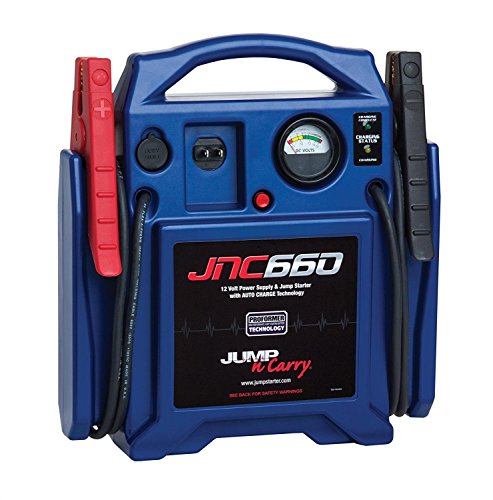
Clore Automotive Jump-N-Carry JNC660
This is the old school lead acid booster still found in garages, with long heavy cables and clamps that bite properly onto corroded terminals. It holds charge well when kept on a maintenance charger and delivers sustained cranking rather than a brief burst. Owners report it outlasts several lithium packs in commercial use.
Pros
- Sustained cranking rather than a short burst
- Long cables reach awkward battery locations
- Extremely durable in workshop use
Cons
- Heavy and not glovebox friendly
- Needs regular recharging in storage

DBPOWER 800A Portable Jump Starter
A genuinely small unit suited to compact petrol cars and motorbikes, with a built in torch that has strobe and SOS modes. It doubles as a phone charger, which is often the feature that gets used most. Based on specifications it is best kept for smaller engines rather than anything approaching a large diesel.
Pros
- Small enough for a door pocket
- Useful torch and phone charging
- Simple to operate under pressure
Cons
- Not suited to diesel engines
- Lower output leaves little margin
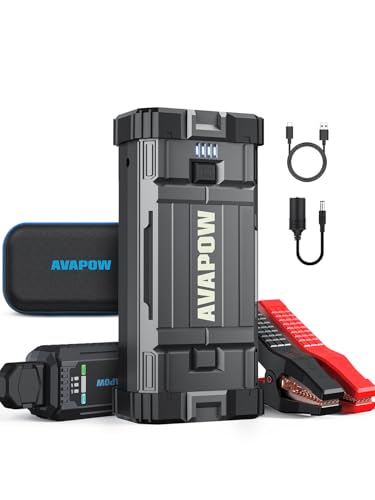
Avapow A58
The A58 undercuts most rivals while still offering enough output for typical family cars, plus reverse polarity protection and a bright work light. It ships with a case and cables, so nothing else is needed. Owners report it is a sensible emergency purchase for a second car that sits unused for weeks at a time.
Pros
- Strong output for the price
- Case and cables included
- Clear safety protections on the clamps
Cons
- Build quality trails premium brands
- Charge holds less well over long storage
How they stack up
| # | Model | Peak amps | Best for | Score | Price |
|---|---|---|---|---|---|
| 1 | NOCO Boost Plus GB40 | 1000A | Best overall | 9.4 | Check price |
| 2 | Hulkman Alpha85 | 2000A | Best value | 9.2 | Check price |
| 3 | NOCO Boost HD GB70 | 2000A | Best for big engines | 9.0 | Check price |
| 4 | GOOLOO GT4000S | 4000A | Best for cold weather | 8.7 | Check price |
| 5 | Clore Automotive Jump-N-Carry JNC660 | 1700A | Best for workshops | 8.5 | Check price |
| 6 | DBPOWER 800A Portable Jump Starter | 800A | Best compact option | 8.3 | Check price |
| 7 | Avapow A58 | 2500A | Best budget | 8.0 | Check price |
Common questions
How many amps do I actually need?
For a typical family petrol car, a unit rated around 1000A peak with a stated limit of six litres is plenty. Diesels, large trucks and cold climates justify stepping up to a 2000A or higher rated pack with a matching diesel engine limit.
Can a jump starter damage my car’s electronics?
Not if it has reverse polarity and surge protection, which all seven picks do. Damage almost always comes from connecting clamps backwards, which these units actively prevent by refusing to output power until connections are correct.
How do I connect it correctly?
Red clamp to the positive terminal, black clamp to a bare metal ground point on the engine block or chassis rather than the negative terminal. Then switch the unit on, wait for the ready indicator and crank. If it does not start within a few seconds, wait before trying again.
Will it work on a completely dead battery?
Often yes, using manual override or boost mode. Most units cannot detect a battery below a few volts and will refuse to output until you force it manually. If the battery is physically damaged or has a dead cell, no jump starter will fix it.
How often should I recharge the unit?
Every three months is a sensible routine for lithium packs, and more frequently for lead acid boosters like the JNC660, which prefer being kept topped up. A unit discovered flat during an emergency is the most common complaint owners report.
Do jump starters work in freezing conditions?
They work, but output drops as temperature falls. Choosing a pack with more capacity than you strictly need gives useful margin, and storing it inside the cabin rather than an unheated boot makes a noticeable difference on winter mornings.
Can I use one on a motorcycle or lawn mower?
Yes. Smaller engines need far less current, so even a compact unit like the DBPOWER 800A handles them easily. Just check that the clamps fit the smaller terminals without shorting against nearby metal.
Is a jump starter better than jumper cables?
For most people yes, because it does not require a second vehicle or a willing stranger. Cables remain useful as a backup and cost very little, so keeping both in the car is a reasonable approach.
Final word
The NOCO Boost Plus GB40 remains the sensible default for petrol cars, combining a compact body with the most forgiving safety system here. Step up to the Hulkman Alpha85 or the NOCO Boost HD GB70 if you run a diesel or want more cranking margin in winter. The Avapow A58 is a reasonable emergency purchase when the unit will mostly sit in a boot unused.