Battery Maintainers for Cars Left Parked for Months
The NOCO GENIUS1 is our overall pick, holding a battery at full charge safely across every common chemistry including lithium. The Battery Tender Junior remains the motorcycle standard for its simplicity, while the CTEK CT5 Time To Go tells you exactly how long is left.
For most seasonal vehicles the NOCO GENIUS1 is the maintainer to leave connected, with the Battery Tender Junior the proven motorcycle choice and the CTEK CT5 Time To Go worth the extra for its readout of remaining charge time.
A maintainer is a different tool from a charger, and buying the wrong one costs you a battery. Maintainers supply a small float current designed to offset natural self discharge indefinitely, whereas an old style trickle charger keeps pushing current whether or not the battery needs it, which slowly boils off electrolyte. We compared float outputs, supported chemistries, weatherproof ratings and harness options, then weighed those against what owners report about units that stay cool for months, indicator lights that are unreadable in daylight and clamps that corrode in an unheated garage.
Our top picks

NOCO GENIUS1 Smart Battery Charger and Maintainer
The GENIUS1 delivers 1 amp with full smart control, monitoring the battery and only supplying current when it drops, which is exactly what a stored vehicle needs. It covers 6V and 12V lead acid plus lithium iron phosphate, so it suits classic bikes and modern powersports batteries alike. The sealed weatherproof housing means it can live in an unheated garage.
Pros
- Safe to leave connected indefinitely
- Covers lithium as well as lead acid
- Sealed case handles damp garages
Cons
- Only 1 amp, so slow as a recovery charger
- Status lights are small to read at a glance

Battery Tender Junior 021-0123 Charger and Maintainer
The Junior has been the default motorcycle maintainer for years, delivering 0.75 amps and then switching to float without any input from you. The permanent ring terminal harness means winter connection is a ten second job rather than digging clamps under a seat. It is 12V lead acid only, so check before using it on a lithium powersports battery.
Pros
- Proven over many years of use
- Ring terminal harness makes reconnecting trivial
- Very low current suits small batteries
Cons
- No lithium support
- No 6V option

CTEK CT5 Time To Go Battery Charger
The CT5 Time To Go displays how long remains until the battery is fully charged, which removes the usual guessing game with blinking status lights. Its maintenance mode is designed for indefinite connection, and the reconditioning stage helps tired lead acid batteries. It costs more than most maintainers and is 12V only.
Pros
- Clear time remaining display
- Reconditioning stage for tired batteries
- Designed for permanent connection
Cons
- Higher outlay than simple maintainers
- No 6V or lithium support

NOCO GENIUS2 Smart Battery Charger and Maintainer
Doubling the output to 2 amps makes the GENIUS2 the better choice when the vehicle is a car rather than a motorcycle, since it can recover a partially drained battery in reasonable time as well as maintain it. Chemistry support and the weatherproof housing carry over from the GENIUS1. Force mode helps when a battery has dropped too low to be detected normally.
Pros
- Enough output to recover as well as maintain
- Same wide chemistry support as the GENIUS1
- Weatherproof for garage and outdoor use
Cons
- Still slow for a fully flat car battery
- Mode selection needs a look at the manual
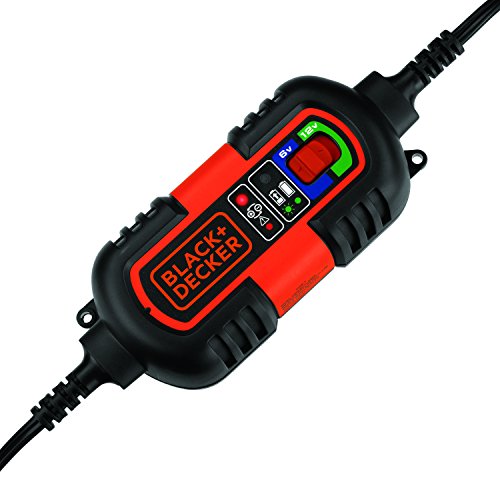
BLACK+DECKER BM3B Battery Charger and Maintainer
The BM3B does one thing well, supplying 1.5 amps of automatic maintenance for a stored car, boat or mower battery. It ships with both clamps and a ring terminal harness so you can leave the connector permanently fitted. There is no display beyond simple status lights and no lithium support.
Pros
- Low outlay for automatic maintenance
- Both harness types supplied
- Wall mount bracket built in
Cons
- Basic status indication only
- Lead acid chemistries only

Schumacher SC1319 Fully Automatic Battery Maintainer
Schumacher’s compact maintainer supplies a steady low current with automatic float and reverse hookup protection, and its low outlay makes it realistic to buy several and leave one on each stored vehicle. It works on both 6V and 12V, which is useful for older machinery. The cable is short, so plan your outlet position.
Pros
- Cheap enough to buy one per vehicle
- Handles 6V systems on older machinery
- Reverse polarity protection built in
Cons
- Short cable limits placement
- No lithium profile
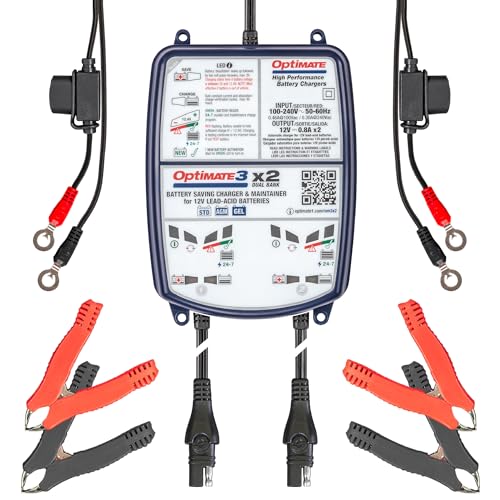
OptiMate 3 TM-431 Battery Charger and Maintainer
OptiMate builds in a desulphation and recovery sequence aimed at batteries that have been left flat, then drops into a long term maintenance cycle that tests the battery periodically rather than floating constantly. That test and top up approach is gentler over many months than continuous float. It is 12V lead acid focused and its indicator sequence takes reading up to interpret.
Pros
- Recovery sequence for deeply discharged batteries
- Tests periodically rather than floating constantly
- Sealed housing suits unheated spaces
Cons
- Indicator sequence is not self explanatory
- Lead acid only, low output
The lineup, side by side
| # | Model | Output | Best for | Score | Price |
|---|---|---|---|---|---|
| 1 | NOCO GENIUS1 Smart Battery Charger and Maintainer | 1 amp | Best overall | 9.4 | Check price |
| 2 | Battery Tender Junior 021-0123 Charger and Maintainer | 0.75 amps | Best for motorcycles | 9.2 | Check price |
| 3 | CTEK CT5 Time To Go Battery Charger | 5 amps | Best display | 9.0 | Check price |
| 4 | NOCO GENIUS2 Smart Battery Charger and Maintainer | 2 amps | Best for cars | 8.8 | Check price |
| 5 | BLACK+DECKER BM3B Battery Charger and Maintainer | 1.5 amps | Best value | 8.6 | Check price |
| 6 | Schumacher SC1319 Fully Automatic Battery Maintainer | 1.5 amps | Best for multiple vehicles | 8.3 | Check price |
| 7 | OptiMate 3 TM-431 Battery Charger and Maintainer | 0.8 amps | Best for neglected batteries | 8.0 | Check price |
Before you buy
Maintainer, trickle charger and smart charger A trickle charger pushes a fixed small current continuously whether the battery needs it or not, which over months boils off electrolyte in flooded batteries. A maintainer monitors voltage and supplies current only when it drops. A smart charger does both jobs, charging at a useful rate then dropping to maintenance. For a stored vehicle you want the second or third of those, never the first.
Match the chemistry, especially with lithium Lithium iron phosphate batteries, now common in powersports, must not be held at a float voltage the way lead acid can. Using a lead acid maintainer on one shortens its life or damages it. The NOCO GENIUS1 and GENIUS2 include a dedicated lithium mode. AGM batteries also want a slightly higher absorption voltage than flooded, so check that setting exists.
Fit a permanent harness The reason maintainers end up unused is the faff of opening the bonnet and attaching clamps every time. A ring terminal harness bolted to the battery with a weatherproof connector left hanging by the fairing or bumper turns the job into plugging in a lead. Most units, including the Battery Tender Junior and BLACK+DECKER BM3B, include one in the box.
Where you put it matters Unheated garages get damp, and condensation inside a non sealed unit is a common failure. Sealed weatherproof housings such as those on the NOCO and OptiMate units handle this. Mount the maintainer on a wall rather than the floor, keep the cable clear of hot exhaust parts, and connect the negative lead to a chassis ground rather than the battery terminal to keep any spark away from the battery.
Common questions
What is the difference between a maintainer and a charger?
A charger replaces significant capacity at meaningful current. A maintainer supplies only enough to offset self discharge and is designed to stay connected for months. Many modern units such as the NOCO GENIUS2 do both automatically.
Can I leave a battery maintainer connected all winter?
Yes, that is exactly what they are built for. Smart maintainers monitor voltage and only supply current when the battery drops, so there is no risk of overcharging as there was with old trickle chargers.
Will a maintainer work on a lithium battery?
Only one with a lithium mode, such as the NOCO GENIUS1. Lithium iron phosphate packs must not be held at a lead acid float voltage, so using the wrong unit shortens their life.
How long before a parked car battery goes flat?
Often four to eight weeks, sooner in cold weather or on a car with alarms and telematics drawing current continuously. That parasitic draw is the reason maintainers exist.
Do I need to disconnect the battery from the vehicle?
No. Maintainers are designed to work with the battery in place, which also preserves stored settings. Connect the positive lead first and the negative to a chassis ground.
Can one maintainer look after several vehicles?
Only one at a time. Fitting a ring terminal harness to each vehicle lets you move a single unit between them, though inexpensive maintainers such as the Schumacher SC1319 make one per vehicle realistic.
Will a maintainer revive a completely dead battery?
Rarely on its own, since low output units often cannot detect a very low battery. The OptiMate 3 and NOCO force mode are designed for exactly this case, but a battery with a shorted cell is beyond recovery.
Is it safe to use a maintainer in a closed garage?
Yes, with sensible precautions. Flooded batteries can vent hydrogen during charging, so allow some ventilation, keep the unit off the floor and use a sealed weatherproof model in damp spaces.
Our pick
The NOCO GENIUS1 is the maintainer we would fit to most stored vehicles, because it covers every common chemistry including lithium and its sealed case copes with an unheated garage. Motorcyclists who only ever run lead acid batteries will do fine with the cheaper Battery Tender Junior, and the CTEK CT5 Time To Go earns its extra outlay if you want to know exactly where the battery stands. Fit a permanent ring harness whichever you choose.

