Which Early Reading Toy Fits Your Child’s Stage
LeapFrog LeapStart 3D leads this list with its expanding phonics library and talking stylus for kids ready to tap through interactive books. Melissa & Doug See & Spell offers the strongest screen-free option, and Skillmatics Alphabet Learning Letter Safari suits tighter budgets. Together they span electronic and hands-on paths into early reading.
Reading toys split into three learning stages: letter recognition, phonics sounds, and sight-word memory. LeapFrog LeapStart 3D covers the widest span of these stages through its expanding book library, while screen-free picks like Melissa & Doug See & Spell teach spelling with zero batteries.
Age labels, learning focus, and power requirements vary widely across current Amazon listings, which makes the choice tricky. We compared listed specifications, stated age ranges, and owner feedback across seven distinct picks to cover both electronic and screen-free paths.
The best picks, ranked

LeapFrog LeapStart 3D Interactive Learning System
A tap pen reads words aloud the moment a child touches a page in the LeapStart 3D library. Books sold separately expand the system from letters through early phonics. Kids ages 2 to 7 can grow with the same console for years.
Pros
- Book library expands the system well past toddler years
- Talking stylus pronounces each word without waiting on a parent
- Auto shutoff extends runtime on 3 AAA batteries
Cons
- Extra books cost more on top of the console price
- Batteries are not included in the box

LeapFrog Fridge Phonics Magnetic Letter Set
Ten magnetic letters snap into a talking learning house built for toddlers as young as 18 months. Dropping a letter in triggers its name and sound. A built-in sing-along song repeats the alphabet sequence for toddlers who want to hear it again.
Pros
- Chunky letters fit small hands still building grip strength
- Auto shutoff conserves the two AA batteries between sessions
- Magnets double as fridge decorations after playtime ends
Cons
- Only 10 letters ship in the set, not a full alphabet
- Volume stays fixed on some units, with no adjustment
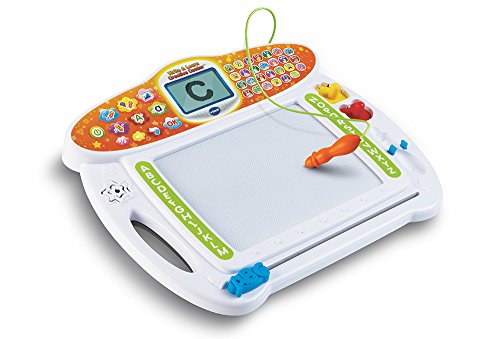
VTech Write and Learn Creative Center
Kids trace letters on a double-sided board while the toy narrates each shape aloud. Built-in games add spelling, counting, and free drawing beyond tracing. Ages 3 to 6 wipe the reusable screen clean for another round.
Pros
- Reusable screen skips paper entirely for repeat practice
- Multiple modes cover more than letter tracing alone
- Tethered stylus stays attached so it will not go missing
Cons
- Traced lines fade faster than fresh markings over time
- Two AA batteries are required but not included
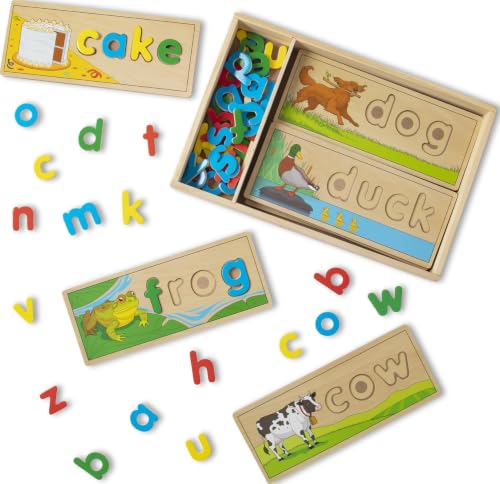
Melissa & Doug See & Spell Wooden Puzzle
Wooden letter tiles slot beneath picture cards to spell out ten common words. No batteries or screens enter the equation here. Kids ages 3 to 6 self-correct by matching tile shapes to the blank spaces.
Pros
- Zero batteries or screens keep play fully analog
- Self-correcting design shows the right letter shape immediately
- Solid wood construction survives years of repeat play
Cons
- Ten preset words limit vocabulary variety over time
- No audio feedback for kids who prefer sound cues

Learning Resources Sight Word Swat a Sight Words Game
Two foam swatters and 34 double-sided cards drill 68 common sight words through a fast-paced matching game. Calling out a word sends players racing to swat the right card. Solo drilling works just as well as group play for ages 5 and up.
Pros
- 68 sight words give plenty of material to rotate through
- Foam swatters keep active play safe indoors
- One player or several can use the same set
Cons
- Kids need some reading skill already to benefit
- Cardstock cards bend after heavy repeated use

Skillmatics Educational Game: Alphabet Learning Letter Safari
Picture and letter cards turn alphabet recognition into a safari-themed matching game for ages 3 to 6. Several game variations extend replay as skills improve. A compact reusable box keeps every piece organized between sessions.
Pros
- Lower price than most electronic alternatives on this list
- Several game modes ship inside one box
- Compact case makes the set easy to travel with
Cons
- No audio component supports independent play
- Card durability depends on how carefully kids handle them

Educational Insights Hot Dots Jr. Let’s Master Phonics Set
An interactive pen pairs with two workbooks covering beginning sounds and letter blends for ages 4 to 6. Touching a correct answer dot triggers a cheerful chime. Wrong answers prompt the pen to encourage another attempt.
Pros
- Instant audio feedback reinforces correct answers right away
- Two workbooks focus specifically on phonics blends
- Playful sound effects add motivation to repeat practice
Cons
- Workbook pages get used up rather than reused long-term
- Two AA batteries are required but not included
Before you buy
What Should You Look For in an Early Reading Toy? Age fit matters more than flashy features when choosing a reading toy. Check whether a toy targets letter recognition, phonics, or sight words, since those skills build in that order. Some toys speak answers aloud, while others rely on a child checking shapes visually. Wood and thick plastic tend to outlast thin cardstock for toddlers who mouth or drop toys often.
Phonics Toys vs Sight-Word Games: What’s the Difference? Letter sounds and blends form the core of phonics instruction, helping kids sound out words they have never seen. Sight-word games instead drill whole words like ‘the’ and ‘and’ that skip standard phonics rules. Toddlers usually start with phonics and letter names first. Kids closer to kindergarten benefit more from sight-word repetition, and many families use both approaches side by side.
Screen-Free Toys vs Electronic Reading Toys Talking pens and phonics consoles give instant audio feedback without an adult narrating every page. That convenience adds battery costs and, in some cases, ongoing purchases of extra books or cards. Wooden puzzles and card games cost less upfront and skip batteries entirely, but a parent or sibling still needs to check the child’s answers. Neither approach wins outright; the choice comes down to how much hands-on involvement a caregiver wants.
Which Reading Toy Fits Your Child’s Age Stage? Toddlers around 18 months do best with chunky magnetic letters and simple cause-and-effect sound buttons, since fine motor control is still developing. Tracing boards, wooden spelling puzzles, and matching card games suit kids between 3 and 4 years, who can handle more precision. Sight-word games and phonics workbooks push preschoolers near kindergarten, roughly 5 and up, toward independent reading. Picking a toy a year or two above a child’s current stage often causes frustration instead of progress.
Compared at a glance
| # | Model | Age range | Best for | Score | Price |
|---|---|---|---|---|---|
| 1 | LeapFrog LeapStart 3D Interactive Learning System | 2 to 7 years | Best overall | 9.4 | Check price |
| 2 | LeapFrog Fridge Phonics Magnetic Letter Set | 18 months to 4 years | Best for toddlers 18 months and up | 9.1 | Check price |
| 3 | VTech Write and Learn Creative Center | 3 to 6 years | Best for letter tracing and writing practice | 8.8 | Check price |
| 4 | Melissa & Doug See & Spell Wooden Puzzle | 3 to 6 years | Best screen-free option | 8.5 | Check price |
| 5 | Learning Resources Sight Word Swat a Sight Words Game | 5 years and up | Best for sight words | 8.3 | Check price |
| 6 | Skillmatics Educational Game: Alphabet Learning Letter Safari | 3 to 6 years | Best budget | 8.1 | Check price |
| 7 | Educational Insights Hot Dots Jr. Let’s Master Phonics Set | 4 to 6 years | Best interactive electronic pen set | 8.0 | Check price |
Common questions
What age should a child start using reading toys?
Phonics toys aimed at letter sounds and names often start at 18 months. Sight-word and workbook-style toys usually target ages 4 to 6, closer to kindergarten reading skills.
How do phonics toys differ from sight-word games?
Phonics toys teach the sounds letters and blends make so kids can sound out new words. Sight-word games drill memorization of common words that skip regular phonics rules, like ‘said’ or ‘they’.
Which reading toy works best for a toddler around 18 months?
LeapFrog Fridge Phonics Magnetic Letter Set fits that age well. Chunky magnetic letters and a simple drop-in action match a toddler’s developing motor skills and short attention span.
Can screen-free toys teach reading as effectively as electronic ones?
Screen-free toys like wooden spelling puzzles depend on a caregiver checking answers, while electronic toys give feedback on their own. Both formats reinforce the same letter and word skills; adult involvement is the real difference.
Is a talking pen system worth it for early reading practice?
A pen-based system like Hot Dots Jr. gives immediate right-or-wrong feedback, letting a child practice phonics blends without constant supervision. It works best paired with its matching workbooks rather than alone.
What is the best reading toy for a preschooler starting kindergarten prep?
Learning Resources Sight Word Swat and Educational Insights Hot Dots Jr. both target the sight-word and phonics-blend skills expected going into kindergarten.
Do reading toys require ongoing purchases like extra books or cards?
LeapFrog LeapStart 3D and the Hot Dots Jr. phonics pen both rely on separate books or workbooks that get consumed over time. Wooden puzzles and card-based games like See & Spell or Letter Safari are one-time purchases.
How many batteries do most electronic reading toys need?
Most electronic options here run on 2 or 3 AA or AAA batteries, typically not included in the box. Battery-free choices like wooden puzzles and card games skip this cost entirely.
Are wooden reading toys better than plastic electronic ones?
Wooden toys last longer and never need batteries, but they lack the audio feedback electronic consoles provide. Durability favors wood; independent feedback favors electronics.
Our pick
No single reading toy fits every child, since phonics, sight words, and letter recognition develop at different ages. Families wanting an expandable system tend to prefer LeapFrog LeapStart 3D, while those wanting a screen-free option lean toward Melissa & Doug See & Spell. Matching a toy to a child’s current stage matters more than chasing the flashiest option.