Toy Kitchens Kids Keep Playing With Past Week One
The KidKraft Uptown Espresso Wooden Play Kitchen leads on size, storage and long term play value. The Step2 Best Chefs Kitchen Playset is the easiest to assemble and clean for younger toddlers, while the Melissa and Doug Wooden Chef’s Kitchen suits smaller rooms.
The KidKraft Uptown Espresso Wooden Play Kitchen is the pick for most families because its scale and storage keep children engaged for years, while the Step2 Best Chefs Kitchen is easier for toddlers and wipe clean, and the Melissa and Doug Wooden Chef’s Kitchen fits rooms where floor space is scarce.
Play kitchens are harder to choose than they look, because the two things that decide whether one gets used, counter height relative to the child and how much play food it holds, are rarely the things listed first on a product page. We compared overall dimensions, counter height, material, included accessories, assembly time reported by owners and how well each holds up to shared use between siblings, and gave weight to models children keep returning to rather than ones that photograph well.
The best picks, ranked

KidKraft Uptown Espresso Wooden Play Kitchen
This is the model that keeps working as a child grows, with a counter height that suits a three year old and still works at six, plus enough cupboards and shelving to absorb a growing play food collection. The chrome effect taps and door handles feel closer to real fittings than moulded plastic, which is a large part of the appeal. Assembly is the price you pay, and owners describe it as a long evening.
Pros
- Scale and storage keep it relevant for years
- Realistic fittings and doors that open properly
- Sturdy enough for two children playing at once
Cons
- Assembly takes a long time
- Large footprint needs a dedicated corner
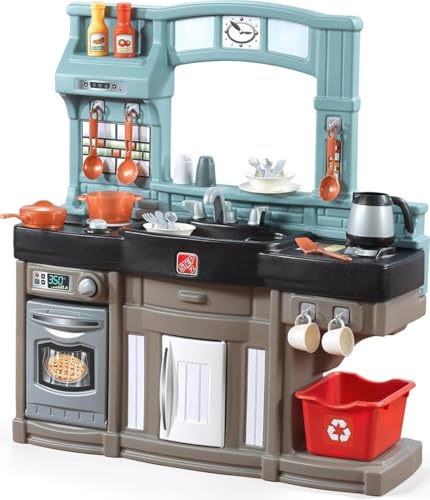
Step2 Best Chefs Kitchen Playset
Moulded plastic construction makes this the practical choice for the youngest age group, since there are no sharp edges, nothing to splinter and the whole thing wipes down after a snack incident. It ships with a generous accessory set, so play starts immediately rather than after a second shopping trip. Owners report assembly is far quicker than wooden rivals.
Pros
- Fast assembly and easy to clean
- Comes with plenty of accessories
- Rounded edges suit younger toddlers
Cons
- Plastic look is less appealing in a living room
- Less storage than wooden models

Melissa and Doug Wooden Chef’s Pretend Play Toy Kitchen
Melissa and Doug keep this narrow enough to sit against a wall in a normal sized room while still offering an oven, sink and hob. The doors and knobs turn and click convincingly, which is what sustains pretend play. Storage is more limited than the KidKraft, so plan on a nearby basket if the play food collection grows.
Pros
- Fits rooms where a full kitchen will not
- Satisfying clicking knobs and working doors
- Solid wood construction
Cons
- Limited internal storage
- Fewer accessories included than plastic rivals

Hape Gourmet Kitchen Wooden Play Set
Hape designs with an adult eye, so this looks like furniture rather than a toy, which matters when the kitchen lives in a shared family room. Details such as the turning oven dial and the removable sink basin are well executed. It sits at the higher end of the range and comes with fewer accessories than the plastic sets, so budget for play food separately.
Pros
- Attractive enough for a shared living space
- Well executed working details
- Removable sink basin makes cleaning easy
Cons
- Fewer accessories in the box
- Higher price than similarly sized rivals

Little Tikes Cook ‘n Grow Kitchen
The clever idea here is a counter that can be reconfigured to a taller setting as the child grows, which addresses the main reason play kitchens get abandoned. Plastic construction keeps it light and easy to wipe down. The accessory set is decent, though the overall look is plainer than the wooden options.
Pros
- Adjusts as the child gets taller
- Light and easy to move or clean
- Simple assembly
Cons
- Plain appearance compared with wooden sets
- Reconfiguring the height takes effort

Teamson Kids Little Chef Florence Classic Play Kitchen
Teamson delivers the wooden look and working doors at a noticeably lower outlay than the premium brands, which makes it the sensible pick if wood matters but budget is tight. The finish is thinner than KidKraft or Hape, so it shows knocks sooner. Owners report the structure itself holds up fine to normal play.
Pros
- Wooden construction at a lower cost
- Several finishes to match a room
- Reasonable storage for the size
Cons
- Surface finish marks more easily
- Instructions are less clear than premium brands

Step2 Grand Walk-In Kitchen and Grill
This is a corner filling playset rather than a single unit, with a walk in layout that lets two or three children play without elbowing each other. The accessory count is the highest here, which is part of why it works for group play. The obvious constraint is space, since it needs a genuinely large area to make sense.
Pros
- Room for multiple children at once
- Huge accessory set included
- Durable plastic suits indoor or covered outdoor use
Cons
- Requires a very large play area
- Bulky to move or store
The lineup, side by side
| # | Model | Material | Best for | Score | Price |
|---|---|---|---|---|---|
| 1 | KidKraft Uptown Espresso Wooden Play Kitchen | Engineered wood | Best overall | 9.4 | Check price |
| 2 | Step2 Best Chefs Kitchen Playset | Moulded plastic | Best for toddlers | 9.2 | Check price |
| 3 | Melissa and Doug Wooden Chef’s Pretend Play Toy Kitchen | Wood | Best for small spaces | 9.0 | Check price |
| 4 | Hape Gourmet Kitchen Wooden Play Set | Wood with painted finish | Best design quality | 8.8 | Check price |
| 5 | Little Tikes Cook ‘n Grow Kitchen | Plastic | Best for growing children | 8.6 | Check price |
| 6 | Teamson Kids Little Chef Florence Classic Play Kitchen | Engineered wood | Best value wooden kitchen | 8.3 | Check price |
| 7 | Step2 Grand Walk-In Kitchen and Grill | Moulded plastic | Best for two children | 8.0 | Check price |
Before you buy
Counter height is the specification that decides everything A play kitchen at the wrong height either forces a toddler onto tiptoes or has a five year old crouching, and either way the toy stops getting used. Measure from the floor to your child’s waist and look for a counter close to that, allowing a little room to grow. Most wooden kitchens sit in a range that suits ages three to six, while toddler focused plastic sets sit lower. The Little Tikes Cook ‘n Grow addresses this directly with an adjustable counter, which is worth considering if you want one purchase to last.
Wood versus plastic Wooden kitchens look better in a shared room, feel more substantial and generally offer more real storage. Plastic kitchens assemble faster, wipe clean completely, weigh less and cost less, and they tolerate juice spills and outdoor use in a way that engineered wood does not. Families with children under three often find plastic more practical, while those buying for a three to six year old in a family room usually prefer wood. Neither is more durable in absolute terms, since both hold up well to normal play.
Storage and accessories drive how long play lasts The kitchen itself is only the stage, and how long a child stays interested depends heavily on what they can put in it. Models with real cupboards, shelves and a fridge compartment absorb a growing collection of play food, pots and utensils, which keeps play evolving. Models with a shallow footprint fill up quickly and the extras end up scattered across the room. If you choose a compact kitchen, plan on a basket or a low shelf nearby from the start.
Budget realistic time for assembly Wooden play kitchens routinely involve dozens of panels, cam locks and small screws, and owner reports commonly describe two or more hours for the larger models. That is worth knowing before a birthday morning. Plastic sets snap together in a fraction of the time. Whatever you buy, assemble on carpet or a blanket to avoid scratching panels, sort the hardware before starting, and keep the spare fixings, since a loose cam lock two years later is easy to fix if you still have the parts.
Common questions
What age is a toy kitchen best for?
Most children engage strongly with pretend cooking between roughly two and six years old. Younger toddlers do better with lower, simpler plastic sets, while three to six year olds get the most from larger wooden kitchens with real storage.
Are wooden or plastic play kitchens better?
Wood generally offers more storage and looks better in a family room. Plastic assembles faster, wipes clean completely and costs less. For under threes and for anywhere spills are likely, plastic is the more practical choice.
How much space does a play kitchen need?
Compact wooden models such as the Melissa and Doug Chef’s Kitchen sit against a wall in a normal room. Large sets like the Step2 Grand Walk-In Kitchen and Grill need a corner of a playroom. Measure the space including room for a child to stand and open doors before ordering.
Do play kitchens come with accessories?
It varies significantly. Plastic sets from Step2 usually include a generous starter set of pots, utensils and play food. Wooden kitchens from Hape and Melissa and Doug often include few or none, so budget for accessories separately.
How long does assembly take?
Owners commonly report two hours or more for large wooden kitchens such as the KidKraft Uptown Espresso, and well under an hour for plastic sets. Sorting the hardware before you start and working on carpet makes a noticeable difference.
Can a play kitchen be used outdoors?
Plastic models from Step2 and Little Tikes tolerate covered outdoor use, though prolonged sun will fade them. Wooden kitchens use engineered board that swells if it gets damp, so they should stay indoors.
Will two children play at one kitchen?
Standard single units work for two children taking turns but get crowded. If you specifically want simultaneous play, a walk in layout such as the Step2 Grand Walk-In gives each child their own station.
How do I keep a play kitchen tidy?
Choose a model with genuine cupboard space, then add a low basket for overflow so tidying is a single scoop rather than a sorting task. Children are far more likely to put things away when the storage is at their height and does not require precision.
Final word
The KidKraft Uptown Espresso Wooden Play Kitchen is the one most families should buy, because the combination of counter height, storage and realistic fittings keeps children coming back well past the novelty stage. For under threes or for anywhere spills are inevitable, the Step2 Best Chefs Kitchen is the more practical choice and assembles in a fraction of the time. If floor space is the constraint, the Melissa and Doug Wooden Chef’s Kitchen delivers most of the play value in a much narrower footprint.


