Bench Grinding Wheels for Sharpening and Shaping
The Norton 3X Bench Grinding Wheel is the best all round choice because its ceramic alumina grain cuts cool enough for tool steel. The Norton 38A White Aluminum Oxide Wheel is the traditional pick for chisels and plane irons, and the POWERTEC White Aluminum Oxide Wheel offers similar behaviour for far less.
For a bench grinder that sharpens rather than ruins edge tools, the Norton 3X Bench Grinding Wheel, Norton 38A White Aluminum Oxide Wheel and POWERTEC White Aluminum Oxide Bench Grinding Wheel are the three that matter. The choice comes down to how cool you need the wheel to run and how much you want to spend.
The confusion here is that most bench grinders ship with grey aluminium oxide wheels that are too hard and too coarse for sharpening, which is why so many people burn their first chisel. Abrasive type, grit, bond hardness and wheel width all change the result more than the grinder does. We compared abrasive materials, published grit and hardness grades, arbor compatibility and what owners report about heat and wheel loading.
How to pick the right one
Pick the abrasive to match the metal Aluminium oxide, in grey, pink or white forms, is the right abrasive for steel and steel alloys. White is the softest bonded and coolest cutting, which is why it suits hardened tool edges. Silicon carbide belongs on carbide tooling, cast iron and non ferrous metals such as aluminium and brass, where aluminium oxide clogs. Ceramic alumina sits at the top for cutting rate and cool running. Using the wrong abrasive is the most common reason a wheel refuses to cut.
Grit and hardness grade both matter Grit is the particle size and controls the finish. Around 36 to 60 grit suits shaping and heavy removal, 80 to 120 suits sharpening, and finer grits are for finishing before honing. Hardness grade, shown as a letter in the wheel marking, describes how tightly the grain is held. A softer grade releases worn grain sooner and runs cooler. For edge tools you want a fine grit and a soft grade, which is exactly what a white wheel provides.
Heat is what destroys tool steel Once the edge turns blue, the temper is gone and that steel will not hold an edge again until you grind past the damaged section. Prevent it by using light pressure, moving the tool constantly across the wheel face, dressing the wheel when it glazes and dipping in water frequently. Fitting a cool running wheel and slowing the grinder both help, but technique matters as much as equipment.
Check the arbor, speed rating and mounting before fitting Wheels are sold in a diameter, a width and an arbor hole size, usually with bushings for smaller shafts. Confirm the wheel’s maximum safe speed exceeds your grinder’s rated speed, since most bench grinders run at a high fixed speed. Inspect for cracks, use the paper blotters between the wheel and the flanges, do not overtighten the nut, and stand aside for the first minute of running. Dress a new wheel true before real work.
The best picks, ranked

Norton 3X Bench Grinding Wheel
Blue ceramic alumina grain that fractures as it wears, constantly exposing fresh cutting edges instead of glazing over. That self sharpening behaviour is what keeps the steel cool. Owners report it removes metal noticeably faster than grey wheels while generating less heat at the edge.
Pros
- Cuts fast while running cool
- Resists glazing better than grey wheels
- Long service life for the removal rate
Cons
- Costs several times a basic grey wheel
- Wears faster than hard bonded wheels

Norton 38A White Aluminum Oxide Grinding Wheel
The classic white wheel, softly bonded so the grain breaks away before it can heat the workpiece. It is the traditional answer to bluing tool edges on a grinder. Owners report it needs dressing more often than grey wheels, which is the trade off for the cool cut.
Pros
- Very low heat build up
- Ideal for hardened edge tools
- Consistent, predictable cutting
Cons
- Wears and needs dressing frequently
- Too soft for heavy stock removal

POWERTEC White Aluminum Oxide Bench Grinding Wheel
A white wheel with the same basic behaviour as premium options at a much friendlier outlay, sold in the common grits and diameters. Bushings for different arbor sizes are included. Based on specifications it is the sensible first upgrade from the grey wheel that came with your grinder.
Pros
- Big improvement over stock grey wheels
- Bushings cover most arbor sizes
- Available in fine sharpening grits
Cons
- Less consistent bonding than premium wheels
- Some units need truing out of the box

CGW Camel Grinding Wheels White Aluminum Oxide Wheel
Available in finer grits than most bench wheels, which suits final shaping before you move to stones or a strop. The bond is soft enough to keep the wheel cutting rather than burnishing. Owners report good roundness and low vibration, which matters on a light bench grinder.
Pros
- Fine grits for finishing work
- Runs true with little vibration
- Predictable cutting behaviour
Cons
- Fine grits load quickly on soft metals
- Not intended for heavy grinding

Forney Silicon Carbide Bench Grinding Wheel
Silicon carbide is the right abrasive for carbide tooling, cast iron and non ferrous metals, where aluminium oxide simply loads up. It is the wrong wheel for steel tools. Based on specifications this is a specialist addition rather than a general purpose wheel.
Pros
- Correct abrasive for carbide tooling
- Handles aluminium and brass without clogging
- Cuts cast iron cleanly
Cons
- Poor choice for hardened steel
- Wears quickly under heavy pressure
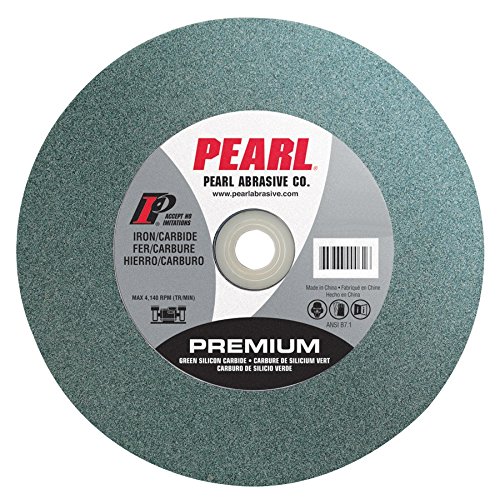
Pearl Abrasive BG Series Bench Grinding Wheel
A general purpose aluminium oxide wheel for deburring, rough shaping and shop maintenance jobs where a cool cut is not critical. It holds shape well under pressure. Owners report it is the wheel to keep on one side of the grinder for dirty work.
Pros
- Holds its shape under pressure
- Good for deburring and rough work
- Long life on general steel
Cons
- Generates more heat than white wheels
- Will glaze if pushed too hard
Woodstock White Aluminum Oxide Grinding Wheel
An inexpensive white wheel that still gets you away from the heat problems of stock grey wheels. Consistency varies more than premium options, so a dressing before first use is worthwhile. Owners report it performs well once trued, which is standard practice for any new wheel anyway.
Pros
- Cheapest way to escape grey wheel burning
- Standard grits and sizes
- Bushings included
Cons
- Usually needs truing before use
- Shorter working life than premium wheels
Compared at a glance
| # | Model | Abrasive | Best for | Score | Price |
|---|---|---|---|---|---|
| 1 | Norton 3X Bench Grinding Wheel | Ceramic alumina | Best overall | 9.4 | Check price |
| 2 | Norton 38A White Aluminum Oxide Grinding Wheel | White aluminium oxide | Best for chisels and plane irons | 9.2 | Check price |
| 3 | POWERTEC White Aluminum Oxide Bench Grinding Wheel | White aluminium oxide | Best value | 9.0 | Check price |
| 4 | CGW Camel Grinding Wheels White Aluminum Oxide Wheel | White aluminium oxide | Best for a fine edge | 8.8 | Check price |
| 5 | Forney Silicon Carbide Bench Grinding Wheel | Silicon carbide | Best for carbide and non ferrous metals | 8.6 | Check price |
| 6 | Pearl Abrasive BG Series Bench Grinding Wheel | Aluminium oxide | Best for general shop use | 8.3 | Check price |
| 7 | Woodstock White Aluminum Oxide Grinding Wheel | White aluminium oxide | Best budget | 8.0 | Check price |
Frequently asked questions
Why does my grinder keep burning my chisels?
Almost certainly the hard grey wheel that came with it, combined with heavy pressure. Switch to a white or ceramic alumina wheel in a finer grit, use light pressure, keep the tool moving and cool it often.
What grit should I use for sharpening?
Around 60 grit for reshaping a damaged edge and 80 to 120 for sharpening. Finish on stones or a strop, since even a fine bench wheel leaves a coarser edge than hand honing.
What is the difference between grey, pink and white wheels?
They are all aluminium oxide with different purity and bonding. Grey is hardest and hottest, suited to rough steel work. Pink sits in the middle. White is the softest and coolest, and it is the one to use on hardened tools.
Do I need to dress a new wheel?
Yes. Dressing trues the wheel so it runs concentric and exposes fresh grain. It also cures much of the vibration people blame on the grinder. Dress again whenever the face glazes or loads up.
How do I know when to replace a wheel?
Replace it when the diameter has worn substantially, when dressing no longer restores a clean cutting face, or at any sign of a crack or chip. Ring test a wheel before fitting by tapping it lightly and listening for a clear tone.
Can I grind aluminium on a bench grinder?
Not on an aluminium oxide wheel, since it loads immediately and can be dangerous. Use a silicon carbide wheel or a different method entirely for soft non ferrous metals.
Does a slow speed grinder make a difference?
It reduces heat build up meaningfully and gives you more time to react, which is why slow speed grinders are popular for sharpening. A cool running wheel on a standard grinder is a cheaper route to a similar result.
How tight should the wheel nut be?
Firm, not forced. Overtightening stresses the wheel and is a known cause of cracking. Always fit the paper blotters and the correct flanges, and never run a wheel without them.
The bottom line
The Norton 3X Bench Grinding Wheel is the best all round upgrade because the ceramic alumina grain cuts quickly without heating the edge, which is exactly what stock grey wheels get wrong. Traditional woodworkers will be happy with the Norton 38A White Aluminum Oxide Wheel for chisels and plane irons. If you simply want the burning to stop without spending much, the POWERTEC White Aluminum Oxide Wheel is the pragmatic answer.


