Benchtop Drill Presses Worth Space On Your Bench
The WEN 4214T is the best all-around benchtop drill press thanks to its variable speed and digital readout, the WEN 4208T is the easiest low-cost entry for light hobby work, and the SKIL 3320-01 lands the sweet spot for value with a built-in laser guide.
For most home shops the WEN 4214T is the standout benchtop drill press, offering variable speed and a digital depth readout, while the WEN 4208T covers basic hobby drilling cheaply and the SKIL 3320-01 balances features and price with a handy laser guide.
Choosing a benchtop drill press is tricky because a low price can hide a wobbly table, weak motor or awkward speed changes that show up only once you start drilling. We compared these seven using published specifications, motor and swing figures, and what long-term owners report about accuracy and build quality.
How to pick the right one
Power and swing come first Motor power decides how easily the press bores through thick or hard material, while swing, the distance from the bit to the column, sets how wide a workpiece you can center a hole in. Light hobby work is fine with a smaller motor and modest swing, but metalwork and larger panels reward more power and a bigger swing so you are not fighting the tool.
Variable speed versus belt changes Different bits and materials call for different speeds. Variable-speed models let you turn a knob to adjust RPM instantly, which is convenient when you switch tasks often. Belt-driven presses cost less but require you to move a belt between pulleys to change speed. If you frequently jump between wood, metal and plastic, variable speed saves real time.
Table quality and accuracy A flat, rigid cast-iron table that tilts and locks squarely is essential for clean, straight holes. Look for a table that adjusts smoothly, holds its setting under load and has slots or a fence for clamping. A depth stop that repeats reliably lets you drill consistent holes across many parts, which matters for cabinetry and jig work.
Extras that earn their keep Laser guides, work lights and digital readouts speed up setup and improve accuracy, though a laser needs occasional recalibration to stay trustworthy. Some presses double as spindle sanders for extra versatility. Weigh these features against price and bench space, since a simple, well-built press often beats a feature-packed but flimsy one for everyday drilling.
The shortlist, ranked
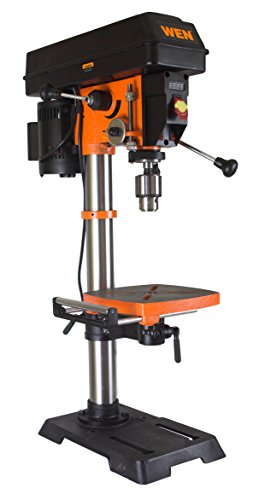
WEN 4214T
The 4214T uses infinitely variable speed so you can dial in the right RPM by turning a knob instead of moving belts. A digital readout shows speed and a depth gauge helps repeat holes, making it a versatile centerpiece for a mixed wood and metal shop.
Pros
- Variable speed with no belt swapping
- Digital speed and depth readout
- Large cast table with tilt
Cons
- Heavier and pricier than basic models
- Larger footprint on the bench

WEN 4208T
The compact 4208T covers the essentials for hobby drilling at a low cost. It uses a five-speed belt system and a small footprint, so it fits tight benches and suits occasional woodworking, light metal and household projects.
Pros
- Very affordable entry point
- Compact and lightweight
- Simple to set up and use
Cons
- Limited power for thick metal
- Small table and short spindle travel

SKIL 3320-01
The 3320-01 pairs a solid five-speed setup with a built-in laser that crosses over your mark for faster alignment. Its X2 laser and tilting table make it a popular midrange pick for hobbyists who want accuracy without a big outlay.
Pros
- Built-in laser speeds up alignment
- Sturdy cast-iron table
- Approachable price for the features
Cons
- Belt changes needed to switch speed
- Laser needs occasional recalibration
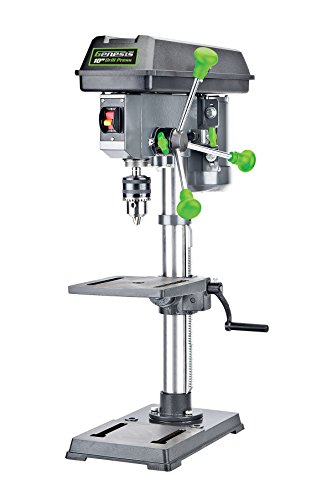
Genesis GDP1005A
The GDP1005A packs a five-speed setup and a work light into a small chassis. It is a practical choice for cramped garages and apartments where bench space is tight but you still want a real drill press instead of a handheld drill.
Pros
- Compact footprint for small shops
- Integrated work light
- Reasonable power for the size
Cons
- Table is on the small side
- Fit and finish is basic

Shop Fox W1668
The W1668 doubles as a drill press and oscillating spindle sander, and its heavier build steadies deeper cuts in metal and hardwood. Woodworkers value the added sanding function, while the sturdy table and quill handle repeat drilling well.
Pros
- Doubles as an oscillating spindle sander
- Heavy, stable build
- Strong motor for tougher materials
Cons
- Heavier and takes more bench space
- Belt changes to alter speed

JET JWDP-12
The JWDP-12 is built for accuracy with a smooth variable-speed system, digital readout and a well-machined table. It is aimed at serious hobbyists and small pro shops that want repeatable precision and are willing to invest for it.
Pros
- Smooth variable speed and digital display
- Precise, well-machined table
- Strong reputation for reliability
Cons
- Premium price versus rivals
- Overkill for occasional light drilling

CRAFTSMAN CMEW320
The CMEW320 offers a familiar brand, a laser guide and a five-speed range in a manageable size. It suits weekend woodworkers who want a dependable, no-fuss drill press with recognizable support behind it.
Pros
- Laser guide for quick alignment
- Familiar brand and support
- Manageable size for home benches
Cons
- Belt swaps to change speed
- Table adjustments feel basic
Side by side
| # | Model | Swing | Best for | Score | Price |
|---|---|---|---|---|---|
| 1 | WEN 4214T | 12 inch | Best overall | 9.3 | Check price |
| 2 | WEN 4208T | 8 inch | Best budget | 8.5 | Check price |
| 3 | SKIL 3320-01 | 10 inch | Best value | 8.8 | Check price |
| 4 | Genesis GDP1005A | 10 inch | Best compact | 8.2 | Check price |
| 5 | Shop Fox W1668 | 13 inch class | Best for metalwork | 9.0 | Check price |
| 6 | JET JWDP-12 | 12 inch | Best premium | 9.1 | Check price |
| 7 | CRAFTSMAN CMEW320 | 10 inch | Best for home shops | 8.4 | Check price |
Good to know
What size benchtop drill press do I need?
For general home use, a model with around a 10 inch swing handles most projects while fitting a standard bench. If you regularly drill wide panels or center holes far from an edge, step up to a 12 or 13 inch class. Match the size to your typical work rather than buying the biggest option by default.
Is a variable-speed drill press worth it?
If you often switch between materials, yes. Variable speed lets you dial in the correct RPM instantly instead of stopping to move a belt, which reduces bit burning and cleaner results. For someone who mostly drills one type of material, a belt-driven press works fine and costs less.
Can a benchtop model drill through metal?
Yes, within limits. A press with adequate motor power and a low speed setting handles steel and aluminum for typical shop tasks. Use the right bit, cutting fluid and slower speeds for metal. For heavy, continuous metal drilling, a heavier machine with more power will hold up better over time.
How important is spindle travel?
Spindle travel, or quill stroke, sets how deep you can plunge in a single pass. More travel lets you drill deeper holes without repositioning the workpiece, which is handy for thicker stock. For thin material and general use, a shorter stroke is perfectly adequate, so match travel to the depth of holes you drill most.
Do I need the laser guide feature?
A laser can speed up lining the bit to your mark, but it is a convenience, not a necessity. Lasers need occasional recalibration to stay accurate, and many woodworkers simply spot the hole with the bit tip. Treat it as a helpful extra rather than a deciding factor between models.
How do I keep holes straight and accurate?
Start with a flat, square table that locks firmly, and use a clamp or fence so the workpiece cannot shift. Mark and center-punch your hole, set the depth stop for repeat drilling, and let the bit cut without forcing it. A stable press and steady technique matter more than any single feature.
Should I bolt the drill press to my bench?
Securing the base to a sturdy bench greatly improves stability and safety, especially for taller presses and heavier drilling. It reduces vibration and prevents the tool from shifting under load. If you need portability, mount it to a movable base or a dedicated stand that you can clamp down when in use.
Benchtop or floor-standing, which should I choose?
Benchtop presses save floor space and cost less, making them ideal for hobbyists and smaller shops. Floor-standing models offer more power, larger swing and greater depth capacity for demanding work. If your projects are moderate and space is tight, a quality benchtop press covers the vast majority of tasks.
Our pick
The WEN 4214T is the best benchtop drill press for most shops, combining variable speed with a digital readout for versatile, repeatable drilling. Pick the WEN 4208T if you only need light hobby drilling on a budget, or the SKIL 3320-01 for a well-rounded midrange option with a helpful laser guide.

