Bike Saddles Compared for Comfort on Long Rides
Selle Royal Respiro Moderate fits the widest range of riders, thanks to a moderate width shell and a full length relief channel. Brooks England B17 Standard remains the touring choice once the leather forms. Bikeroo Oversized Comfort Bike Seat covers upright cruiser and exercise bike positions.
Selle Royal Respiro Moderate suits more riders than anything else here, which makes it the safe first upgrade. Brooks England B17 Standard rewards long distance riders who accept a break in period. Sitting upright on a cruiser or exercise bike? Bikeroo Oversized Comfort Bike Seat is built for that position.
Comfort depends on your sit bone spacing and how far you lean forward, not on how soft a shell feels in your hand. That makes a showroom squeeze almost useless as a guide. We compared published widths, cutout geometry, padding density and rail material, then weighed those against what owners report about numbness and pressure after an hour in the saddle.
Our top picks

Selle Royal Respiro Moderate
Selle Royal builds the Respiro around a moderate forward lean, which covers hybrids, fitness bikes and most gravel setups. A relief channel runs the full length of the shell rather than stopping behind the nose. Gel sits over a firm base, so padding cushions without letting sit bones sink to the shell.
Pros
- Fits a broad mix of body types
- Full length channel unloads soft tissue
- Firm base stops the gel bottoming out
Cons
- Steel rails add weight
- Too upright for a racing position

Brooks England B17 Standard
Vegetable tanned leather stretches across a steel frame, forming a hammock instead of a foam pad. That hide moulds to your anatomy across several hundred miles and then holds the shape. Touring riders accept the wait because the profile stops changing afterwards, unlike foam that keeps compressing year after year.
Pros
- Moulds to your anatomy over time
- Tension bolt takes up stretch
- Lasts decades with regular proofing
Cons
- Break in runs several hundred miles
- Leather needs a cover in rain

WTB Volt Saddle
WTB shapes the Volt with a slight rear rise, giving something to brace against on seated climbs. Multiple widths matter more than any other feature on a trail saddle, and the Volt offers them. Padding stays firm on purpose, because a soft shell shifts under you once the ground turns rough.
Pros
- Sold in several widths
- Rear rise supports seated climbing
- Firm shell stays stable on rough ground
Cons
- Feels hard on short casual rides
- Shape assumes a forward lean

Selle SMP TRK Medium
SMP cuts a channel straight through the shell, so nothing at all sits under the perineum. A downturned nose and raised tail keep weight on the sit bones as the pelvis rotates forward. Riders who go numb on conventional saddles often report the problem vanishing, though tilt becomes a fussy adjustment.
Pros
- Open cutout removes perineal pressure
- Raised tail supports the sit bones
- Works in upright and moderate positions
Cons
- Small tilt changes alter feel sharply
- Unusual profile needs an adaptation period

Selle Italia Model X Green Superflow
Superflow is Selle Italia’s large central cutout, normally reserved for its performance range. Model X Green brings that opening to an accessible tier and uses recycled content in the cover and shell. Its 145 mm width and firm padding suit fitness, commuting and gravel riding rather than an aggressive road tuck.
Pros
- Large cutout without a performance tier outlay
- Recycled cover and shell materials
- Handles fitness, gravel and commuting
Cons
- Feels firm for the first few rides
- Offered in one width only
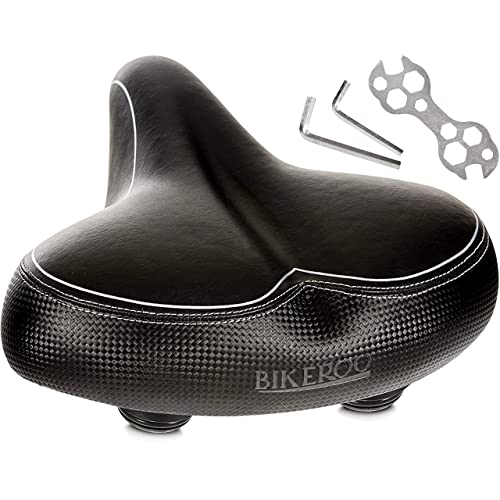
Bikeroo Oversized Comfort Bike Seat
Sitting almost vertically drops your full weight onto the sit bones, and a wide cushioned platform is the correct answer there. Dual rear springs soak up kerbs and broken pavement on cruisers, hybrids and exercise bikes. Fit this to a road bike and the width chafes on every stroke, which explains most negative owner reports.
Pros
- Genuinely comfortable sitting upright
- Springs absorb kerbs and rough pavement
- Clamps to standard seat posts
Cons
- Chafes in any forward leaning position
- Heavy next to performance saddles

ISM PN 3.0 Saddle
ISM removes the nose and splits the front into two arms, leaving open air where soft tissue normally rests. Time trial and triathlon riders rotate the pelvis hard forward, which is exactly where a conventional nose causes trouble. Fitting differs too, since it goes further forward and lower than the saddle it replaces.
Pros
- Clears soft tissue in an aero tuck
- Proven among time trial riders
- Allows a more forward pelvic rotation
Cons
- Needs a different fit setup
- Offers little benefit sitting upright
The lineup, side by side
| # | Model | Riding position | Best for | Score | Price |
|---|---|---|---|---|---|
| 1 | Selle Royal Respiro Moderate | Moderate forward lean | Best overall | 9.4 | Check price |
| 2 | Brooks England B17 Standard | Tensioned vegetable tanned leather | Best for long distance | 9.2 | Check price |
| 3 | WTB Volt Saddle | Trail and gravel | Best for trail riding | 9.0 | Check price |
| 4 | Selle SMP TRK Medium | Full length open cutout | Best for pressure relief | 8.8 | Check price |
| 5 | Selle Italia Model X Green Superflow | Superflow central cutout | Best value performance | 8.6 | Check price |
| 6 | Bikeroo Oversized Comfort Bike Seat | Upright | Best for upright riding | 8.3 | Check price |
| 7 | ISM PN 3.0 Saddle | Noseless split front | Best for aero positions | 8.0 | Check price |
How to pick the right one
How do you measure sit bone width at home? Sit bones land roughly 100 to 150 millimetres apart, and a saddle needs to carry them directly. Corrugated cardboard on a hard chair works well: sit on it, lean forward slightly, then measure between the two dents. Add about 20 to 30 millimetres for your saddle width. Getting this number right fixes more discomfort than any padding upgrade.
Which saddle suits your riding position? Leaning further forward rolls weight off the sit bones and onto the front of the pelvis. Racing shells answer that by staying narrow and firm. Cruisers and exercise bikes hold you vertical, so a wide platform carries the load properly. Match shape to position first, then filter by width.
Is a softer bike saddle more comfortable? Thick foam feels right for the first ten minutes. It then compresses, your sit bones reach the base, and squeezed foam presses into soft tissue at the sides. Firmer shells spread weight more evenly across an hour or more. Padded shorts with a proper chamois do more for distance comfort than extra saddle foam.
Do cutout saddles stop numbness? Cutouts and channels unload the perineum, which is where numbness begins. They only help if the width already suits your sit bones, because a wrong width concentrates pressure on the rim of the opening. Setup counts as much as shape: start level, adjust in tiny increments, and check saddle height. Numbness that survives a correct saddle usually points to fit rather than the shell.
Good to know
How do I know if my bike saddle is the right width?
Sit bones should land on the widest supported part of the shell, not the narrow section or the outer edge. Soreness at the outer edges usually means too narrow. Inner thigh chafing points the other way, especially in a forward lean.
Why do I go numb when cycling?
Pressure on perineal nerves and blood vessels cuts sensation, usually after weight shifts forward off the sit bones. Cutout saddles such as the Selle SMP TRK Medium address that directly. Check tilt first, because a nose up angle causes numbness on any model.
How long does a new bike saddle take to break in?
Foam and gel saddles need two to four rides for you to adapt to the shape. Brooks England B17 Standard is different, wanting several hundred miles before the leather sets. Pain that worsens across those rides means wrong saddle, not unfinished break in.
Do I need a saddle with springs?
Springs make sense on upright bikes ridden over rough surfaces, where your arms and legs cannot absorb the shock. In a forward lean they add weight and let the saddle move under you. No performance saddle uses them for that reason.
Are cutout saddles better than solid ones?
For riders who go numb, usually yes. Cutouts are not automatically comfortable though, since the wrong width pushes pressure onto the edge of the opening. Sort width first and treat the cutout as your second filter.
How do I set saddle height correctly?
Aim for a slight knee bend at the bottom of the pedal stroke, with hips staying level. Resting your heel on the pedal should straighten the leg without rocking. Pain at the front of the knee suggests too low, pain behind it suggests too high.
Do padded cycling shorts matter more than the saddle?
Beyond an hour they matter a great deal. A chamois manages friction and spreads pressure in ways no shell can. Many riders settle on a firm saddle plus good shorts rather than a soft saddle in street clothes.
Which bike saddle is best for long distance touring?
Leather hammocks such as the Brooks England B17 Standard hold their shape for decades and form to one rider. Foam alternatives work if the width is right, though support fades over years. Tension adjustment on the Brooks takes back sag as the hide stretches.
How often should a bike saddle be replaced?
Foam loses support across a few thousand miles, and a visibly sagging shape is the signal. Cracked covers let water into the padding, which speeds that up. Leather saddles run far longer with periodic tensioning and proofing.
The verdict
Selle Royal Respiro Moderate takes the top spot because it fits more riders and more positions than anything else in this group. Long distance riders willing to wait out a break in should choose the Brooks England B17 Standard. Anyone sitting upright on a cruiser or exercise bike will be happier on the Bikeroo Oversized Comfort Bike Seat than on any performance shell here.