Board Games Worth Keeping on the Shelf All Year
Ticket to Ride is our overall pick because almost anyone can learn it in five minutes and still enjoy it repeatedly. Codenames is the party choice for larger groups, and Azul delivers real strategy in a short, attractive package that suits mixed ability tables.
Ticket to Ride is the board game we would put in most households first, because it teaches in minutes and stays interesting across dozens of plays. Codenames is the better pick if your gatherings run to six or more people, and Azul gives you genuine strategic depth in around forty minutes without a rulebook that scares people off.
Picking board games is tricky because the ones that reviewers praise are often the ones that never get played, either because they take an hour to explain or because they only work at an exact player count. The best game for a household is the one that hits the table repeatedly. We compared published player counts, playing times, rules complexity and component quality, alongside what owners report about how well each game holds up after many sessions.
The shortlist, ranked

Ticket to Ride by Days of Wonder
Players collect coloured cards to claim railway routes across a map, racing to connect cities before someone else takes the track. The rules fit on a card, yet there is real tension in when to claim a route and when to hold cards. It is the game most often used to convert people who think they dislike board games.
Pros
- Explains in about five minutes
- Works across a wide age range
- Attractive durable components
Cons
- Route blocking can frustrate newcomers
- Less depth than heavier strategy games

Catan Board Game
Catan built the modern hobby around resource trading, settlement building and a shifting board that plays differently every time. Negotiation between players is the heart of it, which makes it lively rather than solitary. Dice rolls introduce luck, so it rewards adapting more than planning several turns ahead.
Pros
- Different board every game
- Trading keeps everyone involved
- Large range of expansions
Cons
- Poor dice luck can sideline a player
- Needs an expansion for larger groups

Codenames by Czech Games Edition
Two teams race to identify their own agents from a grid of words using single word clues from their spymaster. It scales comfortably to large groups because everyone on a team contributes to guessing. Rounds are short, teaching takes two minutes, and the box is small enough to travel.
Pros
- Handles large groups easily
- Extremely quick to teach
- Small portable box
Cons
- Spymaster role suits some players more than others
- Word cards eventually become familiar

Azul by Next Move Games
Players draft heavy resin tiles from shared factories and place them to score patterns, with a penalty for anything they cannot use. The rules are simple but the decisions are genuinely sharp, since taking what you need often hands your neighbour exactly what they wanted. Component quality is a large part of the appeal.
Pros
- Excellent tactile components
- Deep decisions with simple rules
- Plays well at two players
Cons
- No theme to draw in casual players
- Scoring takes a game or two to grasp

Wingspan by Stonemaier Games
A card driven engine builder about attracting birds to habitats, where each new card can chain into the abilities you already have. The artwork and the bird facts give it appeal beyond the usual hobby audience. A solid solo mode makes it one of the few games here that gets played when nobody else is around.
Pros
- Strong solo mode included
- Outstanding artwork and production
- Highly replayable card pool
Cons
- Longer teach than gateway games
- Little direct player interaction

Pandemic by Z-Man Games
Everyone plays on the same side, travelling the board to treat outbreaks and research cures before the situation runs away from them. Because it is cooperative, it works well with mixed experience levels and avoids the arguments competitive games can cause. Each player has a distinct role, which keeps turns meaningful.
Pros
- Cooperative rather than confrontational
- Distinct roles keep everyone involved
- Adjustable difficulty levels
Cons
- One experienced player can dominate decisions
- Losing streaks can discourage new players
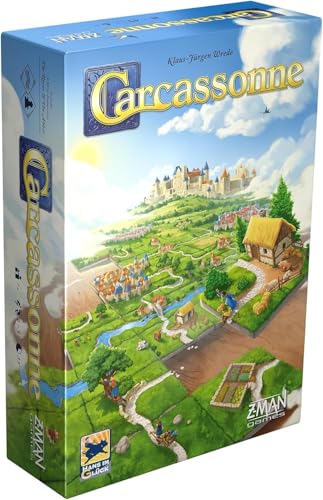
Carcassonne by Z-Man Games
Players draw and place tiles to build a landscape, claiming roads, cities and fields with a limited supply of followers. It teaches in a couple of minutes and plays well at two, which makes it a common choice for couples. The map is different every game because the tiles come out in a new order.
Pros
- Very quick to learn
- Excellent two player game
- Compact box and low cost
Cons
- Farm scoring confuses beginners
- Tile draw luck can swing endings
How they stack up
| # | Model | Players | Best for | Score | Price |
|---|---|---|---|---|---|
| 1 | Ticket to Ride by Days of Wonder | 2 to 5 | Best overall | 9.4 | Check price |
| 2 | Catan Board Game | 3 to 4, expandable | Best for classic strategy | 9.2 | Check price |
| 3 | Codenames by Czech Games Edition | 2 to 8 plus | Best for parties | 9.1 | Check price |
| 4 | Azul by Next Move Games | 2 to 4 | Best for short strategy sessions | 8.9 | Check price |
| 5 | Wingspan by Stonemaier Games | 1 to 5 | Best for solo and repeat play | 8.7 | Check price |
| 6 | Pandemic by Z-Man Games | 2 to 4 | Best cooperative game | 8.4 | Check price |
| 7 | Carcassonne by Z-Man Games | 2 to 5 | Best budget | 8.1 | Check price |
How to pick the right one
Buy for the group you actually have The most common mistake is buying a game for an imagined game night rather than the people who will really sit down. If your household is two people, prioritise games that shine at two, such as Azul and Carcassonne. If you host groups of six or more, party games like Codenames are the ones that will get played. A brilliant four player game gathers dust in a two person home.
Teaching time predicts how often it gets played A game that takes twenty minutes to explain has to be worth setting aside a whole evening for, and that means it comes out rarely. Games that teach in five minutes get played on a weeknight. If you are building a collection, start with short teach games and add one heavier title once you know the group enjoys the hobby.
Cooperative games solve specific problems If your group includes someone who dislikes direct conflict, or if experience levels vary widely, a cooperative game like Pandemic removes the awkwardness of a stronger player crushing a newcomer. The trade off is that one confident player can end up directing everyone else’s turns, so agree beforehand that each person makes their own decisions.
Components and box size are worth checking Card stock, tile thickness and insert quality decide whether a game still feels good after fifty plays. Heavier resin or wooden pieces also make a game more inviting to people who are not sure they like board games. On the practical side, check the box footprint against your shelf, since some popular titles come in boxes far larger than their contents need.
Good to know
What is a good first board game for a family?
Ticket to Ride is the usual recommendation because it explains in minutes, works across ages and still holds interest for adults. Carcassonne is a cheaper alternative with a similarly gentle learning curve.
Which board games work best for two players?
Azul and Carcassonne are both excellent at two, since they were designed to stay tense without needing a crowd. Wingspan also plays well at two and adds a solo mode for when you are on your own.
What should I buy for a large group?
Codenames handles eight or more comfortably because teams guess together rather than taking individual turns. Games with fixed player counts tend to leave people watching, which is what kills a party.
How long do these games take to play?
Most sit between thirty and sixty minutes once everyone knows the rules. First plays typically run longer, so allow extra time and expect the second game to be noticeably quicker.
Are expansions necessary?
Rarely at first. Play the base game a dozen times before adding anything, since expansions usually add complexity and setup time. The exception is Catan, where an expansion is required to play with five or six people.
What age are these games suitable for?
Most in this list are labelled for eight or ten and up. Younger children often manage in teams with an adult, especially for Ticket to Ride and Carcassonne, where the core decisions are visual rather than mathematical.
Which game has the best replay value?
Wingspan and Catan change the most between sessions, one through its card pool and the other through a randomised board. Codenames stays fresh for a long time simply because clue giving depends on the people playing.
Do cooperative games get boring after winning?
Some do, but Pandemic includes adjustable difficulty that raises the challenge as your group improves. Increasing the number of epidemic cards is the standard way to keep it tense.
The bottom line
Ticket to Ride is the safest single purchase for a household, quick to teach and reliably replayed. Add Codenames if you host larger groups and Azul if you want something sharper for two to four players. Heavier titles like Wingspan are worth owning, but only once your group has shown it enjoys sitting down for a longer game.