Affordable Aquarium Water Test Kits Worth Keeping
The API Freshwater Master Test Kit is our overall pick because liquid reagents give readable results across hundreds of tests. API 5-in-1 Aquarium Test Strips are the fastest routine check, and the API Ammonia Test Kit is the cheapest way to watch the one parameter that kills fish.
For anyone cycling a tank or diagnosing a problem, the API Freshwater Master Test Kit is the best starting point, with API 5-in-1 Test Strips covering fast routine checks and the API Ammonia Test Kit handling the single most urgent parameter.
Testing is trickier than it should be because strips fade, colours are judged by eye and a kit that has sat on a shelf for two years can read wrong without any obvious sign. We compared parameters covered, tests per kit, reagent versus strip formats and stated shelf lives, then weighed those against what owners report about colour chart readability and consistency between batches.
How to pick the right one
Ammonia, nitrite and nitrate are the cycle you are watching In a new tank, ammonia rises first as waste breaks down, then nitrite as bacteria consume the ammonia, then nitrate as a second bacterial population takes over. A cycled tank reads zero ammonia, zero nitrite and some nitrate, and getting there takes weeks. Any kit that cannot measure ammonia leaves you blind to the most dangerous stage, which is why strip only setups need a separate ammonia test alongside.
Liquid reagents and strips are for different jobs Strips are fast, cheap per use and perfectly adequate for confirming that a stable tank has not drifted. Liquid reagent kits take a few minutes, cost far less per test over the life of the box and give readings you can actually act on. The sensible setup is strips for weekly routine checks and a liquid master kit for cycling, troubleshooting and anything that looks wrong.
Reading conditions change the answer Colour matching is subjective, and the same vial can read differently under warm kitchen bulbs, daylight and aquarium lighting. Hold the vial against the white section of the chart in natural daylight where possible, and view it from the top down for liquid tests where the instructions specify. Owners report that involving a second pair of eyes helps most when a reading sits between two colour blocks.
Check dates and store kits properly Reagents and strips both degrade, and an expired kit can read plausibly wrong rather than obviously wrong. Note the purchase date on the box, keep bottles tightly capped and stored away from heat and direct sunlight, and seal strip containers immediately because humidity is what ruins them. If results ever contradict what the tank is visibly doing, suspect the kit before you suspect the tank.
The shortlist, ranked

API Freshwater Master Test Kit
This is the kit most experienced aquarists point new keepers toward, covering pH, high range pH, ammonia, nitrite and nitrate with liquid reagents. It works out to a very low cost per test because a single box runs to hundreds of readings. Owners report the ammonia test requires careful timing and shaking of the second bottle, and that following the instructions exactly is the difference between a useful result and a confusing one.
Pros
- Covers every parameter needed to cycle a tank
- Very low cost per individual test
- Liquid reagents read more precisely than strips
Cons
- Slower than strips, with timed steps
- Colour matching in poor lighting is difficult

API 5-in-1 Aquarium Test Strips
Dip strips give pH, nitrite, nitrate, carbonate hardness and general hardness in under a minute, which makes them realistic to use weekly rather than occasionally. They are the right tool for confirming a stable tank is still stable. Owners report they are less precise than liquid tests and that the bottle must be sealed immediately, because humidity ruins the remaining strips.
Pros
- Results in seconds with no measuring
- Covers hardness, which the master kit does not
- Encourages regular testing through convenience
Cons
- No ammonia test included
- Less precise and affected by humidity

API Ammonia Test Kit
Ammonia is the parameter that harms fish fastest, and this standalone liquid kit covers it for very little outlay. It is the right purchase for someone who already has strips and needs to fill the one gap they leave. Owners report it is invaluable during a fish in cycle, when ammonia readings change day to day and precision genuinely matters.
Pros
- Covers the most dangerous parameter precisely
- Cheapest liquid kit here
- Works in both fresh and salt water
Cons
- Single parameter only
- Requires careful shaking and timing

Tetra EasyStrips 6-in-1 Test Strips
Tetra’s six parameter strips add chlorine to the usual line up, which is useful when tap water is the fill source for water changes. The colour blocks are large and reasonably easy to match against the chart. Owners report the readings track the right direction reliably even if the exact number is approximate, which is what a routine screening test needs to do.
Pros
- Includes a chlorine check for tap water
- Large colour pads are easy to read
- Very quick to use during water changes
Cons
- No ammonia measurement
- Approximate rather than precise readings

API GH and KH Test Kit
General and carbonate hardness decide whether pH stays stable and whether certain species and shrimp will thrive, and this titration style kit reads them far more precisely than strips do. Counting drops removes the colour matching guesswork. Owners report it is essential for anyone keeping shrimp, African cichlids or soft water species where hardness is not optional.
Pros
- Precise drop counting instead of colour matching
- Explains pH instability that other kits miss
- High test count for the outlay
Cons
- Only covers hardness parameters
- Requires steady counting and a consistent sample size

Seachem Ammonia Alert
This is not a test kit but an adhesive sensor disc that sticks inside the tank and changes colour when free ammonia rises. It gives an at a glance warning between scheduled tests, which is exactly when problems tend to appear. Owners report it lasts around a year and should be treated as an alarm rather than a substitute for a proper reagent test.
Pros
- Continuous warning with no testing effort
- Detects free ammonia, the toxic form
- Works in both fresh and salt water
Cons
- Not a quantitative measurement
- Needs replacing annually
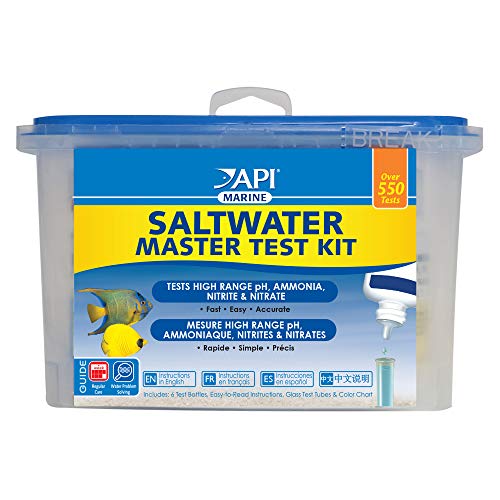
API Saltwater Master Test Kit
The saltwater version swaps the freshwater parameters for the ones marine keepers need most, covering pH, high range pH, ammonia and nitrite with reagents calibrated for salt water. It is the affordable starting point before adding reef specific calcium and alkalinity kits. Owners report it handles the fish only stage well and that reef tanks need additional tests beyond this box.
Pros
- Reagents calibrated for salt water accuracy
- Good test count for the price
- Covers the parameters that matter during cycling
Cons
- No nitrate test included
- Reef tanks need extra calcium and alkalinity kits
Compared at a glance
| # | Model | Parameters | Best for | Score | Price |
|---|---|---|---|---|---|
| 1 | API Freshwater Master Test Kit | pH, high range pH, ammonia, nitrite, nitrate | Best overall | 9.4 | Check price |
| 2 | API 5-in-1 Aquarium Test Strips | pH, nitrite, nitrate, KH, GH | Best value | 9.2 | Check price |
| 3 | API Ammonia Test Kit | Ammonia, free and total | Best budget | 9.0 | Check price |
| 4 | Tetra EasyStrips 6-in-1 Test Strips | pH, nitrite, nitrate, chlorine, KH, GH | Best for quick weekly checks | 8.7 | Check price |
| 5 | API GH and KH Test Kit | General hardness and carbonate hardness | Best for hardness sensitive fish | 8.5 | Check price |
| 6 | Seachem Ammonia Alert | Free ammonia only | Best for continuous monitoring | 8.3 | Check price |
| 7 | API Saltwater Master Test Kit | pH, high range pH, ammonia, nitrite | Best for marine tanks | 8.0 | Check price |
Good to know
Are test strips accurate enough for aquariums?
They are accurate enough to confirm that a stable tank has not changed, and not precise enough for cycling or diagnosing a problem. Owners generally use strips for routine checks and liquid reagents when a number really matters.
How often should I test my aquarium water?
During cycling, daily or every other day for ammonia and nitrite. Once established, weekly checks are common, with additional tests after adding fish, changing filtration or noticing unusual behaviour.
Why is ammonia the most important parameter?
Free ammonia is directly toxic to fish gills even at low concentrations, and it rises fastest when something goes wrong with filtration or stocking. Nitrite is similarly dangerous, while nitrate is tolerated at much higher levels.
Do test kits expire?
Yes. Reagents lose potency and strips absorb moisture, both of which cause false readings. Check for a printed expiry or lot date and replace kits that are several years old, even if bottles look full.
Can I use a freshwater kit on a saltwater tank?
Some tests transfer and others do not. Ammonia kits usually work in both, while pH ranges and nitrate reagents are often calibrated differently. Check the packaging, since API sells separate freshwater and saltwater versions for good reason.
What should my readings actually be?
A healthy cycled freshwater tank generally shows zero ammonia, zero nitrite and a modest nitrate level kept down by water changes. Target pH and hardness depend entirely on the species you keep.
Is a digital meter better than a test kit?
Digital pH and TDS meters are convenient and repeatable, but they need regular calibration with buffer solutions and they do not measure ammonia or nitrite. Most keepers use a meter alongside a reagent kit rather than instead of one.
Why do my strip and liquid results disagree?
Strips are coarser and more affected by storage, so small disagreements are normal. If they differ substantially, trust the liquid reagent result and check whether the strip bottle has been left open or is past its date.
Our take
The API Freshwater Master Test Kit remains the best value in aquarium testing because the cost per reading is tiny and it covers every parameter that matters while a tank establishes itself. Pair it with API 5-in-1 strips so quick weekly checks actually happen, and add the standalone ammonia kit if you are cycling with fish in the tank. Keep an eye on kit age, because an old reagent is worse than no test at all.