How to Choose a Button Maker Machine That Lasts
The Tecre Button Machine Model 100 leads this ranking on die precision and long service life. VEVOR’s Button Maker Machine 32mm gives clubs and schools the best value for occasional use. Sellers needing more than one pin size should look at the Mophorn 3 in 1 Button Badge Maker instead.
Serious output points to the Tecre Button Machine Model 100, built for daily use rather than occasional craft projects. Schools and clubs get more value from the VEVOR Button Maker Machine 32mm. Sellers offering several pin sizes should start with the Mophorn 3 in 1, which covers three diameters from one frame.
Hundreds of listings share the same cast frame photo while differing sharply in die machining, which decides whether a button crimps cleanly or pops apart in someone’s hand. We compared frame construction, die alignment, output rate and how easily consumables can be sourced in each size. Owner reports after long production runs shaped where each machine landed on this list.
Our top picks

Tecre Button Machine Model 100
Ask anyone making buttons for a living what brand they trust, and Tecre comes up first. The Model 100 in the 2.25 inch size machines its die precisely enough that crimps stay identical hundreds of buttons into a run. Cost runs well above import presses, which only pays off at production volume.
Pros
- Die precision holds through very long runs
- Built to be bolted down and used daily
- Well supported with parts and matching consumables
Cons
- Substantially more expensive than import presses
- Overkill for occasional hobby use

VEVOR Button Maker Machine 32mm
Schools, youth groups and clubs making buttons in bursts rather than continuously find the sweet spot here, where build quality stops being a concern and price stops climbing. A heavy cast iron frame stays put during pressing, and a circle cutter ships in the box. Owners typically check die alignment once on arrival, and it holds after that.
Pros
- Solid cast frame for the price
- Circle cutter included in the box
- 32mm size suits logos and short text well
Cons
- Die alignment usually needs checking on arrival
- Single size with no upgrade path

Mophorn Button Badge Maker 3 in 1
Customers ask for different pin sizes almost immediately, and buying three separate presses rarely makes sense for a small seller. Three die sets and matching cutters ship on one frame here, covering that range for roughly the cost of one machine plus a short changeover. Batch each size in one run instead of alternating, since realigning after every swap wastes more time than it saves.
Pros
- Three pin sizes from a single frame
- Matching circle cutters supplied for each size
- Much cheaper than three separate presses
Cons
- Die swaps are too slow for mixing sizes mid run
- Alignment needs rechecking after every change

American Button Machines Standard Button Maker
This press comes from the same tradition as Tecre, with machined dies and a frame built for years of production rather than a single craft fair season. Handle geometry eases wrist strain over long sessions, which matters more than it sounds after several hundred pins. Matching consumables stay readily available in the standard sizes it supports.
Pros
- Handle geometry reduces fatigue on long runs
- Machined dies give consistent crimping
- Readily available matching consumables
Cons
- Priced well above import presses
- Heavy and not portable

Yescom 2.25 Inch Button Maker Machine
Band merchandise and campaign buttons use the 2.25 inch size because it holds real artwork rather than a single icon. This Yescom press covers that size at a fraction of a professional machine’s cost, useful for testing whether the size sells before committing further. A bigger die needs more handle force, so a solid, clamped or bolted table makes a real difference.
Pros
- Popular large pin size at a low entry cost
- Enough face area for detailed artwork
- Circle cutter included
Cons
- Needs clamping for comfortable fast pressing
- Finish and tolerances below professional presses

ChiButtons 44mm Button Badge Maker
Makers rather than production shops are the target here, reflected in a forgiving die and a short handle throw suited to mixed ability users. The 44mm size sits usefully between small pins and full size badges. Speed is not the point, but for a stall or a class project making a few dozen buttons, that pace never matters.
Pros
- Forgiving die suits inexperienced users
- Useful middle pin size
- Short handle throw is easy to operate
Cons
- Slow for anything approaching production volume
- Basic finish
BAOSHISHAN 58mm Button Maker Machine
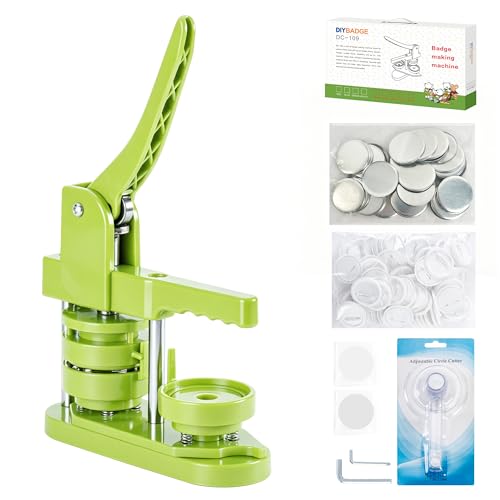
58mm is the most widely stocked consumable size anywhere, which makes this BAOSHISHAN press a cheap, low risk way into button making. Restocking shells and pin backs in this diameter stays easy and inexpensive. Expect to check die alignment on arrival and bolt the frame down for faster pressing sessions.
Pros
- Most widely stocked consumable size
- Lowest cost entry into a popular pin diameter
- Cast frame rather than a pressed shell
Cons
- Alignment check needed before first use
- Benefits from being bolted to the bench
Before you buy
What button size should you buy first? Almost every button press locks to one diameter, so the artwork planned determines the machine. Small pins around 25mm suit single icons, 32mm and 44mm handle logos and short text, 58mm works as the most common all rounder, and 2.25 inch pins carry real artwork for merchandise. Decide what gets sold or given away first, then shop only within that size.
Why does die machining matter more than frame looks? The die folds a shell’s edge over the artwork and back to form the crimp. Precisely machined dies produce an identical crimp on the first button and the thousandth, while loose tolerances leave buttons that spin on the pin or pop apart. Professional presses cost several times more than import presses for exactly this reason, and it only matters once volume climbs.
How do you plan consumable supply before buying? Every button uses a shell, a printed disc, a mylar cover and a back, bought again and again after the machine itself is a one time purchase. A size with deep supplier support is worth more long term than a slightly better machine in an unusual diameter. Standard sizes like 25mm, 58mm and 2.25 inch have that supply; check availability before building a product line around anything else.
How do you get the artwork template and cutter right? A printed disc must be larger than the visible face, since the edge wraps around the shell during crimping. Most presses include a matching circle cutter, far more consistent than scissors and considerably faster. Print one test sheet, cut it, press a single button, and check where the design crops before running a full batch.
Side by side
| # | Model | Button size | Best for | Score | Price |
|---|---|---|---|---|---|
| 1 | Tecre Button Machine Model 100 | 2.25 inches | Best overall | 9.4 | Check price |
| 2 | VEVOR Button Maker Machine 32mm | 32 millimetres | Best value | 9.2 | Check price |
| 3 | Mophorn Button Badge Maker 3 in 1 | Three interchangeable die sets | Best for multiple sizes | 9.0 | Check price |
| 4 | American Button Machines Standard Button Maker | Machined steel construction | Best build quality | 8.8 | Check price |
| 5 | Yescom 2.25 Inch Button Maker Machine | 2.25 inches | Best for large pins | 8.6 | Check price |
| 6 | ChiButtons 44mm Button Badge Maker | 44 millimetres | Best for hobby use | 8.3 | Check price |
| 7 | BAOSHISHAN 58mm Button Maker Machine | 58 millimetres | Best budget option | 8.0 | Check price |
Common questions
What size button maker should you buy?
58mm and 2.25 inch cover the most ground, with the widest consumable supply and enough face area for real artwork. Smaller sizes suit simple icons and cost less per pin.
Can one machine make different button sizes?
Only multi die kits like the Mophorn 3 in 1 can. Standard presses are machined for a single diameter. Even on kits, changeover takes minutes, so batch each size instead of alternating.
What parts does each button need?
A metal shell, a printed paper disc, a clear mylar disc that protects the print, and a back with a pin, magnet or clip. Suppliers sell these as matched sets for each diameter.
Is a cheap button maker good enough for hobby use?
Yes, for occasional projects. Production sellers making hundreds of pins weekly see real value from precision machined dies, since crimp consistency and reduced hand fatigue compound over volume.
What paper works best for button artwork?
Standard printer paper is what most suppliers recommend, since the mylar layer adds gloss and protection on its own. Heavy card often proves too thick to crimp cleanly, so test one sheet before committing to a stock.
How many buttons can you make per hour?
Owners report roughly one to three per minute during steady work once artwork is precut. Cutting usually sets the pace rather than pressing, which is why a proper circle cutter matters.
Why do buttons come out loose or spinning?
An incomplete crimp is almost always the cause. Push the handle through its full travel, check die alignment, and confirm the paper disc is not cut oversized. Any of the three produces the same symptom.
Do button makers need regular maintenance?
Very little. Keep the dies clean and free of paper fragments, check alignment bolts occasionally, and add a small amount of light oil to the pivot if the handle stiffens over time.
Our pick
Pins as a business point straight to the Tecre Button Machine Model 100, since its die precision holds crimp quality through runs that leave import presses drifting off spec. Schools, clubs and hobby makers get everything needed from the VEVOR 32mm at a fraction of that cost. Sellers offering several pin sizes should start with the Mophorn 3 in 1 instead.