Which Camping Cot Actually Keeps You Off Cold Ground?
TETON Sports Outfitter XXL Camp Cot tops this list for length, width and weight capacity. Coleman ComfortSmart Cot wins on value thanks to its foam mattress pad. Helinox Cot One Convertible is the lightest pick, worth carrying when pack weight matters most.
TETON Sports Outfitter XXL Camp Cot suits taller campers who need real length and a frame that resists flex under load. Coleman ComfortSmart Cot adds a foam layer for anyone who dislikes firm fabric decks. Helinox Cot One Convertible sheds the most weight, which matters once you carry gear any distance.
Cots are harder to judge than they look, since the spec that matters most, how the frame feels at three in the morning, never appears on the box. Squeaking joints, sagging fabric and a cot two inches too short all ruin sleep the same way. We compared published dimensions, weight ratings, packed sizes and frame materials, then checked what owners report about noise, tent floor damage and fabric stretch over time.
Our top picks

TETON Sports Outfitter XXL Camp Cot
Extra length and width give taller sleepers room that standard cots cut short at the ankles. A steel frame with taut canvas resists the sag that turns cheaper cots into hammocks by the second night. Packed size stays bulky, so this one lives in a car trunk, not a backpack.
Pros
- Fits sleepers well over six feet
- Minimal fabric sag under weight
- Wide deck for side sleepers
Cons
- Heavy for anything but car camping
- Packed bag is bulky in a trunk

Coleman ComfortSmart Cot
A foam mattress pad sits over a coil suspension here, closer to a camp bed than stretched fabric. Anyone who struggles on firm surfaces will notice the difference on the first night. Setup takes under a minute and the frame folds flat, though the mattress adds bulk in the car.
Pros
- Noticeably softer than fabric only cots
- Folds flat in under a minute
- Strong comfort for the price
Cons
- Foam pad adds bulk when packed
- Foam holds moisture if stored damp

Helinox Cot One Convertible
Aluminium tent poles replace the folding steel frame here, so the whole cot packs to roughly the size of a small tent. Kayak trips, motorcycle camping and backpacking base camps all become realistic uses. Optional leg extensions raise it higher off the ground for gear storage underneath.
Pros
- Packs smaller than any steel frame cot
- Light enough for backpacking trips
- Rigid once fully tensioned
Cons
- Setup takes practice the first few times
- Leg extensions are sold separately

Disc-O-Bed Cam-O-Bunk
Two cots stack into a bunk or split into separate benches, which saves real floor space in a crowded tent. Side organisers clip onto the frame for glasses and headlamps. Weight is the trade off, since this is the heaviest option on the list by a wide margin.
Pros
- Halves the tent floor space two cots need
- Converts to benches during the day
- Sturdy frame under both bunks
Cons
- Heaviest and bulkiest cot here
- Top bunk needs real tent height
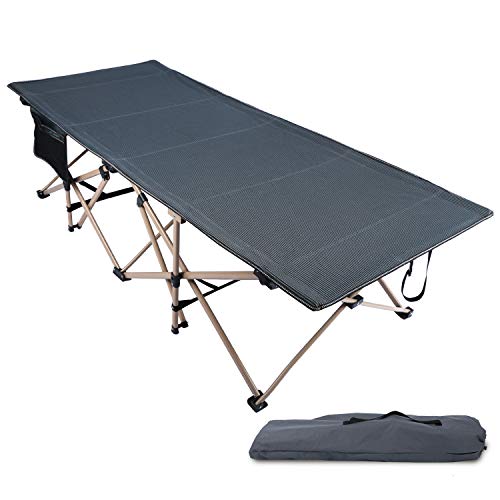
REDCAMP Folding Camping Cot
A steel frame and polyester deck do the basic job of lifting you off the ground, nothing more. There is no mattress or suspension, so pair it with a sleeping pad on cold nights. Owners report it folds out in under a minute and holds up fine for occasional trips.
Pros
- Fast fold out setup
- Lowest cost entry point here
- Compact when folded
Cons
- Firm without a sleeping pad added
- Frame can squeak with movement

Kamp-Rite Original Tent Cot
A compact one person tent folds together with the cot frame, so you can pitch on gravel, sand or ground too uneven to stake. Overlanders and festival campers get the most use from that combination. The trade off is a heavier unit and an interior too snug for anyone claustrophobic.
Pros
- Skips carrying a separate tent
- Works on ground you cannot stake
- Unfolds as one complete unit
Cons
- Heavy and awkward to transport
- Interior space is genuinely tight
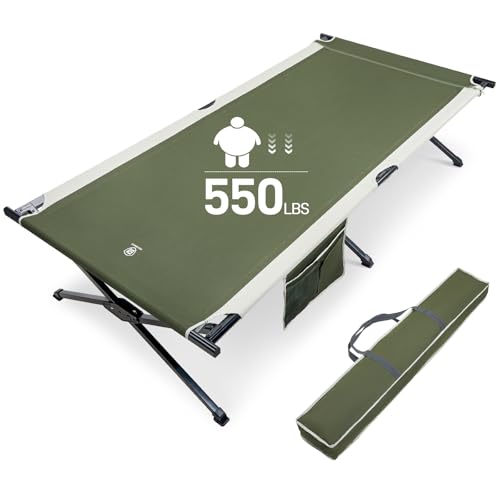
ALPHA CAMP Oversized Camping Cot
Width and capacity take priority over extras here, using a reinforced steel frame under a wide deck. People who move around a lot at night gain room that narrow cots deny them. Owners report a sturdy build for the class, though the folded package stays large.
Pros
- Plenty of room to roll over
- High weight capacity for the price
- Little frame flex under load
Cons
- Takes up significant tent floor space
- Bulky to store in a car
The lineup, side by side
| # | Model | Sleep surface | Best for | Score | Price |
|---|---|---|---|---|---|
| 1 | TETON Sports Outfitter XXL Camp Cot | About 84 by 40 inches | Best overall | 9.4 | Check price |
| 2 | Coleman ComfortSmart Cot | About 74 by 28 inches | Best value | 9.1 | Check price |
| 3 | Helinox Cot One Convertible | Shock corded aluminium poles | Best lightweight | 9.0 | Check price |
| 4 | Disc-O-Bed Cam-O-Bunk | Bunk or two separate cots | Best for families | 8.8 | Check price |
| 5 | REDCAMP Folding Camping Cot | Steel | Best budget | 8.5 | Check price |
| 6 | Kamp-Rite Original Tent Cot | Combined cot and tent | Best for sleeping without a tent | 8.3 | Check price |
| 7 | ALPHA CAMP Oversized Camping Cot | About 82 by 35 inches | Best for wide sleepers | 8.0 | Check price |
What matters most
What size camping cot do I actually need? Most sleep complaints trace back to length, not comfort. Anyone near six feet tall finds their feet pressed against the end bar on a standard cot, and no padding fixes that. Check the sleeping surface dimension printed in the specs, not the overall frame length, and add a few inches of margin. Width counts almost as much for restless sleepers who roll over during the night.
Does weight capacity affect how a cot feels? A capacity rated well above your body weight flexes less and creaks less, even far from the limit. Frames rated close to your weight sag in the middle and let fabric stretch faster over a season. Treat the capacity number as a proxy for build quality, not a target to approach. Steel frames generally handle higher loads than aluminium pole designs.
Are camping cots warm enough on their own? Lifting off the ground removes conductive cold from soil, which helps on any night. That same gap lets air move underneath, and moving air steals heat faster than most people expect below fifty degrees. A sleeping pad or closed cell foam layer on top of the cot fixes this in cold weather. Summer campers can skip the pad and let that airflow work in their favor.
Will a camping cot damage my tent floor? Cot legs concentrate a lot of weight onto small contact points, which is exactly how tent floors get punctured. Wide or capped feet spread that load and cut the risk substantially. Scraps of foam or an old mat under each leg add cheap extra protection. Check the folded footprint against your trunk too, since steel cots take up more space than most people plan for.
Questions worth asking
Are camping cots warmer than sleeping pads?
Not by themselves. A cot removes ground contact but leaves air moving underneath it. In cool weather the warmest setup pairs a cot with an insulated pad on top, combining height with real insulation.
Do camping cots damage tent floors?
They can, since legs press substantial weight into small areas. Cots with wide or capped feet reduce that risk. Placing foam or an old mat under each leg removes most of what remains.
How much weight can a camping cot hold?
Ratings range from around 300 pounds on basic folding models to over 600 pounds on heavy duty steel frames. Choosing a cot rated comfortably above your weight cuts sag, reduces squeaking and adds a safety margin.
Can two people sleep on one camping cot?
Standard cots are built for a single sleeper and flex badly under two. Couples who want to sleep off the ground together should look at a double camp bed or set up two cots side by side.
Why do camping cots squeak at night?
Metal joints rubbing under load cause most of the noise. Tightening bolts and adding dry lubricant to pivot points usually helps. Tensioned pole designs like the Helinox have fewer joints and stay quieter.
Are camping cots better than air mattresses?
Cots never lose air overnight and hold you further off the ground. Air mattresses pack smaller and feel softer when fully inflated, but cold ground pulls heat through them faster than a cot with a pad.
How much tent space does a camping cot need?
Budget the folded footprint plus room to climb in and out. A full width cot in a two person tent leaves almost no floor space, which is why bunk style cots like the Disc-O-Bed appeal to families.
Can a camping cot be used indoors for guests?
Yes, and plenty of owners buy one for exactly that. Models with a foam mattress layer, like the Coleman ComfortSmart, suit guests better than bare fabric decks.
What is the most comfortable camping cot?
Comfort usually comes down to surface type. Foam over coil suspension, as on the Coleman ComfortSmart, feels closer to a real mattress than taut fabric alone, which is why it scores well for casual campers.
Do lightweight camping cots hold up as well as steel ones?
Aluminium pole cots like the Helinox Cot One trade some capacity for weight savings, not durability. Properly tensioned, they handle repeated seasons of use, though they suit backpacking loads more than heavy campers.
Final word
TETON Sports Outfitter XXL Camp Cot remains the pick for car camping, with length, width and rigidity most cots lack. Coleman ComfortSmart Cot is the better buy when comfort matters more than raw capacity, and Helinox Cot One Convertible wins once packed size becomes the priority. Add a sleeping pad on top for anything colder than mild weather.


