Canister vs Liquid Fuel: Picking a Camping Stove
For car camping the Camp Chef Everest 2X leads with two high-output burners and strong wind performance. The Coleman Classic covers the same job for less, and the MSR PocketRocket 2 wins for lightweight backpacking.
Most car campers will be happiest with the Camp Chef Everest 2X. Budget-conscious campers get nearly the same result from the Coleman Classic, and backpackers should lean toward the MSR PocketRocket 2 instead.
A stove that boils fast in a calm kitchen can stall completely in a breeze, and one that sits flat at home may wobble on a picnic table. We compared these seven models on published BTU output, wind guarding, packed dimensions and fuel type, covering both weekend car trips and long trail days.
What to look for
How many burners does a camping stove need? A single burner handles boiling water and one-pot trail meals while keeping weight and cost down. Two burners let you cook a main dish and a side at once, which matters more for family car camping than solo backpacking. Match burner count to how you actually eat at camp, not to the biggest option available.
What does BTU actually mean for cooking heat? BTU ratings describe fuel flow, not guaranteed cooking speed, since pot size, altitude and wind all affect the result. High BTU burners boil fast but can be hard to turn low for delicate cooking, so look for stoves that both crank up and simmer well. Wind protection often matters more than a few thousand extra BTU.
Propane vs butane vs isobutane: which fuel is best? Propane is easy to find, works in cold weather and suits car camping, though the canisters are bulky. Isobutane canisters are lighter and popular for backpacking, but performance drops near freezing. Butane costs the least to run and suits warm-weather car camping, yet it struggles once temperatures fall.
Best camping stove for backpacking vs car camping Packed size and weight decide everything for backpacking, so a canister-top burner that nests inside a pot makes the most sense. Car camping allows a trade toward a wide, stable base and fold-flat wind panels instead. Check that pot supports grip your cookware and that the stove sits level on an uneven table.
What we recommend

Camp Chef Everest 2X
Two 20,000 BTU burners give this two-burner genuine cooking power. A recessed design and side wind screens help it hold a flame outdoors. Owners report fast boils alongside steady simmering, an uncommon combination at this size.
Pros
- High output on both burners
- Wind guards keep flame steady
- Simmers as well as it boils
Cons
- Heavier than compact models
- Uses larger propane canisters
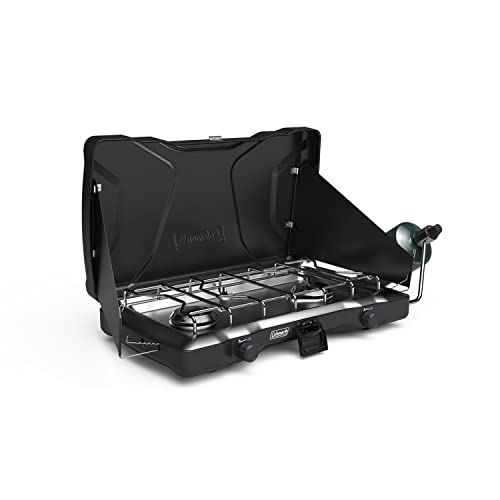
Coleman Classic Propane Stove
A long-running two-burner keeps setup and controls simple. Fold-up wind panels and 20,000 combined BTU output cover most campsite meals. It runs on standard one-pound propane cylinders sold almost everywhere.
Pros
- Low price for a two-burner
- Widely available parts and fuel
- Fold-flat panels pack easily
Cons
- Simmer control is basic
- No built-in igniter

MSR PocketRocket 2
At just a few ounces, this canister-top burner folds down small enough to fit inside a cookpot. Owners report quick boils for a solo or two-person setup. Every gram counts on the trail, which is where this stove earns its reputation.
Pros
- Extremely light and packable
- Fast boil for its size
- Serrated pot supports grip well
Cons
- Exposed flame catches wind
- Not suited to large pots

Jetboil Flash Cooking System
An all-in-one system locks the burner to an insulated cup with a heat exchanger. Based on specifications, water reaches a boil in around two minutes. A color strip on the cup signals when it is ready.
Pros
- Very fast water boiling
- Cup and burner nest together
- Fuel efficient design
Cons
- Best for boiling, not cooking
- Narrow cup limits meals

GasOne GS-3400P Portable Butane Stove
A single-burner butane stove ships in a hard carry case for very little outlay. It runs on inexpensive butane cartridges and suits car camping, tailgates or a backup burner. Storage space stays minimal thanks to the compact case.
Pros
- Very low cost
- Cartridges are cheap and easy
- Compact hard case
Cons
- Butane struggles in cold weather
- Single burner only

Coleman Cascade 3-in-1 Camping Stove
This two-burner swaps between a grill grate, a griddle and open burners, so one stove handles pancakes, burgers and boiling pots. Owners report the interchangeable surfaces simplify campsite breakfasts considerably.
Pros
- Grill and griddle inserts included
- Handles varied meals
- Familiar Coleman fuel setup
Cons
- Inserts add bulk to carry
- Heavier packed weight

Eureka Ignite Plus 2-Burner Stove
Cooks who want more than a rolling boil get two 10,000 BTU burners with fine flame control here. A push-button igniter removes the need for matches. Recessed burners and side panels help keep the flame stable in a breeze.
Pros
- Excellent low-flame simmer
- Reliable built-in igniter
- Sturdy pot supports
Cons
- Lower peak output than rivals
- Costs more than basic two-burners
How they compare
| # | Model | Burners | Best for | Score | Price |
|---|---|---|---|---|---|
| 1 | Camp Chef Everest 2X | 2 | Best overall | 9.4 | Check price |
| 2 | Coleman Classic Propane Stove | 2 | Best value | 9.0 | Check price |
| 3 | MSR PocketRocket 2 | 2.6 oz | Best for backpacking | 9.1 | Check price |
| 4 | Jetboil Flash Cooking System | Integrated system | Best for fast boiling | 8.9 | Check price |
| 5 | GasOne GS-3400P Portable Butane Stove | 1 | Best budget | 8.4 | Check price |
| 6 | Coleman Cascade 3-in-1 Camping Stove | 2 | Best for versatility | 8.6 | Check price |
| 7 | Eureka Ignite Plus 2-Burner Stove | 2 | Best simmer control | 8.7 | Check price |
Questions worth asking
Are propane or butane stoves better for camping?
Propane handles cold weather and stays easy to find, suiting most car camping trips. Butane costs less to run and packs small, but it loses power in the cold, making it best for warm-weather trips.
Do I need a two-burner camping stove?
Only if cooking more than one thing at a time matters to you. Solo campers and backpackers are usually fine with a single burner, which stays lighter and cheaper.
What does BTU mean on a camping stove?
BTU measures how much fuel a burner can flow. Higher numbers can boil faster, though pot size, wind and altitude affect real cooking speed more than the rating alone.
Can I use a camping stove indoors?
No. These stoves produce carbon monoxide and are built for open-air use only. Cook outdoors or in a well-ventilated space away from tents.
Which camping stove is best for backpacking?
A lightweight canister-top burner like the MSR PocketRocket 2 packs into a pot and boils quickly, making it a strong choice where every ounce of pack weight matters.
How do I keep a camping stove flame steady in wind?
Choose a stove with recessed burners and fold-up wind panels, then position it so your body or a natural feature blocks the breeze. Exposed canister-top burners need the most shielding.
How much fuel should I bring camping?
Plan on roughly one small canister per person for a weekend of boiling water and simple meals, then pack a spare. Cold weather and long simmering both burn through fuel faster.
Do camping stoves come with a carrying case?
Some do, especially compact butane models like the GasOne, while larger two-burners often fold into their own lid. A case helps protect burners and keeps grease off other gear.
Two-burner vs single burner camping stove: which should I buy?
A single burner suits solo trips and minimal cooking, while a two-burner earns its extra weight once you are cooking for a family or want a side dish alongside the main pot.
Final word
For real campsite cooking power the Camp Chef Everest 2X is the all-round pick, pairing two strong burners with solid wind resistance. Choose the Coleman Classic to save money on a capable two-burner, or the MSR PocketRocket 2 when every ounce on the trail counts.


