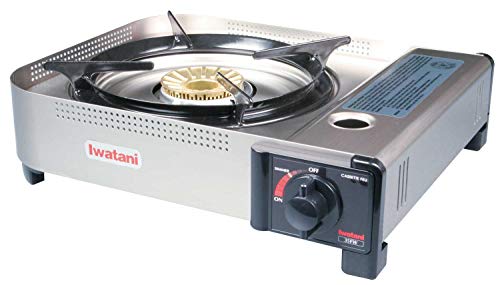
Camping Stoves That Stay Lit in Wind and Cold
The Camp Chef Everest 2X is the strongest choice for group cooking thanks to two high output burners and real wind protection. The Jetboil Flash boils fastest for solo trips, and the Coleman Cascade Classic 2-Burner Propane Stove remains the dependable value pick for car camping.
For general outdoor cooking the Camp Chef Everest 2X, Jetboil Flash and Coleman Cascade Classic 2-Burner Propane Stove cover the three main use cases: cooking for a group, boiling fast for one, and reliable car camping without fuss.
Choosing is harder than the output figures suggest because published burner ratings are measured in still air at room temperature. A stove with an impressive number on the box can be useless in a breeze or below freezing, depending on its fuel and burner design. We compared burner output, wind shielding, fuel canister behaviour in cold conditions, simmer control and what owners report about stability with a full pot.
Before you buy
Fuel type decides your cold weather ceiling Butane stops vaporising near freezing, which is why cheap cartridge stoves die on cold mornings. Isobutane propane blends do better and are the standard for canister backpacking stoves. Straight propane, used by most car camping stoves, keeps working well below freezing. Liquid fuel stoves handle the deepest cold of all but need priming. Match the fuel to the coldest trip you realistically take, not the average one.
Wind matters more than raw output A published burner rating is measured in still air. In a steady breeze, an unshielded burner can lose most of its useful heat as the flame is pushed off the pot base. Folding wind panels help, integrated heat exchanger systems help more, and a bare backpacking burner needs a separate windscreen or a sheltered spot. Never fully enclose a canister stove with a windscreen, since trapped heat can overheat the canister.
Simmering is a different skill from boiling Integrated systems like heat exchanger cookers are optimised to boil water fast and are poor at holding a low flame, so sauces scorch. Stoves with progressive valves and a wider burner ring spread heat and hold a genuine simmer. If your camp cooking involves anything beyond dehydrated meals and coffee, prioritise valve quality over headline output.
Stability is a safety feature The most common camp stove accident is a full pot tipping. Tall narrow canister systems are the worst offenders, which is why canister stabiliser feet exist. Wide two burner stoves are stable but only on a level surface, so avoid picnic tables with a warp. Whatever you choose, check the pot supports hold your largest pan without the handle overhanging into the wind.
What we recommend

Camp Chef Everest 2X
Two high output burners with proper three sided wind shielding make this the stove that keeps cooking when conditions turn. The matchless ignition and independent controls mean you can boil on one side and simmer on the other. Owners report it handles full size pans without the burner flame fanning out sideways.
Pros
- High output holds up in wind
- Genuine simmer control on both burners
- Stable platform for large pans
Cons
- Heavy and bulky for anything but car camping
- Uses fuel quickly at full output

Jetboil Flash Cooking System
An integrated burner and cup system with a heat exchanger that captures far more energy than an open flame. The colour changing indicator tells you when water is ready without lifting the lid. Owners report boil times in the low minutes, which matters when you are cooking freeze dried meals.
Pros
- Fastest boil times in the group
- Very fuel efficient
- Packs inside its own cup
Cons
- Poor simmer control for real cooking
- Tall narrow shape tips easily without the stabiliser

MSR PocketRocket 2
A tiny screw on canister burner that folds down to almost nothing and still puts out enough heat to boil quickly. The serrated pot supports grip better than most compact stoves. Based on specifications it is one of the lightest usable stoves that still simmers reasonably.
Pros
- Almost weightless in a pack
- Better simmer than integrated systems
- Works with most pot sizes
Cons
- No wind protection at all
- Small supports limit pan diameter

Coleman Cascade Classic 2-Burner Propane Stove
The default car camping stove for good reason: two burners, folding wind panels and a design that has barely needed changing. Output is lower than premium stoves but adequate for most camp meals. Owners report it keeps working for years with only occasional cleaning of the burner ports.
Pros
- Proven long term reliability
- Folds flat for transport
- Widely available spare parts
Cons
- Lower output than premium two burner stoves
- Side panels are thin and flex in strong wind
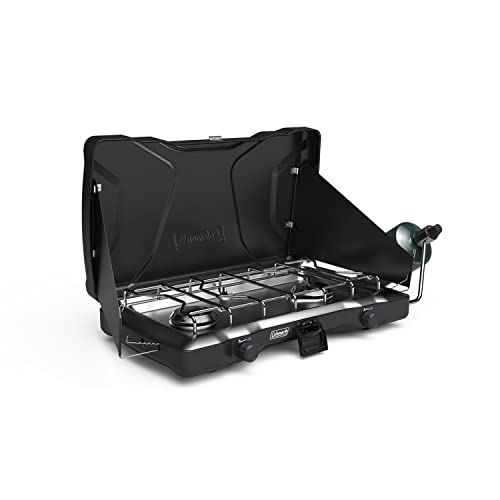
Eureka Ignite Plus 2-Burner Camp Stove
Eureka builds a wider burner ring and a more progressive valve, which is what makes actual cooking possible rather than just boiling. It holds a low flame without cutting out. Owners report it is the stove to pick if you cook real meals rather than reheating.
Pros
- Holds a genuine low simmer
- Wide burner spreads heat evenly
- Sturdy hinged wind panels
Cons
- Heavier than the Coleman
- Peak output trails the Camp Chef
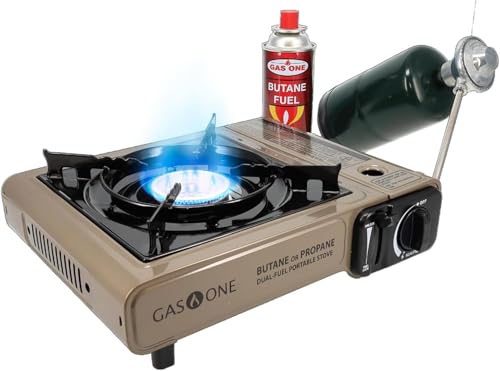
Gas One GS-3400P Portable Butane Stove
A single burner unit that runs on butane cartridges or propane with the included adapter, which is a useful hedge when one fuel is out of stock. It stores in a hard case and sets up in seconds. Based on specifications it is best kept out of hard wind and deep cold.
Pros
- Runs on either fuel type
- Sets up in seconds
- Compact hard case storage
Cons
- Butane performs poorly near freezing
- Single burner limits group cooking

Solo Stove Lite
A double wall wood burning stove that runs on twigs and pine cones, so there is no canister to carry or run out of. The secondary combustion design burns cleaner than an open fire. Owners report it is a joy in dry forest but frustrating after rain, when dry fuel is scarce.
Pros
- No fuel to buy or carry
- Clean secondary combustion
- Nothing to break or leak
Cons
- Useless where fires are banned or fuel is wet
- Needs constant feeding while cooking
Side by side
| # | Model | Burners | Best for | Score | Price |
|---|---|---|---|---|---|
| 1 | Camp Chef Everest 2X | Two, independently controlled | Best overall | 9.4 | Check price |
| 2 | Jetboil Flash Cooking System | Integrated canister system | Best for fast boiling | 9.2 | Check price |
| 3 | MSR PocketRocket 2 | Around 2.6 ounces | Best for backpacking | 9.0 | Check price |
| 4 | Coleman Cascade Classic 2-Burner Propane Stove | Two | Best value | 8.8 | Check price |
| 5 | Eureka Ignite Plus 2-Burner Camp Stove | Two | Best simmer control | 8.6 | Check price |
| 6 | Gas One GS-3400P Portable Butane Stove | One | Best for tailgating | 8.3 | Check price |
| 7 | Solo Stove Lite | Twigs and biomass | Best fuel free option | 8.0 | Check price |
Questions worth asking
Which fuel is best for camping stoves?
Propane for car camping, because it is cheap, widely stocked and works in cold. Isobutane propane canisters for backpacking, because of the weight saving. Avoid plain butane for anything below about forty degrees Fahrenheit.
Can I use a camp stove inside a tent?
No. Every fuel burning stove produces carbon monoxide, and tent fabric ignites easily. Cook in the open or under a well ventilated shelter with the stove clear of any fabric.
How long does a propane cylinder last?
It depends on burner output and how much you simmer. A standard portable cylinder typically covers a weekend of moderate two burner cooking. Cold weather and full output both shorten that considerably.
Do I need two burners?
If you cook for more than two people, yes, since one burner turns every meal into a queue. Solo and pair campers are usually better served by one efficient burner and a second small pot.
Why does my canister stove lose power as it empties?
Pressure drops as the canister empties and as it cools from its own evaporation. Keeping the canister slightly warm, for example in a jacket pocket before use, restores much of the output.
Are wood burning camp stoves worth it?
They are excellent where dry twigs are plentiful and fires are permitted. They are a poor primary choice for wet regions, alpine areas above the treeline and anywhere with fire restrictions.
How do I clean a camp stove burner?
Let it cool, brush the burner ports with a stiff brush, and clear blocked holes with a thin wire. Uneven or yellow flames are the usual sign of a partly blocked burner rather than a fuel problem.
Can I fly with camp stove fuel?
No. Fuel canisters and cylinders are prohibited in both checked and cabin baggage. Stoves themselves are generally allowed if completely free of fuel residue, so plan to buy fuel at your destination.
Our pick
The Camp Chef Everest 2X is the stove to buy if you cook for a group and camp in exposed places, because its output and wind shielding hold up when conditions do not. Solo hikers who mainly boil water get more from the Jetboil Flash and its fuel efficiency. For straightforward car camping without spending heavily, the Coleman Cascade Classic 2-Burner Propane Stove is still the safe pick.