Camping Stoves You Can Use Indoors With Ventilation
The Iwatani ZA-3HP is our overall pick thanks to its pressure sensor cutoff and consistent flame. The Gas One GS-3400P offers the best value with dual fuel flexibility, while the Coleman Portable Butane Stove is the simplest budget option for occasional tabletop cooking.
Among stoves genuinely designed for indoor tabletop cooking with ventilation, the Iwatani ZA-3HP is the one we would choose, with the Gas One GS-3400P offering dual fuel flexibility for less and the Coleman Portable Butane Stove covering occasional use on a budget.
This category needs a clear warning before anything else, because most camping stoves are strictly outdoor equipment and using them inside is genuinely dangerous. Liquid fuel, propane, wood and charcoal stoves produce carbon monoxide at levels that kill in enclosed spaces, and no amount of care changes that. The stoves ranked here are butane tabletop burners of the type used for restaurant tableside cooking, which are designed for indoor use in a well ventilated room with a working carbon monoxide alarm. We compared published safety systems, fuel types and burner output, along with what owners report about real world stability and flame control.
How to pick the right one
Only butane tabletop stoves belong indoors Propane, white gas, wood burning and charcoal stoves all produce carbon monoxide at levels that are dangerous in enclosed spaces, and some also present a real fire risk. Butane tabletop burners of the kind used for tableside cooking in restaurants are the exception, and even those require a well ventilated room. If a stove’s manual says outdoor use only, that instruction is not negotiable.
Ventilation and a carbon monoxide alarm are mandatory Any combustion indoors consumes oxygen and produces carbon monoxide, which has no smell and gives no warning. Open a window, run an extractor fan or range hood, and fit a working carbon monoxide alarm in the room before you cook. Never use one of these stoves in a tent, a camper van with the vents shut, a garage or any confined space.
Look for cartridge safety systems The most important safety feature on a butane stove is a system that ejects or shuts off the cartridge if pressure rises, which is what prevents a canister rupture when a pan or heat shield traps heat. Iwatani’s pressure sensing design is the reference point. Also never place an oversized pan or a griddle across the burner, because that reflects heat back onto the cartridge.
Match burner output to what you cook BTU ratings tell you how fast a burner heats, not how well it simmers. A high output burner boils water quickly but may be hard to turn low enough for sauces. For occasional tabletop cooking, controllability matters more than raw power, and stoves with a finer valve are worth the small premium.
Our top picks
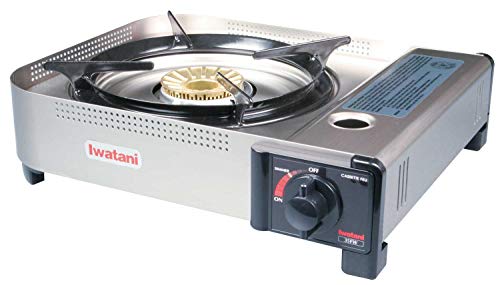
Iwatani ZA-3HP Portable Butane Stove
Iwatani effectively defined this category and the ZA-3HP shows why, with a pressure sensing cartridge ejection system that shuts the stove down if the canister overheats. The flame is even and controllable enough for real cooking rather than just boiling. It costs more than generic butane stoves and the safety engineering is the reason.
Pros
- Cartridge ejection system is the best safety design here
- Even, controllable flame for genuine cooking
- Solid build that lasts years
Cons
- Priciest option we ranked
- Butane performance drops in cold conditions
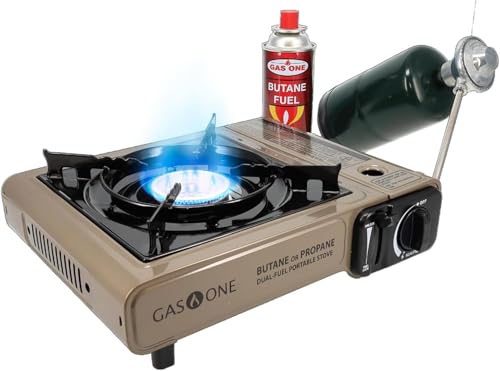
Gas One GS-3400P Dual Fuel Portable Stove
The dual fuel design accepts butane cartridges or propane canisters through an adapter, which is useful flexibility. For indoor use you should stay on butane, since propane belongs outdoors. Owners report solid output and reliable piezo ignition for the money.
Pros
- Fuel flexibility for indoor and outdoor use
- Carry case included
- Strong value against the Iwatani
Cons
- Only butane is appropriate indoors
- Pan supports are narrower than premium models
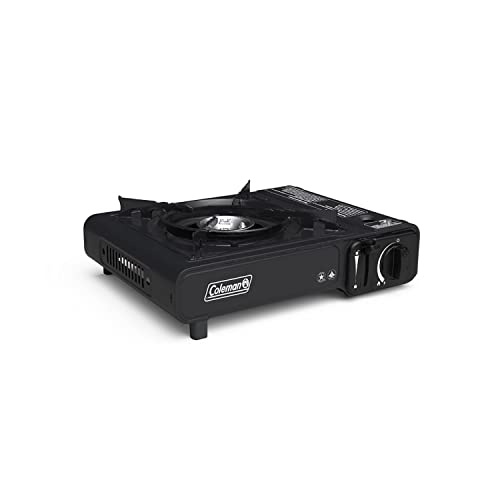
Coleman Portable Butane Stove
Coleman’s tabletop butane burner covers the basics from a brand with long standing support and easy parts availability. It includes an instant start ignition and a case for storage. Flame control is coarser than the Iwatani, which shows when simmering rather than boiling.
Pros
- Trusted brand with easy parts availability
- Simple to operate
- Includes a case for storage
Cons
- Coarser simmer control
- Lighter build than premium stoves
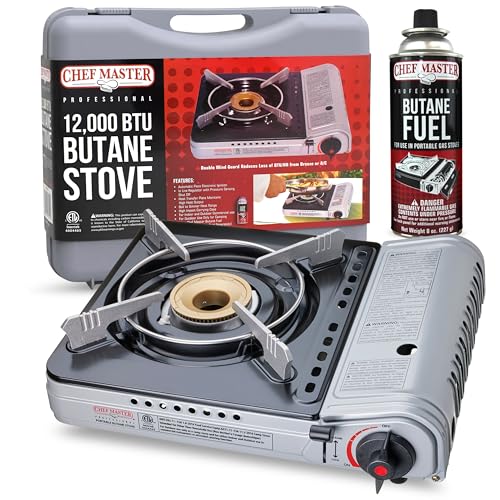
Chef Master 90019 Butane Countertop Range
Built for catering and buffet service, this is the sturdiest option here for someone cooking indoors regularly rather than occasionally. The wider pan supports handle larger pots without wobbling. It is bulkier than camping oriented stoves and less convenient to pack away.
Pros
- Stable with large or heavy pots
- Built for frequent use
- Straightforward controls
Cons
- Bulkier than camping stoves
- Less convenient to store

Sterno 50180 Single Burner Butane Stove
A compact single burner from a brand best known for catering fuel, this suits a dorm room, a small apartment or a kitchen being renovated. The footprint is small enough to store in a cupboard. Output is modest, so large pots take longer to come up to heat.
Pros
- Small enough to store easily
- Useful backup during a kitchen renovation
- Simple, few parts to fail
Cons
- Lower output than full size burners
- Small pan supports limit pot size

SereneLife Portable Butane Camp Stove Burner
A straightforward butane burner with a case, aimed at people who need a second cooking surface a few times a year rather than every week. Build quality is adequate rather than exceptional. Owners report it works well provided you use quality butane cartridges.
Pros
- Low cost for a spare burner
- Case keeps it clean in storage
- Simple cartridge loading
Cons
- Build quality is adequate rather than robust
- Sensitive to cheap butane cartridges
Martin Portable Butane Gas Stove
Kept in a cupboard with a few spare cartridges, this becomes a working cooktop when the power goes out, which is the most practical indoor use case for the whole category. It is basic, cheap and quick to deploy. Flame control is not refined enough for careful cooking.
Pros
- Inexpensive insurance against power cuts
- Quick to set up from cold storage
- Cartridges store safely for long periods
Cons
- Basic flame control
- Not built for daily cooking
How they stack up
| # | Model | Fuel | Best for | Score | Price |
|---|---|---|---|---|---|
| 1 | Iwatani ZA-3HP Portable Butane Stove | Butane cartridge | Best overall | 9.4 | Check price |
| 2 | Gas One GS-3400P Dual Fuel Portable Stove | Butane cartridge or propane with adapter | Best value | 9.2 | Check price |
| 3 | Coleman Portable Butane Stove | Butane cartridge | Best budget | 9.0 | Check price |
| 4 | Chef Master 90019 Butane Countertop Range | Butane cartridge | Best for regular cooking | 8.8 | Check price |
| 5 | Sterno 50180 Single Burner Butane Stove | Butane cartridge | Best for small kitchens | 8.6 | Check price |
| 6 | SereneLife Portable Butane Camp Stove Burner | Butane cartridge | Best for occasional use | 8.3 | Check price |
| 7 | Martin Portable Butane Gas Stove | Butane cartridge | Best for emergency backup | 8.0 | Check price |
Questions worth asking
Is it safe to use a camping stove indoors?
Only butane tabletop stoves specifically rated for indoor use, and only in a well ventilated room with a working carbon monoxide alarm. Propane, liquid fuel, wood and charcoal stoves are outdoor equipment and must never be used inside.
Why is carbon monoxide the main risk?
It is colourless and odourless, so there is no warning before symptoms begin, and symptoms resemble tiredness or flu. Combustion in an enclosed space produces it steadily, which is why ventilation and an alarm are non negotiable.
Can I use a butane stove in a tent or camper van?
No. Tents and closed vans are exactly the enclosed spaces where carbon monoxide accumulates fastest. Cook outside the tent, and in a camper van use only appliances designed and installed for that vehicle.
How long does a butane cartridge last?
Typically somewhere between one and two hours of continuous cooking at high output, and considerably longer at lower settings. Keep spares if you are relying on one during a power cut.
Can I use a griddle or large pan on a butane stove?
Manufacturers generally warn against pans wider than the stated maximum, because they trap heat over the cartridge compartment. Doing so is one of the main causes of cartridge failure, so check the manual limit and respect it.
How should butane cartridges be stored?
Upright, in a cool place away from direct sunlight and heat sources, and never in a car on a hot day. Remove the cartridge from the stove between uses rather than leaving it loaded.
Is an electric hotplate a better indoor option?
For pure indoor use, usually yes, because it produces no combustion gases at all. Butane stoves make sense specifically when you need cooking that works during a power cut or away from an outlet.
What should I do if I feel unwell while cooking?
Turn off the stove, get into fresh air immediately, and seek medical advice. Headache, dizziness or nausea while a combustion appliance is running should always be treated as a possible carbon monoxide warning rather than dismissed.
Our take
The Iwatani ZA-3HP is the stove we would choose for indoor tabletop cooking because its cartridge safety system is the most convincing in the category and the flame is genuinely controllable. The Gas One GS-3400P is the value pick provided you keep it on butane indoors. Whichever you use, ventilate the room and fit a carbon monoxide alarm, and never bring an outdoor only stove inside.