Car Amplifiers Compared for Clean Power and Loud Bass
The JL Audio JD400/4 is the top pick for driving a full speaker set cleanly. The Rockford Fosgate R500X1D Prime handles a single subwoofer at a lower cost, and the Kenwood KAC-M1804 fits tight mounting spaces where a full-size chassis will not.
JL Audio’s JD400/4 leads this ranking, with the Rockford Fosgate R500X1D Prime and Kenwood KAC-M1804 following for subwoofer duty and compact installs. All seven amplifiers below are currently sold on Amazon, covering everything from a factory system upgrade to a dedicated subwoofer channel.
Car amplifiers are hard to compare because peak power figures on the box rarely match what an amplifier delivers into a real load. We compared published continuous power ratings at common impedances, channel layouts and crossover features. Chassis dimensions and what installers report about heat and current draw rounded out the comparison.
The top picks, ranked
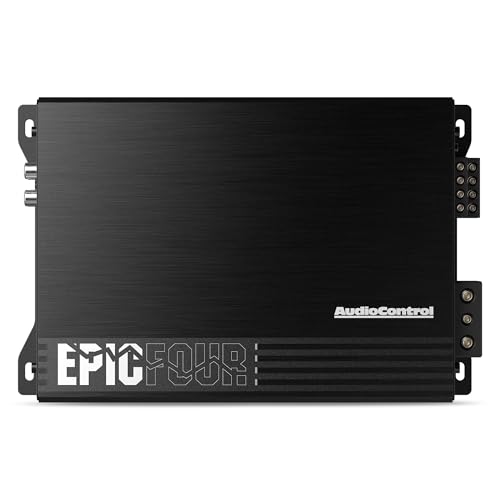
JL Audio JD400/4
This amplifier delivers a genuine hundred watts per channel into four ohms across four channels, with variable crossovers on each pair. That’s enough to drive front and rear speakers properly, or bridge the rear pair onto a subwoofer. Installers consistently call JL Audio’s power ratings conservative, the opposite of most of this market.
Pros
- Honest, conservative power ratings
- Flexible crossovers on both channel pairs
- Bridges to add a subwoofer channel
Cons
- Costs more than similarly rated rivals
- No built-in bass remote

Rockford Fosgate R500X1D Prime
Built for one job, this mono amplifier drives a subwoofer at low impedance with a stable class D design and a punch bass control. Five hundred watts into two ohms suits most single-sub installs. Owners report it stays cool in typical trunk mounting without extra ventilation.
Pros
- Ample power for a single subwoofer
- Runs cool in confined trunk spaces
- Straightforward setup controls
Cons
- Mono only, so it cannot drive speakers
- Bass boost is easy to overuse and distort

Kenwood KAC-M1804 Compact Amplifier
Genuinely small, this four-channel amplifier fits under a seat or behind a panel where a full-size chassis will not go. Power output is modest, but it comfortably outperforms a factory head unit. Conformal coating adds protection for marine and powersports use.
Pros
- Fits where full-size amplifiers cannot
- Weather-resistant coating for boats and utility vehicles
- Clear improvement over factory head unit power
Cons
- Modest power output
- Limited crossover adjustment

Alpine S-A60M Mono Amplifier
Packing six hundred watts at two ohms into a small chassis, this amp suits installs where a subwoofer enclosure already fills the trunk. A bass level control and variable low pass filter round out the controls. Alpine’s protection circuitry is well regarded for surviving marginal wiring.
Pros
- High output from a small chassis
- Subsonic filter protects the subwoofer
- Robust protection circuitry
Cons
- Bass remote sold separately
- Needs a solid power and ground run to perform

Kicker 46CXA6004 CX600.4 Amplifier
This unit delivers a hundred and fifty watts per channel into two ohms, enough headroom to run components up front and coaxials in back without straining. Crossover controls are clearly laid out, and a bass boost sits on the rear pair. It runs warmer than the JL Audio unit under sustained load.
Pros
- Plenty of headroom for a four-speaker system
- Clear crossover layout for setup
- Bridgeable for a subwoofer
Cons
- Runs warm under sustained high output
- Needs generous ventilation when mounted

Pioneer GM-D9705 Five Channel Amplifier
A five-channel amplifier drives four speakers and a subwoofer from a single chassis, halving the wiring and mounting space compared with two separate amplifiers. Class D efficiency and separate crossover sections handle that job here. Compromise is inherent to the format, but the convenience is real.
Pros
- Complete system from one chassis
- Single power and ground run to install
- Saves significant mounting space
Cons
- Less flexible than separate dedicated amplifiers
- Single point of failure for the whole system
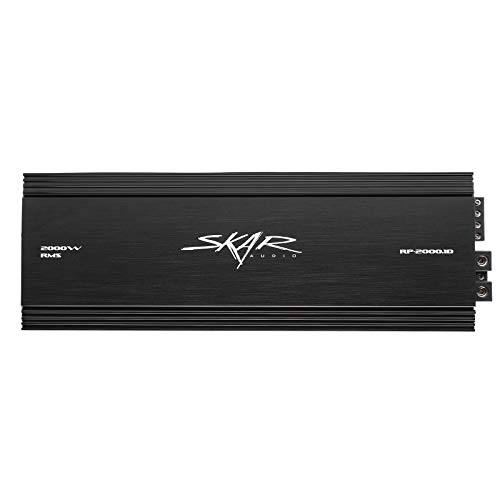
Skar Audio RP-2000.1D Monoblock Amplifier
Serious subwoofer output at one ohm is this amplifier’s job, territory that demands upgraded wiring and often a second battery. A bass remote and subsonic filter come included. This is specialist equipment rather than a general upgrade, and current draw reflects that.
Pros
- Very high output for demanding subwoofers
- Bass remote included in the box
- Stable at one ohm
Cons
- Requires upgraded wiring and charging system
- Excessive for a mild system upgrade
Compared at a glance
| # | Model | Channels | Best for | Score | Price |
|---|---|---|---|---|---|
| 1 | JL Audio JD400/4 | Four | Best overall | 9.4 | Check price |
| 2 | Rockford Fosgate R500X1D Prime | Mono | Best value for subwoofers | 9.2 | Check price |
| 3 | Kenwood KAC-M1804 Compact Amplifier | Four | Best for tight spaces | 9.0 | Check price |
| 4 | Alpine S-A60M Mono Amplifier | Mono | Best compact sub amp | 8.8 | Check price |
| 5 | Kicker 46CXA6004 CX600.4 Amplifier | Four | Best for a full system | 8.6 | Check price |
| 6 | Pioneer GM-D9705 Five Channel Amplifier | Five | Best all in one | 8.3 | Check price |
| 7 | Skar Audio RP-2000.1D Monoblock Amplifier | Mono | Best for high output subs | 8.0 | Check price |
What matters most
What does continuous power actually mean on an amplifier? Peak or maximum power figures describe a brief burst, largely a marketing number. Continuous power, sometimes labeled RMS, is what matters, along with the impedance it’s measured at. A hundred watts per channel at four ohms is a very different amplifier from one claiming a thousand watts peak. Match continuous power to the speaker’s continuous handling and you’ll rarely go wrong.
How many amplifier channels do you actually need? A mono amplifier drives a subwoofer only. A four-channel amplifier drives front and rear speakers, or front speakers plus a bridged subwoofer. Five-channel units do everything from one chassis, saving space and wiring at the cost of flexibility. Decide the system’s final shape before buying, since adding a subwoofer later to a full four-channel amp usually means buying a second amplifier.
Why does impedance change an amplifier’s power rating? Amplifier ratings rise as impedance falls, which is why the same unit gets quoted at very different figures into four, two and one ohms. What matters is that the amplifier is rated stable at the impedance your subwoofer wiring presents. Dual voice coil subwoofers can often wire to two different impedances, so plan the wiring and the amplifier together.
What does a proper amplifier installation require? An amplifier only delivers what its wiring supplies, so use the recommended cable gauge and fit the fuse close to the battery. Ground to bare chassis metal, never a painted panel. Mount the amplifier where air circulates around the heatsink, never sealed under carpet, and keep power and signal cables on opposite sides of the vehicle to avoid alternator whine.
Questions worth asking
How much power do my car speakers need?
Match the amplifier’s continuous power per channel to the speaker’s continuous rating, ideally at or slightly above it. Extra amplifier power with the gain set correctly is safer than an underpowered amp driven into clipping, which is what actually destroys tweeters.
Do I need an amplifier if my head unit has built-in power?
A head unit typically produces far less real power than its rating suggests, and it runs out of headroom quickly at road speed. An external amplifier gives cleaner output at volume and is essential for any subwoofer or component speaker set.
What does class D mean on a car amplifier?
Class D describes a switching design that’s far more efficient than older class A or class AB layouts, producing less heat and drawing less current for the same output. Nearly every modern car amplifier, including every pick here, uses it.
Can one amplifier run both speakers and a subwoofer?
Yes, in two ways. A five-channel amp like the Pioneer GM-D9705 has a dedicated subwoofer channel, and many four-channel amps bridge the rear pair into a single subwoofer channel. Bridging costs you the rear speakers, so decide which arrangement you want first.
What size wiring kit does a car amplifier need?
It depends on current draw and cable run length, and the amplifier manual specifies a minimum gauge. Undersized cable is the most common cause of poor performance and overheating connections. Use genuine copper cable, not copper-clad aluminum, and fit the main fuse close to the battery.
Why does my amplifier keep going into protection mode?
Common causes are impedance below the amplifier’s stable rating, a shorted speaker wire, inadequate ventilation causing thermal shutdown, or a poor ground connection. Check the ground first, since a bolt onto painted metal is the single most frequent installation fault.
How do I set an amplifier’s gain correctly?
Gain matches the amplifier’s input sensitivity to the head unit’s output; it isn’t a volume control. Set the head unit to roughly three-quarters volume with tone controls flat, raise the gain until distortion first appears, then back it off.
Do car amplifiers need a second battery or bigger alternator?
Not for a modest system. High-output subwoofer amplifiers like the Skar RP-2000.1D can exceed what a standard charging system supplies, showing up as dimming lights and voltage drops. At that point, a bigger alternator or an added battery becomes necessary.
Our pick
The JL Audio JD400/4 makes the strongest all-round system amplifier, with honest power ratings and headroom for a full speaker set. Choose the Rockford Fosgate R500X1D Prime for single-subwoofer duty, or the Pioneer GM-D9705 to run everything from one chassis. Tight installs are exactly what the Kenwood KAC-M1804 exists for.