Power Steering Fluid: Matching the Type to Your Car
Prestone AS261 is our overall pick for its broad compatibility and clear labelling. Lucas Oil 10442 is the choice for a pump that has started whining, and Honda Genuine Power Steering Fluid is the only sensible option for Honda and Acura systems that reject universal formulas.
Prestone AS261 leads this list because it meets a wide range of manufacturer specifications and states them plainly on the bottle, which is the single most useful thing a power steering fluid can do. Lucas Oil 10442 is the pick when a pump has begun groaning at low speed, since its conditioners target hardened seals, and Honda Genuine Power Steering Fluid is the correct answer for Honda and Acura systems that are known to reject universal fluids.
Power steering fluid is deceptively tricky to buy because the bottles all look interchangeable and they are not. Some vehicles call for automatic transmission fluid, some for a dedicated mineral based power steering fluid, some for a specific synthetic like Pentosin CHF 11S, and Honda systems are notorious for damage when filled with anything other than the factory fluid. Mixing incompatible chemistries can swell or shrink seals and leave you replacing a rack. We compared the specifications each fluid claims to meet, base oil chemistry, seal conditioner content, cold weather behaviour and what owners report about noise and leaks after a flush, then weighed those against how clearly each bottle communicates what it is actually for.
What matters most
Read the manual before you read the bottle The single most important step is finding what your vehicle actually specifies, because the answer varies more than shoppers expect. Many Ford, GM and Chrysler vehicles call for automatic transmission fluid rather than power steering fluid. Most Japanese vehicles other than Honda take a dedicated power steering fluid. Honda and Acura require their own formulation. Many European vehicles, particularly Volkswagen, Audi, BMW and Mercedes, specify a green synthetic to the Pentosin CHF 11S standard, and putting anything else in one of those systems is expensive. The reservoir cap often prints the requirement, and the manual always does.
What happens when the fluid is wrong Different fluid chemistries interact differently with the elastomer seals in a rack and pump. The wrong fluid can swell seals until they bind, or shrink them until they leak, and neither shows up immediately. The usual sequence owners report is a squeal on startup, then stiff steering when cold, then a persistent leak, then a rack replacement. Automatic transmission fluid in a system designed for dedicated power steering fluid is the most common mistake, and Honda systems are the least forgiving of any substitution.
Flushing versus topping up Adding fluid to bring a low reservoir back to the mark is a five minute job. Exchanging the fluid properly means removing the old fluid from the reservoir with a syringe or turkey baster, refilling, running the engine while turning lock to lock a few times, then repeating until what comes out looks clean. Three or four cycles usually gets most of the old fluid out without disconnecting a line. If the fluid is dark brown or smells burnt, an exchange is worthwhile regardless of mileage.
Diagnose the noise before you buy a bottle A whine that rises with engine speed usually means low fluid or air in the system, and topping up plus bleeding by turning lock to lock with the engine idling often clears it. A groan that appears mainly at parking speeds suggests aged fluid or hardening seals, which a conditioner fluid can help. A grinding or metallic sound is mechanical failure inside the pump, and no fluid will address that. Foam or bubbles visible in the reservoir mean air is being drawn in, usually at a low pressure hose clamp or the reservoir seal, so find the leak rather than repeatedly refilling.
The best picks, ranked
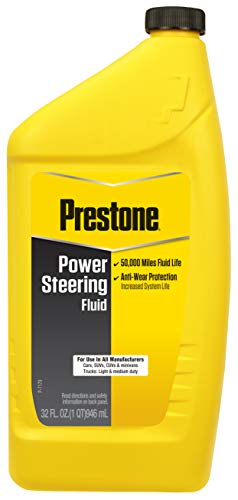
Prestone AS261 Power Steering Fluid
Prestone covers most domestic and many Asian applications in one bottle and prints the specifications it meets on the label rather than making vague universal claims. The formulation includes seal conditioners and anti foam additives, which is what keeps assist consistent during quick lock to lock steering. Always confirm your owner manual before pouring, because wide compatibility is not the same as universal.
Pros
- States the specifications it meets clearly
- Seal conditioners included as standard
- Widely stocked so top ups are easy
Cons
- Not suitable for Honda or many European systems
- Conventional base offers less cold flow than synthetics

Lucas Oil 10442 Power Steering Fluid with Conditioners
Lucas leans heavily on conditioners aimed at seals that have hardened with age, which is the usual cause of the low speed groan and the weep at the reservoir. Owners report noise reduction after a full fluid exchange rather than a top up, which makes sense given the old fluid has to leave. It will not fix a mechanically failed pump, and treating it as a repair in a bottle is a mistake.
Pros
- Conditioner package targets aged, hardened seals
- Owners report reduced pump groan after an exchange
- Blends with conventional fluid already in the system
Cons
- Does nothing for mechanically worn pumps
- Thicker feel in very cold starts

Valvoline Full Synthetic Power Steering Fluid
A synthetic base flows better on a cold morning, which is when pumps are loudest and wear fastest, and it resists thermal breakdown in systems that run hot from towing or stop and go traffic. Valvoline covers a broad range of applications and includes anti wear additives. It costs more per bottle, and the benefit is most obvious in northern winters.
Pros
- Noticeably better flow on cold starts
- Resists breakdown in hot running systems
- Mixes safely with conventional fluid of the same spec
Cons
- Costs more than conventional alternatives
- Still not a substitute for Honda or Pentosin specifications
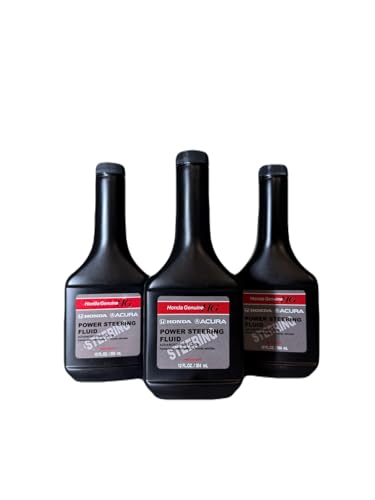
Honda 08206-9002 Genuine Power Steering Fluid
Honda power steering systems are the best known example of a design that genuinely requires its own fluid, and owners report squealing, stiff steering and eventual rack damage from universal fluids or ATF. This is the factory formulation, and there is no good reason to substitute. Buy several bottles if you are doing a proper turkey baster exchange over multiple cycles.
Pros
- The only fluid Honda specifies for its systems
- Eliminates the squeal caused by wrong fluid
- Removes any compatibility guesswork
Cons
- Costs more per bottle than universal fluids
- Useless for any other manufacturer

Royal Purple Max EZ Power Steering Fluid
Royal Purple combines a synthetic base with a conditioner package, which suits a vehicle past a hundred thousand miles where the seals are old but the pump is still healthy. The claimed benefit is smoother assist and quieter operation, and owners report the difference is clearest on cold mornings. Check compatibility carefully, as with any premium aftermarket fluid.
Pros
- Synthetic base with a conditioner package included
- Suits older systems that are noisy but not failing
- Stable in high temperature operation
Cons
- Premium pricing for an incremental benefit
- Compatibility list is narrower than mainstream brands

Red Line 30404 Power Steering Fluid
Red Line targets vehicles that see track days, autocross or heavy towing, where the fluid sees sustained high temperature and conventional formulations start to foam and lose assist. The synthetic base holds viscosity under that load. For a commuter car this is more fluid than the application needs, and the price reflects the intended use.
Pros
- Holds viscosity under sustained heat
- Resists foaming during repeated hard steering
- Well regarded in motorsport applications
Cons
- Overspecified and expensive for daily driving
- Limited availability compared with mainstream brands

STP Power Steering Fluid
For topping a reservoir back to the cold fill line on a system that is otherwise healthy, an inexpensive conventional fluid is entirely adequate, and STP is stocked almost everywhere. It includes basic conditioners and anti foam additives. Check the label against your manual, since like all universal fluids it does not cover Honda or most European applications.
Pros
- Cheapest way to keep a spare bottle in the boot
- Available almost anywhere for emergency top ups
- Adequate for healthy conventional systems
Cons
- Basic additive package compared with rivals
- Not suitable for Honda or European specifications
The lineup, side by side
| # | Model | Type | Best for | Score | Price |
|---|---|---|---|---|---|
| 1 | Prestone AS261 Power Steering Fluid | Conventional power steering fluid | Best overall | 9.4 | Check price |
| 2 | Lucas Oil 10442 Power Steering Fluid with Conditioners | Power steering fluid with conditioners | Best for a noisy pump | 9.2 | Check price |
| 3 | Valvoline Full Synthetic Power Steering Fluid | Full synthetic | Best synthetic | 9.0 | Check price |
| 4 | Honda 08206-9002 Genuine Power Steering Fluid | Honda specific formulation | Best for Honda and Acura | 8.8 | Check price |
| 5 | Royal Purple Max EZ Power Steering Fluid | Synthetic with seal conditioners | Best for high mileage systems | 8.6 | Check price |
| 6 | Red Line 30404 Power Steering Fluid | Synthetic performance fluid | Best for performance use | 8.3 | Check price |
| 7 | STP Power Steering Fluid | Conventional power steering fluid | Best budget | 8.0 | Check price |
Common questions
Can I use automatic transmission fluid as power steering fluid?
Only if your vehicle specifies it, which many Ford, GM and Chrysler models do. Check the reservoir cap and the owner manual. In a system designed for dedicated power steering fluid, ATF has a different additive and friction package and can affect the seals over time.
Is universal power steering fluid safe for any car?
No. Universal describes broad coverage across common domestic and Asian systems, not every vehicle. Honda and Acura systems and most European systems calling for Pentosin CHF 11S are explicitly outside that coverage, and using a universal fluid in either is a known cause of noise and eventual damage.
How often should power steering fluid be changed?
Many manufacturers list it as fill for life, which in practice means it is never scheduled. A common independent recommendation is every fifty to a hundred thousand miles, or whenever the fluid turns dark and smells burnt. Vehicles that tow, sit in traffic or live in hot climates work the fluid harder.
Why is my power steering whining after adding fluid?
Almost always air trapped in the system. With the engine idling, turn the wheel slowly lock to lock several times, then check the level again once it settles. If the noise persists and the reservoir shows foam, air is being drawn in somewhere, commonly at a low pressure hose connection or the reservoir seal.
Do power steering stop leak additives work?
They can slow a weep from a hardened seal by swelling the rubber, and fluids with conditioners do the same thing more gently. Neither fixes a torn seal, a scored rack shaft or a failing pump. Treat them as a way to buy time before a proper repair rather than a solution.
What colour should power steering fluid be?
It depends on the type. Conventional fluid is usually amber or clear, ATF used in steering systems is red, and many European synthetics are green. What matters is the change over time. Dark brown or black fluid with a burnt smell has degraded and should be exchanged whatever colour it started.
Can I mix two different power steering fluids?
Only if both meet the same specification for your vehicle. Topping conventional fluid with a synthetic of the same specification is generally fine. Mixing across chemistries, such as adding a universal fluid to a Honda or Pentosin system, is the situation that causes problems.
How much power steering fluid does a flush need?
Typically one to two quarts for a syringe exchange over three or four cycles, since each cycle only replaces what the reservoir holds. A full flush with the return line disconnected uses more, commonly two to three quarts. Buying an extra bottle is cheaper than stopping halfway through.
Our take
Prestone AS261 is the sensible default for most domestic and Asian vehicles, mainly because it tells you exactly what it meets instead of leaning on the word universal. If the pump has started groaning at parking speeds and the system is otherwise sound, exchange the fluid for Lucas Oil 10442 and give the conditioners a few hundred miles to work. Honda and Acura owners should skip all of that and buy the Honda Genuine fluid, because the alternative is a rack.


