Which LED Headlight Kit Fits Your Car’s Housing?
The SEALIGHT Scoparc S1 offers the most consistent beam pattern in reflector housings, which is where most conversions go wrong. The Hikari Ultra LED Headlight Bulbs suit projector housings needing more output, while the Fahren H11 LED Headlight Bulbs are the value pick with solid cooling.
The SEALIGHT Scoparc S1 is the LED conversion kit that behaves best in the reflector housings most cars use, with the Hikari Ultra for projector housings and the Fahren H11 as the value choice when budget matters more than the last few percent of output.
LED headlight conversions are difficult to judge because the headline lumen figures are meaningless if the chips sit in the wrong place for your housing, producing glare rather than usable road light. We compared chip layout, heat management design, base dimensions and published housing guidance, weighting beam pattern quality over raw brightness. Check the road legality of aftermarket LED conversions in your country and confirm the bulb fitment for your specific vehicle before buying.
What we recommend

SEALIGHT Scoparc S1
SEALIGHT positions the chips to mimic a halogen filament closely, which is the single factor that determines whether a reflector housing produces a clean cutoff or scatter. Owners report a noticeably tidier beam than generic kits at similar output. The compact driver makes it easier to fit behind dust caps than bulkier designs.
Pros
- Clean cutoff in reflector housings
- Compact enough for tight dust caps
- Even colour across the beam
Cons
- Not the brightest kit on paper
- Fitment varies by vehicle dust cap depth

Hikari Ultra LED Headlight Bulbs
Higher output makes more sense in a projector housing, where the lens and shield control the beam and extra brightness is put to use rather than scattered. Hikari pairs that output with active cooling to keep the chips within their thermal envelope. It is the wrong choice for open reflector housings on a shared road.
Pros
- Strong output where a projector can control it
- Active cooling supports sustained brightness
- Solid build quality
Cons
- Fan is an additional failure point
- Excessive glare in reflector housings
Fahren H11 LED Headlight Bulbs
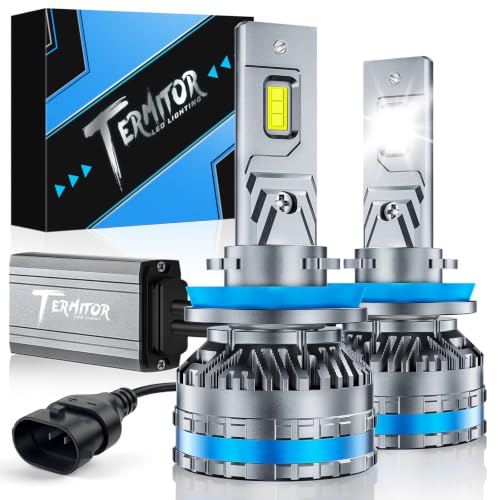
Fahren has built a reputation on turbo fan cooling at a mid range price, which matters because heat is the main reason LED bulbs dim or fail early. Beam quality is respectable if not class leading. Based on specifications it fits a wide range of common housings without adapters.
Pros
- Effective cooling for the price
- Wide fitment availability
- Consistent colour temperature
Cons
- Beam pattern trails the best kits
- Fan noise audible with the bonnet open

Auxbeam F-16 Series LED Headlight Bulbs
The short body and compact driver make this one of the easier kits to fit where the dust cap leaves little room behind the bulb. That practical advantage matters more than a small brightness difference if the alternative is not fitting at all. Owners report it clears most factory dust caps without modification.
Pros
- Fits behind shallow dust caps
- Integrated driver avoids loose ballast boxes
- Straightforward installation
Cons
- Moderate output compared with larger kits
- Beam pattern housing dependent

Cougar Motor F5 LED Headlight Bulbs
Cougar Motor puts the emphasis on thermal management and driver quality, which are the components that determine whether a kit lasts years or months. The build feels heavier than budget bulbs. It is a sensible choice for a vehicle where changing bulbs means removing a bumper.
Pros
- Substantial heat management
- Sealed driver resists moisture
- Good choice for awkward access vehicles
Cons
- Bulkier than compact kits
- Needs clearance behind the housing

Lasfit LC Plus LED Headlight Bulbs
Many modern vehicles report a bulb fault when a low draw LED replaces a halogen, and Lasfit designs around that with better electrical compatibility. That saves buying separate decoders for many cars. Fitment specific listings help avoid the wrong base type.
Pros
- Fewer dashboard bulb warnings
- Vehicle specific fitment guidance
- Stable output
Cons
- Some vehicles still need separate decoders
- Not the brightest option available

Beamtech H11 LED Headlight Bulbs
A long standing budget option that gets the fundamentals right without extras, using a fanless heat sink that has no moving parts to fail. Output is modest but the colour is consistent. It suits a second vehicle or a low mileage car where a full upgrade is hard to justify.
Pros
- No fan to fail
- Low cost entry to LED
- Consistent colour output
Cons
- Lower output than fan cooled kits
- Passive cooling limits sustained brightness
How they compare
| # | Model | Chip layout | Best for | Score | Price |
|---|---|---|---|---|---|
| 1 | SEALIGHT Scoparc S1 | Filament mimicking placement | Best overall | 9.4 | Check price |
| 2 | Hikari Ultra LED Headlight Bulbs | High, projector oriented | Best for projectors | 9.2 | Check price |
| 3 | Fahren H11 LED Headlight Bulbs | Turbo fan | Best value | 9.0 | Check price |
| 4 | Auxbeam F-16 Series LED Headlight Bulbs | Short, tight clearance friendly | Best for tight housings | 8.7 | Check price |
| 5 | Cougar Motor F5 LED Headlight Bulbs | Aluminium heat sink with fan | Best for durability | 8.5 | Check price |
| 6 | Lasfit LC Plus LED Headlight Bulbs | Improved CANbus compatibility | Best for CANbus vehicles | 8.3 | Check price |
| 7 | Beamtech H11 LED Headlight Bulbs | Fanless heat sink | Best budget | 8.0 | Check price |
What to look for
Reflector or projector decides everything Halogen reflector housings are shaped around a filament in a very specific position, so an LED whose chips sit differently throws light where the reflector was never designed to send it. That produces glare for oncoming drivers and often less usable road light for you. Projector housings use a lens and a cutoff shield, so they tolerate LED conversions far better. Look at your headlight: a visible lens ball behind the glass means projector, an open mirrored bowl means reflector.
Lumen claims are largely marketing Advertised lumen figures for aftermarket LED kits are frequently theoretical chip ratings rather than measured output at the bulb, and they say nothing about where that light goes. A well designed kit at a modest rating will out perform a badly designed one claiming a much higher number. Judge on chip placement, cooling design and beam photos from real vehicles rather than the headline figure printed on the box.
Cooling determines how long the kit lasts LEDs dim as they heat, and the driver electronics fail if heat is not moved away. Fan cooled bulbs manage heat more actively but add a moving part that can seize, particularly in a damp housing. Fanless heat sink designs are more robust but need airflow and generally run at lower output. Neither approach is universally better, but a kit with inadequate cooling of either type will disappoint within a year.
Check fitment and legality before ordering Measure the space behind the headlight, because many kits will not clear the factory dust cap and some vehicles need an extended cap. Confirm the bulb base code for your specific vehicle and year rather than assuming. Also check the rules where you drive: in many countries an LED conversion in a housing approved for halogen bulbs is not road legal and can fail a roadworthiness inspection, regardless of how well it performs.
Common questions
Are LED headlight conversion kits road legal?
It varies by country. In many places retrofitting LEDs into a housing type approved for halogen is not legal for road use and may fail an inspection. Check local regulations first.
Will LEDs work in reflector headlights?
They can, but only kits with accurate filament mimicking chip placement produce an acceptable pattern. Poorly designed kits scatter light and dazzle oncoming drivers.
Why do I get a dashboard bulb warning?
LEDs draw far less current than halogens, so some vehicles report a fault. Kits designed for CANbus compatibility usually avoid this, otherwise a decoder module is needed.
What colour temperature should I choose?
Around 5000K to 6000K is the practical range. Higher colour temperatures look bluer but perform worse in rain and fog.
Do LED headlight bulbs need adjusting after fitting?
Beam alignment should be checked after any bulb change, and it matters more with LEDs because the light source position differs from the original halogen.
Are fanless LED bulbs better than fan cooled?
Fanless bulbs have no moving parts to fail but generally run at lower output. Fan cooled bulbs sustain more brightness but add a potential failure point.
Will an LED kit fit behind my dust cap?
Not always. Measure the depth available behind the bulb and choose a short body kit, or fit an extended dust cap where one is available for your vehicle.
How long do LED headlight bulbs last?
Well cooled kits commonly run for years. Early dimming or failure almost always traces back to inadequate heat management rather than the LED chips themselves.
Our take
The SEALIGHT Scoparc S1 is the safest recommendation because it gets chip placement right, which matters far more than lumen claims in the reflector housings most cars have. Choose the Hikari Ultra if your car has projector housings that can control the extra output, and the Fahren H11 if you want strong cooling at a lower outlay.