Car Subwoofers That Actually Fit Your Trunk and Budget
Rockford Fosgate’s P300-12 leads as an all in one powered enclosure, skipping amplifier matching entirely. Kicker’s CompRT 10 suits shallow under seat spaces. JL Audio’s 10W3v3-4 wins on accuracy when clean bass lines matter more than raw volume.
Skip the guesswork and the Rockford Fosgate P300-12 solves it: amplifier, box and driver arrive matched, needing only power, ground and a signal wire. Under seat space calls for the Kicker CompRT 10 instead. Chasing accuracy over volume points to the JL Audio 10W3v3-4.
Subwoofer shopping goes wrong because the driver is only one third of the equation. Enclosure and amplifier decide what actually reaches your ears, and a strong driver in the wrong box underperforms a modest one built correctly. We compared RMS power handling, mounting depth, recommended enclosure volumes, impedance and sensitivity across current listings, then weighed that against what owners report about rattles, trunk space and daily usability.
The top picks, ranked

Rockford Fosgate P300-12 Powered Subwoofer Enclosure
Power, ground, remote turn on and signal are the only wires this box needs. A 12 inch driver sits inside a sealed enclosure with a 300 watt amplifier built in, so no separate amp matching is required. Owners describe tight, controlled bass rather than one note boom, with a remote knob for adjusting level from the driver seat.
Pros
- No amplifier or enclosure matching needed
- Remote level control reachable from the seat
- Bass stays tight instead of one note boom
Cons
- Takes real space in the trunk
- Output ceiling fixed by the built in amp
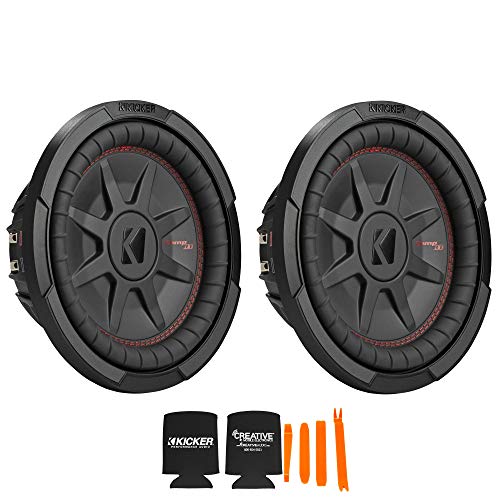
Kicker 48CWRT102 CompRT 10 Inch Subwoofer
Shallow mounting depth lets this driver slide under a seat or behind a rear panel where full size subs cannot go. Power handling reaches 400 watts RMS despite the slim profile, and dual 2 ohm voice coils allow flexible wiring. Buyers still need to size an enclosure and match an amplifier separately.
Pros
- Fits under seat spaces normal subs miss
- Handles 400 watts RMS despite its depth
- Dual voice coils simplify amplifier wiring
Cons
- Enclosure volume must be sized precisely
- Amplifier sold separately, adds to setup

JL Audio 10W3v3-4 10 Inch Subwoofer
Accuracy defines this driver more than raw output, reproducing bass lines with definition instead of a general rumble. A compact sealed box suits it well, which helps anyone short on trunk space. JL Audio publishes detailed enclosure parameters, so building or buying the right box is straightforward.
Pros
- Defined bass instead of generic boom
- Performs well in a compact sealed box
- Enclosure specifications are published in detail
Cons
- Costs more than comparable 10 inch drivers
- Needs a quality amplifier to sound its best

Alpine S2-W12D4 12 Inch Subwoofer
Excursion and power handling both run high here, built for bass you feel as much as hear. A braced enclosure and a capable amplifier are needed to unlock that potential. Owners often address cabin rattles first, since the driver exposes weak points elsewhere in the car.
Pros
- High output backed by strong excursion
- Dual 4 ohm coils suit varied amp setups
- Build quality holds up under heavy use
Cons
- Reveals rattles elsewhere in the cabin
- Needs a large enclosure for best results

Pioneer TS-WX130DA Compact Powered Subwoofer
Sliding under a seat, this slim powered unit adds low end without claiming any trunk space. Output trails a full size enclosure, but in a small hatchback it fills gaps factory speakers leave behind. A wired remote handles level changes, and wiring stays simple throughout.
Pros
- Uses zero trunk space
- Wiring and setup stay simple
- Wired remote adjusts level on the move
Cons
- Output is modest next to full size subs
- Under seat clearance varies by vehicle
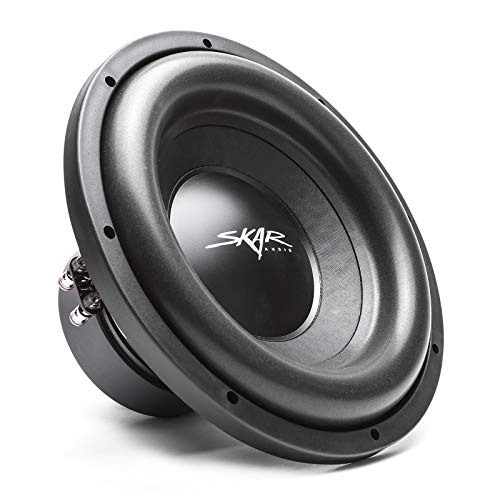
Skar Audio SDR-12 D2 12 Inch Subwoofer
High power handling for a modest outlay built Skar’s reputation, and this 12 inch driver follows that pattern. A ported enclosure lets it play loud, suiting bass heavy genres more than acoustic tracks. Build quality beats the price point, though refinement sits behind premium brands.
Pros
- 800 watts RMS handling for the price
- Plays loud in a ported enclosure
- Solid build quality for a value driver
Cons
- Less refined than premium drivers
- Ported box requirement eats trunk space

Rockville W12K9D2 12 Inch Subwoofer
Lowest cost route here to a full size 12 inch driver, with power figures that look generous on paper. Real world output stays respectable inside a well built ported box paired with an honest amplifier. Treat peak power claims with scepticism and match gear to the RMS rating instead.
Pros
- Lowest outlay for a full size driver
- Respectable output in a proper enclosure
- Dual voice coils allow wiring flexibility
Cons
- Peak power claims overstate real capability
- Sound control trails premium drivers
What to look for
Powered enclosure or separate components? A powered enclosure bundles driver, box and amplifier already matched, so setup is wiring only and the result is predictable. Separate components reach higher performance but hand you enclosure volume math, amplifier matching and wiring choices. First subwoofer, and want a result rather than a project? A powered enclosure is the honest recommendation.
Sealed vs ported: what changes in the sound Tighter, more accurate bass and a smaller footprint come from a sealed enclosure, which suits most music and most trunks. Ported boxes play louder and reach lower for the same power, at the cost of size and control. Varied music and accuracy favor sealed; volume and low extension favor ported.
How to match amplifier power correctly RMS is the only power figure worth comparing, since peak numbers are marketing. An amplifier’s RMS output at the subwoofer’s impedance should sit close to the driver’s RMS rating. Underpowering causes more damage than slight overpowering, because a clipping amp sends distorted signal that destroys voice coils faster than clean power does.
Measuring trunk space before you buy Mounting depth catches people out most often, particularly with under seat and behind panel installs where a conventional driver simply will not fit. Shallow mount subwoofers exist for exactly that reason. Measure available depth, width and enclosure volume first, then filter drivers by those numbers before weighing performance.
Side by side
| # | Model | Driver | Best for | Score | Price |
|---|---|---|---|---|---|
| 1 | Rockford Fosgate P300-12 Powered Subwoofer Enclosure | 12 inch | Best overall | 9.4 | Check price |
| 2 | Kicker 48CWRT102 CompRT 10 Inch Subwoofer | 10 inch shallow mount | Best for shallow spaces | 9.2 | Check price |
| 3 | JL Audio 10W3v3-4 10 Inch Subwoofer | 10 inch | Best sound quality | 9.0 | Check price |
| 4 | Alpine S2-W12D4 12 Inch Subwoofer | 12 inch | Best for high output | 8.8 | Check price |
| 5 | Pioneer TS-WX130DA Compact Powered Subwoofer | Compact powered enclosure | Best for small cars | 8.6 | Check price |
| 6 | Skar Audio SDR-12 D2 12 Inch Subwoofer | 12 inch | Best value driver | 8.3 | Check price |
| 7 | Rockville W12K9D2 12 Inch Subwoofer | 12 inch | Best budget | 8.0 | Check price |
Frequently asked questions
Do I need an amplifier for a car subwoofer?
Yes, unless a powered enclosure with the amplifier built in is the choice. A head unit cannot drive a subwoofer properly, since its preout exists to feed an external amplifier.
What size subwoofer should I get?
Ten inch drivers respond quicker and stay more accurate, while twelve inch drivers move more air and dig lower. Available space usually decides for you. Two smaller drivers can also outperform one larger one while fitting a shallower area.
Will a subwoofer drain my car battery?
Not at normal listening levels with a healthy charging system. High power systems run with the engine off will drain a battery, and very high power installs sometimes need an upgraded alternator or a second battery.
Sealed or ported enclosure, which should I choose?
Sealed suits accuracy and compact size, ported suits volume and lower extension. Varied music tastes lean toward sealed, while bass heavy genres benefit more from ported.
Can I install a subwoofer without cutting my car?
Yes. Powered enclosures and under seat units install with wiring only. Custom fiberglass or panel mounted installs are the only builds that require cutting, and those stay optional rather than typical.
Why does my car rattle when the bass plays?
Panels, trim clips and the number plate resonate at low frequencies. Sound deadening material on the trunk lid and door panels addresses most of it, and tightening loose trim handles the rest.
What does dual voice coil mean on a subwoofer?
Two separate coils sit inside the driver, letting it wire to different total impedances to suit an amplifier. Wiring flexibility is the benefit, not extra output on its own.
How do I set subwoofer gain correctly?
Gain matches an amplifier to the head unit’s output level; it is not a volume control. Set the head unit to around three quarters volume, raise the gain until distortion appears, then back it off. Setting gain by ear at maximum volume is how voice coils get damaged.
The bottom line
Rockford Fosgate’s P300-12 suits most cars, delivering clean bass without any matching decisions. Depth constrained trunks favor the Kicker CompRT 10. Want to hear bass lines rather than just feel them? The JL Audio 10W3v3-4 delivers that.


