6 Cold Frames That Extend Your Growing Season
Juwel’s Biostar 1500 leads because twin wall polycarbonate holds overnight warmth and its ratchet lid stays make precise venting easy. Choose the Palram Canopia Cold Frame for similar durability at a lower outlay, or the Outsunny wooden cold frame when a traditional timber look on a raised bed matters.
For gardeners planning to use a frame every season, the Juwel Biostar 1500 is the one to buy. Twin wall polycarbonate holds heat far better than single glazing, and ratchet lid stays set precise ventilation instead of a brick propping the lid. Palram’s Canopia Cold Frame does most of that job in a smaller, cheaper package, and the Outsunny wooden frame wins where looks on a raised bed count as much as performance.
Cold frames fail in two predictable ways: seedlings cook on a sunny February afternoon because nobody vented the lid, or a gale takes the lid off an unanchored box. Glazing choice, lid hardware, and wind behavior therefore matter more than raw capacity. We compared glazing materials, venting mechanisms, frame construction, footprint, and assembly, weighed against what owners report after two or three seasons outdoors.
What to look for
What does a cold frame actually do? A cold frame extends the growing season at both ends rather than creating winter growing space. In late winter it hardens off seedlings raised indoors. Spring sowings of hardy crops start earlier under one, autumn salads and hardy greens run weeks longer, and dormant cuttings shelter through winter inside. Expecting tender crops to survive a hard freeze in an unheated box leads to disappointment.
Which glazing is best for a cold frame? Twin wall polycarbonate traps a layer of air, holding warmth into the night and giving real protection against light frost. Single skin plastic and glass pass more light but shed heat quickly after dark. Glass stays clearest yet breaks easily, a poor match for gardens with children or footballs. Plastic film mostly blocks wind and rain. For most gardeners, twin wall is the right compromise.
When should you open and vent a cold frame? Sunshine can push a closed frame to seedling killing temperatures even when outside air sits near freezing, and this is how most first seasons go wrong. Open the lid every bright morning and close it mid afternoon so the frame banks warmth before dark. Ratchet stays like the Juwel’s make partial venting simple. An automatic vent opener, driven by a wax cylinder and needing no power, handles midday for anyone away from home.
Where should a cold frame go, and how do you anchor it? Point the low, sloped side toward the sun so the lid catches maximum light, ideally against a wall or fence that stores daytime heat and blocks the coldest wind. Avoid frost pockets at the bottom of slopes and spots shaded through winter. Then anchor everything. Lightweight frames turn into sails in a gale, and owners report lost lids and cracked panels far more often than frames simply wearing out.
Our top picks

Juwel Biostar 1500 Cold Frame
Twin wall polycarbonate panels sit in an aluminium frame, so this insulates noticeably better than single skin boxes and shrugs off hail and frost without cracking. Ratchet lid stays earn it the top spot: they hold the lid at set angles, letting you match ventilation to the weather. Assembly takes a while, but the frame goes together square and stays that way.
Pros
- Twin wall glazing insulates far better than single skin
- Ratchet stays give precise ventilation control
- Aluminium frame will not rot or rust
Cons
- Assembly takes longer than the simpler frames
- Costs more than the entry level options

Palram Canopia Cold Frame Grow House
Polycarbonate panels in a resin frame deliver most of the premium frames’ durability at a substantially lower cost. Twin lids open independently, so you can harden off one tray of seedlings while the rest stay covered. Being lighter than the Juwel, it must be pegged or weighted in any exposed garden.
Pros
- Good durability for the price
- Twin lids allow partial opening
- Light enough to reposition through the season
Cons
- Needs anchoring in exposed sites
- Lids have no ratchet, so props are manual

Outsunny Wooden Cold Frame Greenhouse
Fir timber under a sloped polycarbonate lid gives the classic look that suits a kitchen garden, and wood adds a little insulation that plastic frames lack. A stay props the hinged lid open for venting. Plan on a plant safe preservative every year or two, because untreated timber is the honest price of the appearance.
Pros
- Looks right in a traditional kitchen garden
- Timber adds a little insulation
- Heavy enough to stay put in wind
Cons
- Requires re treating to resist rot
- Heavier to move once positioned

Best Choice Products Wooden Cold Frame Greenhouse
Sitting neatly on top of a standard raised bed, this frame covers plants growing in the bed soil with nothing disturbed underneath. Its hinged lid opens the full width for planting and harvesting. Panels are single skin clear plastic rather than twin wall, so the interior warms fast on sunny days and demands closer attention to venting.
Pros
- Works with an existing raised bed
- Lid opens wide for planting and harvesting
- Straightforward assembly
Cons
- Single skin glazing loses heat overnight
- Overheats quickly if left closed on a sunny day

VIVOSUN Mini Greenhouse
Tiered shelving stacks seed trays vertically, so a balcony or patio corner becomes usable propagation space. A clear PE cover zips open for access, and the wire shelves lift out for larger pots. Frost protection is minimal through the thin cover, making this a propagation shelter rather than a true cold frame or overwintering box.
Pros
- Very small footprint for the growing space
- Zip cover makes access easy
- Packs away flat out of season
Cons
- Thin cover gives little frost protection
- Blows over easily unless tied down

Quictent Portable Mini Greenhouse
A powder coated steel frame under a reinforced PE cover outlasts the flimsiest pop up shelters while staying light enough to carry to a sunnier spot. Roll up doors give full access to the trays inside. Anchoring with pegs and guy ropes is not optional, and strong sun degrades any soft cover within a few seasons.
Pros
- Light enough to reposition through the year
- Reinforced cover outlasts basic pop up shelters
- Roll up door for easy access
Cons
- Cover degrades in prolonged sunlight
- Must be pegged and guyed to survive wind
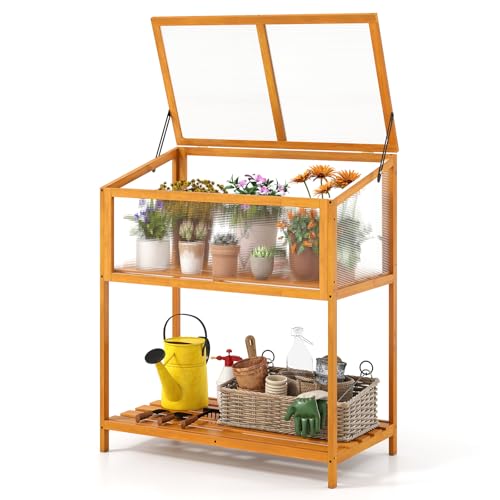
Giantex Wooden Greenhouse Cold Frame
Giantex keeps things basic: a fir frame, clear panels, and room for a couple of seed trays, at less cost than the better finished wooden frames. Assembly is quick, and a simple stay props the hinged lid. Timber sections run slimmer than premium frames, so treat the wood and check the hinges after a hard winter.
Pros
- Lowest cost wooden frame here
- Quick to assemble
- Compact enough for a small plot
Cons
- Slimmer timber than the better wooden frames
- Hardware benefits from being upgraded
Side by side
| # | Model | Glazing | Best for | Score | Price |
|---|---|---|---|---|---|
| 1 | Juwel Biostar 1500 Cold Frame | Twin wall polycarbonate | Best overall | 9.4 | Check price |
| 2 | Palram Canopia Cold Frame Grow House | Polycarbonate panels | Best value | 9.2 | Check price |
| 3 | Outsunny Wooden Cold Frame Greenhouse | Treated fir timber | Best wooden frame | 9.0 | Check price |
| 4 | Best Choice Products Wooden Cold Frame Greenhouse | Wood | Best for raised beds | 8.8 | Check price |
| 5 | VIVOSUN Mini Greenhouse | Tiered mini greenhouse | Best compact option | 8.6 | Check price |
| 6 | Quictent Portable Mini Greenhouse | Powder coated steel | Best portable option | 8.3 | Check price |
| 7 | Giantex Wooden Greenhouse Cold Frame | Fir timber | Best budget wooden | 8.0 | Check price |
Frequently asked questions
How much warmer is a cold frame than outside?
Expect a few degrees of overnight frost protection from a twin wall frame, and much warmer conditions on sunny days. Glazing, shelter, and a wall behind the frame all raise the gain. Treat it as weeks of season extension, not a frost proof box.
When should I open and close a cold frame?
Open on any bright morning, even a cold one, because sun heats the interior fast. Close in mid afternoon to trap warmth before temperatures fall. Partial venting suits mild overcast days, and during a hard freeze keep it closed and covered.
Is an automatic vent opener worth it?
Very much so if you are out during the day. A wax cylinder expands as the frame warms and lifts the lid with no electricity. Check the opener’s weight rating against your lid before buying one.
What can you grow in a cold frame over winter?
Hardy salads such as lamb’s lettuce and winter lettuce, spinach, rocket, hardy herbs, and overwintering onions and garlic all do well. Dormant cuttings and pots of hardy perennials shelter happily too. Tender crops will not survive a hard freeze inside an unheated frame.
Glass, polycarbonate or plastic film: which glazing wins?
Twin wall polycarbonate is the best all rounder because it insulates and resists impact. Glass passes the clearest light but breaks. Plastic film keeps off wind and rain, adds little frost protection, and needs replacing every few seasons.
Where is the best place to put a cold frame?
Somewhere sunny with the sloped lid facing the sun, sheltered from prevailing wind, ideally against a south facing wall that radiates stored heat at night. Skip frost pockets at the foot of slopes and any spot shaded for most of the winter day.
Can you put a cold frame on a raised bed?
Yes, and it is one of the most practical setups, since plants grow in the bed soil and the frame simply covers them. Measure the bed first and pick a topper style frame such as the Best Choice Products model rather than one with a solid base.
Do plants in a cold frame need watering?
Yes. The lid keeps rain out, so everything inside depends on you. Winter plants need far less water than summer ones, and overwatering in cold conditions kills more than drought does, so check the soil instead of watering on a schedule.
The verdict
The Juwel Biostar 1500 remains the frame to buy for years of proper use, because twin wall glazing and ratchet vent stays solve the two problems that decide results. Palram’s Canopia Cold Frame delivers most of that performance in a smaller, cheaper footprint. Whichever you choose, anchor it well and vent it on sunny mornings; those two habits matter more than the model.