How to Choose Commercial Ice Cream for a Shop or Cart
Breville’s BCI600XL Smart Scoop leads because its compressor runs batch after batch and twelve hardness settings remove guesswork. The Whynter ICM-201SB brings the same compressor advantage at a mid range outlay. For dense, low overrun gelato close to a counter product, choose the Lello 4080 Musso Lussino.
Breville’s BCI600XL Smart Scoop is the machine to buy for repeat production, since its built in compressor freezes on demand and hardness sensing stops the churn at the right consistency. Budget minded buyers get the same no bowl workflow from the Whynter ICM-201SB. Gelato purists should look straight at the Lello 4080 Musso Lussino.
Marketing applies the word commercial to appliances that need hours of recovery between batches, which makes this category hard to shop. One distinction settles most of it: a built in compressor freezes on demand, while a pre frozen bowl is spent after a single use. We compared batch capacity, cycle and recovery times, dasher design and its effect on overrun, bowl removal for cleaning, and what owners report about running several batches in one afternoon.
Our top picks

Breville BCI600XL Smart Scoop Ice Cream Maker
A second mix can go in the moment the first batch comes out, because the built in compressor freezes on demand instead of relying on a pre chilled bowl. Twelve hardness settings run from soft sorbet through firm scoopable ice cream, and sensors end the churn at the target consistency rather than on a timer. Expect a heavy unit that hums audibly while the compressor cycles.
Pros
- Runs back to back batches with no bowl freezing
- Hardness sensing gives repeatable texture across flavors
- Keep cool mode holds a finished batch until serving
Cons
- Heavy enough to need a permanent counter spot
- Compressor noise carries in a small kitchen

Whynter ICM-201SB Upright Automatic Ice Cream Maker
An upright cabinet fits the 2.1 quart bowl into a smaller counter footprint than horizontal compressor machines occupy. Cleaning stays simple because the bowl lifts straight out and goes to the sink. Thick custard bases work the modest motor hard, so very rich mixes churn slowly, and the fit and finish sits a step below the premium machines here.
Pros
- Largest compressor batch here at a mid range outlay
- Removable bowl turns cleanup into a quick sink job
- Upright shape suits crowded counters
Cons
- Motor labors on very thick custard mixes
- Build quality trails the premium machines

Lello 4080 Musso Lussino Ice Cream Maker
Italian built with a stainless steel body, this is the machine gelato enthusiasts name first. Its powerful compressor pulls temperature down fast, which keeps ice crystals small, while a slow working dasher whips in very little air. Low overrun is what produces gelateria density. Cleaning takes more effort than rivals because the stainless bowl is fixed inside the housing.
Pros
- Low overrun texture close to a gelato counter
- Rapid freezing keeps ice crystals fine
- Stainless construction stands up to daily use
Cons
- Fixed bowl means washing inside the machine
- Among the biggest investments in this group

VEVOR Commercial Soft Serve Ice Cream Machine
Unlike every batch machine here, this hopper fed unit dispenses soft serve continuously through a pull handle. That format serves a cafe counter, a market stall or an event queue where speed matters more than artisan density. Daily stripping and sanitizing of the hopper and barrel is mandatory, and the unit needs dedicated space with proper airflow around the condenser.
Pros
- Dispenses continuously for real service volume
- Hopper keeps mix chilled and ready between customers
- Serves a queue faster than any batch machine
Cons
- Daily sanitizing routine takes real time
- Requires dedicated space and ventilation

Cuisinart ICE-100 Compressor Ice Cream and Gelato Maker
Two dedicated dashers ship in the box, one shaped for aerated ice cream and one for dense gelato, and the texture difference between them is genuine. Controls stay simple enough that a first batch usually succeeds, with a timer and keep cool function covering the basics. Capacity is modest for the counter space the machine occupies, so treat it as a household unit.
Pros
- Gelato paddle produces noticeably denser results
- Simple timer controls suit first time users
- Compressor removes all bowl freezing prep
Cons
- Modest yield for the footprint it occupies
- Bowl does not lift out for washing
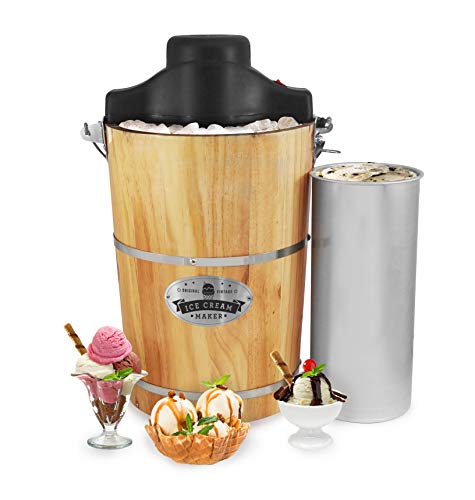
Elite Gourmet EIM-506 6-Quart Ice Cream Maker
Six quarts in a single run makes this rock salt and ice bucket the volume champion here by a wide margin. An electric motor handles the churning while the wooden style bucket looks right on a picnic table. Plan on stocking ice and rock salt, tolerating motor noise, and accepting a softer, slightly icier texture than any compressor machine delivers.
Pros
- Biggest single batch of any machine in this group
- Low outlay relative to the volume produced
- Traditional bucket format suits gatherings
Cons
- Consumes a steady supply of ice and rock salt
- Noisier and messier than compressor machines

Nostalgia ICMP400 4-Quart Electric Ice Cream Maker
Nothing here costs less to get started with, and the format could not be simpler: an aluminum canister churns four quarts inside a bucket packed with ice and rock salt. Occasional summer use is the right expectation, not daily production. Ice needs topping up mid churn, and the finished texture runs softer and icier than compressor results.
Pros
- Lowest outlay here for a family sized batch
- Nothing to program, just pack ice and switch on
- Classic look works for outdoor gatherings
Cons
- Icier finish than any compressor machine
- Ice must be replenished during the churn
Compared at a glance
| # | Model | Type | Best for | Score | Price |
|---|---|---|---|---|---|
| 1 | Breville BCI600XL Smart Scoop Ice Cream Maker | Compressor, self refrigerating | Best overall | 9.4 | Check price |
| 2 | Whynter ICM-201SB Upright Automatic Ice Cream Maker | Compressor, self refrigerating | Best value compressor | 9.2 | Check price |
| 3 | Lello 4080 Musso Lussino Ice Cream Maker | Compressor, self refrigerating | Best for dense gelato | 9.1 | Check price |
| 4 | VEVOR Commercial Soft Serve Ice Cream Machine | Soft serve, continuous dispense | Best for soft serve service | 8.8 | Check price |
| 5 | Cuisinart ICE-100 Compressor Ice Cream and Gelato Maker | Compressor, self refrigerating | Best for gelato at home | 8.6 | Check price |
| 6 | Elite Gourmet EIM-506 6-Quart Ice Cream Maker | Ice and rock salt bucket | Best for large batches | 8.3 | Check price |
| 7 | Nostalgia ICMP400 4-Quart Electric Ice Cream Maker | Ice and rock salt bucket | Best budget | 8.0 | Check price |
Before you buy
Compressor vs frozen bowl: which type keeps up? Frozen bowl machines need their insert in a freezer for around twenty four hours before every use, and one batch spends the bowl completely. Weekly ice cream works fine that way. Anyone planning two flavors in an afternoon, or supplying a stall or a big household, needs a built in compressor that freezes on demand. Compressor machines cost more and weigh more, and they are the only design that sustains real output.
What is overrun and how does it change texture? Overrun measures the air whipped into a mix during churning. Supermarket ice cream can approach half air by volume, which keeps it light and cheap to produce. Gelato runs far lower, which is why it tastes denser and more intense. Dasher shape and churn speed set the number: a slow, deliberate dasher like the Lello 4080’s produces dense results, while fast whipping paddles aerate heavily.
How much batch capacity do you really need? Listed capacity usually describes maximum mix volume, not finished output, and mix expands as air works in. Filling past about two thirds risks overflow and a poor churn. For a household, 1.5 to 2 quarts per batch covers most occasions. Service settings need a different category entirely: continuous dispense soft serve machines like the VEVOR sustain a queue, which no batch machine can, regardless of bowl size.
How hard are these machines to clean each day? Removable bowls travel to the sink; fixed bowls mean sponging inside a housing that contains electronics. Dairy residue dries hard and harbors bacteria, so washing has to happen promptly after every batch. Soft serve units carry the heaviest routine of all, with the hopper, barrel and dispensing parts stripped and sanitized daily. Weigh that time honestly before bringing a service format into a home kitchen.
Questions worth asking
What makes an ice cream machine commercial rather than domestic?
A compressor rated for continuous running, a motor sized for thick mixes, stainless food contact surfaces and the ability to produce back to back batches without downtime. Continuous dispense soft serve machines go further and hold chilled mix ready for service all day.
Do I need a compressor ice cream maker?
Anyone making ice cream more than occasionally does. Frozen bowl designs need roughly a day of freezer time before each single batch. A compressor freezes on demand, so a second flavor can start the moment the first finishes.
What is overrun in ice cream?
Overrun is the percentage of air incorporated during churning. High overrun yields light, fluffy ice cream at lower ingredient cost per quart. Low overrun yields the dense, intense texture associated with gelato. Dasher design and speed control it directly.
Why is my homemade ice cream icy?
Slow freezing lets large ice crystals form, and an unbalanced sugar to fat ratio makes it worse. Chill the mix thoroughly before churning and use a machine that pulls temperature down quickly, since both keep crystals small.
How long does one batch take to churn?
Compressor machines typically finish in twenty to forty minutes depending on the mix and target hardness. Bucket machines take a similar time but need ice replenished along the way. Frozen bowl machines churn quickly yet demand a full day of bowl freezing first.
Can a commercial soft serve machine work at home?
It can, with caveats. A unit like the VEVOR needs dedicated space, airflow around the condenser and a daily sanitizing routine. Most households get more benefit from a compressor batch machine with a fraction of the maintenance.
Should ice cream be hardened after churning?
Yes for most recipes. Straight from the machine the consistency resembles soft serve. A few hours in a shallow container in the freezer firms it to scoopable and improves the final texture.
How do you clean an ice cream maker properly?
Wash the paddle and bowl in warm soapy water immediately, before dairy residue dries hard. Never immerse the motor or compressor housing. Soft serve machines require the hopper, barrel and dispensing parts stripped and sanitized on the manufacturer’s schedule.
Which machine is best for making gelato?
The Lello 4080 Musso Lussino comes closest to gelateria texture thanks to fast freezing and a low overrun dasher. On a smaller budget, the Cuisinart ICE-100 includes a dedicated gelato paddle that noticeably densifies results.
The verdict
Serious home production points to the Breville BCI600XL Smart Scoop, because the compressor removes the bowl freezing bottleneck and hardness sensing makes every batch repeatable. Whynter’s ICM-201SB delivers the same core advantage with a larger bowl if you accept a weaker motor. Anyone chasing true gelato density should stretch to the Lello 4080 Musso Lussino and live with the fixed bowl.


