How to Choose a Kitchen Scale for Baking or Portion Control
The OXO Good Grips Stainless Steel Food Scale earns first place for a pull out display that stays readable under a wide bowl. The Escali Primo is the value pick for everyday baking. The My Weigh KD8000 suits serious bread work.
Buy the OXO Good Grips Stainless Steel Food Scale if you want a scale you never fight with. The Escali Primo covers straightforward value, and the My Weigh KD8000 suits bakers working in percentages.
Scales look nearly identical in listings, since maximum capacity and a one gram graduation are shared by almost every model in the category. What separates them is behavior: how fast the tare settles, whether the display disappears under a mixing bowl, and whether the platform wobbles under a heavy load. Auto shut off timing during a slow recipe matters too. We compared published specifications against consistent owner reports on exactly those points.
The shortlist, ranked

OXO Good Grips Stainless Steel Food Scale with Pull-Out Display
A pull out display slides forward on a small arm, so a wide mixing bowl no longer hides the numbers. The stainless platform lifts off for washing, and the tare button is large enough to hit with a floury knuckle. Owners report it ends the constant lifting and peering that plagues cheaper scales.
Pros
- Pull out display solves the wide bowl problem
- Removable stainless top washes easily
- Large tare button works with messy hands
Cons
- Bulkier to store than a flat slab scale
- Costs more than most kitchen scales
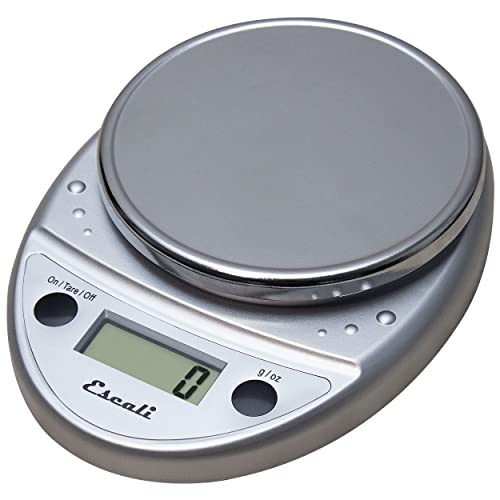
Escali Primo Digital Kitchen Scale
This has been the default recommendation in home kitchens for years, since it handles the basics without drama: fast tare, clear numbers, two button operation. A slim body slides into a drawer, and there is no removable platform, so a wipe down is the cleaning method. Owners report years of service from a single pair of batteries.
Pros
- Fast, reliable tare with minimal drift
- Slim enough to store in a drawer
- Excellent battery life
Cons
- Display is hidden by large bowls
- No backlight in a dark kitchen

My Weigh KD8000 Baker’s Math Kitchen Scale
Bread bakers reach for the KD8000 because it calculates baker’s percentages directly, scaling a formula up or down without a calculator. Capacity runs higher than most home scales, and the auto shut off can be disabled entirely. It runs from mains power as well as batteries, though the interface takes a session to learn.
Pros
- Baker’s percentage mode is genuinely useful
- Auto shut off can be turned off entirely
- High capacity handles large dough batches
Cons
- Interface needs learning
- Plain utilitarian appearance

Greater Goods Digital Food Kitchen Scale
A clean glass topped design with a backlit display suits kitchens short on drawer space. Response is quick, and the tare holds steady while ingredients go in incrementally. The flat glass surface wipes clean instantly, though its low profile makes buttons easy to bump while positioning a bowl.
Pros
- Backlit screen is easy to read
- Flat glass wipes clean instantly
- Very low outlay for the features
Cons
- Buttons sit flush and are easy to press by accident
- Glass surface can feel slippery under a smooth bowl

Etekcity Food Kitchen Scale
Etekcity keeps this scale about as small as a useful kitchen scale gets, with a slim stainless top and rounded edges that slide into a utensil drawer. It covers the standard eleven pound capacity in one gram increments and switches between five unit systems. Small kitchens short on storage gain the most here.
Pros
- Genuinely compact and easy to store
- Five unit modes cover most recipe sources
- Fine 0.05 ounce resolution in imperial mode
Cons
- Small platform limits bowl size
- Auto shut off is quick and cannot be extended

Ozeri Pronto Digital Multifunction Kitchen Scale
This scale reads down to a single gram across a wide unit selection. Response is fast enough for spices, yeast, and coffee, where a slow reading makes pouring guesswork. Elevated button placement keeps controls clear of the weighing surface. Its light body benefits from a flat solid counter rather than a wobbly board.
Pros
- Quick response suits pouring small amounts
- Buttons sit clear of the weighing platform
- Wide unit selection including liquid measures
Cons
- Light body can shift on a slick counter
- Plastic finish feels less durable than steel

Taylor Precision Products Digital Kitchen Scale
A broad flat platform supports a stand mixer bowl or a large stockpot without overhanging, where compact scales become impractical. Capacity is generous, and the display stays straightforward. Owners describe it as the practical choice for batch cooking and preserving, at the cost of more counter space.
Pros
- Wide platform supports big bowls and pots
- Large clear digits
- Stable footing under heavy loads
Cons
- Takes up more storage space
- Display is easily obscured by wide vessels
How to pick the right one
Why grams beat cups for anything baked A cup of flour can vary by a third depending on whether it was scooped, spooned, or shaken, enough to turn soft dough stiff. Weight removes that variable entirely, so a recipe that worked once works again. Fewer measuring cups need washing too, since you can tare between ingredients into the same bowl. For bread, pastry, and anything with yeast, this single change improves results more than any equipment upgrade.
Resolution, capacity and where they conflict Most kitchen scales read in one gram steps up to around five kilograms, fine for general cooking. Tension appears at the extremes. Weighing two grams of yeast on a one gram graduation gives a coarse reading, and a full stockpot can exceed capacity entirely. Pair a standard kitchen scale with a separate 0.1 gram pocket scale for salt, yeast, coffee, or spices. That combination solves both problems more cheaply than one scale trying to do everything.
Tare, auto shut off and other daily annoyances Tare resets the reading to zero so you can weigh into a container or add ingredients cumulatively, and slow or drifting tare frustrates every session. Auto shut off is the other common irritation, since a scale that powers down after sixty seconds dies mid drizzle. Models that let you disable or extend the shut off, such as the KD8000, hold up far better through long recipes.
Display placement and cleaning practicality Nearly every complaint about kitchen scales traces back to the display vanishing under a mixing bowl. Pull out displays, or screens set well forward of the platform, solve that directly. Remember that most kitchen scales are not waterproof and should never be submerged. A removable stainless platform is the most practical answer, and a flat glass top comes close, since spills wipe away without seams to trap flour.
How they compare
| # | Model | Capacity | Best for | Score | Price |
|---|---|---|---|---|---|
| 1 | OXO Good Grips Stainless Steel Food Scale with Pull-Out Display | 11 pounds or 5 kilograms | Best overall | 9.4 | Check price |
| 2 | Escali Primo Digital Kitchen Scale | 11 pounds or 5 kilograms | Best value | 9.2 | Check price |
| 3 | My Weigh KD8000 Baker’s Math Kitchen Scale | 17.6 pounds or 8 kilograms | Best for serious baking | 9.0 | Check price |
| 4 | Greater Goods Digital Food Kitchen Scale | 11 pounds or 5 kilograms | Best budget | 8.8 | Check price |
| 5 | Etekcity Food Kitchen Scale | 11 pounds or 5 kilograms | Best compact option | 8.6 | Check price |
| 6 | Ozeri Pronto Digital Multifunction Kitchen Scale | 11.24 pounds or 5.1 kilograms | Best for small quantities | 8.3 | Check price |
| 7 | Taylor Precision Products Digital Kitchen Scale | 11 pounds or 5 kilograms | Best for large batches | 8.0 | Check price |
Frequently asked questions
What capacity kitchen scale do I need?
Eleven pounds or five kilograms covers almost all home cooking, including a full mixing bowl of dough. Step up to eight kilograms only if you batch cook, preserve in quantity, or weigh whole poultry regularly.
Is a one gram graduation precise enough?
For flour, sugar, butter, and liquids, yes. For yeast, salt, spices, and espresso doses it runs coarse, since being one gram off on a three gram measure is a large proportional error. A cheap 0.1 gram pocket scale alongside your main scale covers that gap.
Can I weigh liquids on a kitchen scale?
Yes, and it is often more accurate than a jug. Water weighs one gram per millilitre, so the conversion is direct. Milk, oil, and syrup have different densities, so weigh them in grams whenever the recipe gives grams.
How do I know if my scale is accurate?
Weigh something of known mass. A stack of nickels works, since each weighs five grams, and some people keep a small calibration weight. Check across the range rather than at one point, and replace batteries before assuming the scale failed, since low power causes drift.
Why does my scale show a different weight each time?
Usually an uneven or flexing surface is the cause. Kitchen scales need a flat rigid counter, not a chopping board or a mat. Weak batteries, a bowl touching a wall behind it, and even a running extractor fan can all shift readings by a gram or two.
Can kitchen scales be washed?
Not by submerging them. Wipe the body with a damp cloth and dry it. Models with a removable stainless platform let you wash that piece separately, the most hygienic setup for raw meat or sticky doughs.
What does the tare function do on a kitchen scale?
It resets the display to zero with weight already on the platform, so you can subtract the bowl and then add ingredients one at a time. It is the most used button on the scale and the reason one bowl can replace a set of measuring cups.
Should I choose a battery or rechargeable kitchen scale?
Standard AA or AAA batteries typically last a year or more in a kitchen scale, since the draw is tiny, and they are trivial to replace. Rechargeable models save waste but add a charging chore. Either works fine, so decide based on the rest of the scale.
What is the best kitchen scale for bread baking?
The My Weigh KD8000 calculates baker’s percentages directly and offers a higher capacity than most home scales, which suits large dough batches and formula-based recipes.
Which kitchen scale is best for small apartments?
The Etekcity Food Kitchen Scale keeps a slim stainless profile that slides into a drawer. Its five unit modes cover most recipe sources without extra bulk on the counter.
Our take
The OXO Good Grips Stainless Steel Food Scale wins because it fixes the one problem every other scale shares: a display that vanishes under a real mixing bowl. The Escali Primo remains the best straightforward buy for everyday cooking. Bakers working in formulas rather than recipes save a calculator’s worth of arithmetic with the My Weigh KD8000.