Compact Clamp Meters That Slip Into Any Toolbox
The Klein Tools CL120 is the top pick for most users because it packs true RMS, a 400 amp capacity, and a slim jaw into a body that fits in a pocket. It suits electricians, HVAC techs, and DIYers who need reliable readings in tight panels. Its main limitation is the lack of a built-in flashlight, which some owners miss in dark work areas.
Working in crowded breaker boxes or tight conduits demands a meter that does not get in the way. Full sized clamps often feel bulky and awkward. Compact clamp meters offer the same core functions in a smaller body, making them easier to carry and maneuver.
We looked at seven popular models from brands like Klein, Fluke, and AstroAI. Each one is small enough for a tool pouch but still provides accurate current readings. The list includes options for basic checks and advanced troubleshooting.
What to look for
The top picks, ranked
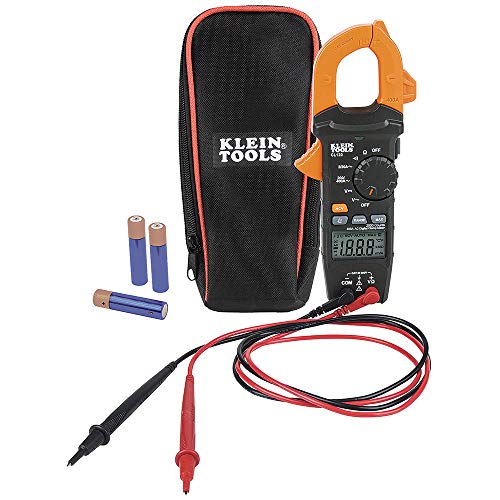
Klein Tools CL120 Digital Clamp Meter
The Klein CL120 measures AC current up to 400 amps with true RMS for accurate readings on non linear loads. Its jaw opens to 1.0 inches, fitting most wires in residential and light commercial panels. The compact body includes a backlit display and auto ranging, plus a low impedance mode to prevent ghost voltages.
Pros
- True RMS for accurate readings
- Low impedance mode reduces ghost voltages
- Compact and lightweight design
Cons
- No built-in work light
- Lacks DC current measurement

Fluke 323 True-RMS Clamp Meter
Fluke 323 delivers reliable true RMS measurements in a rugged, compact case. It handles AC current up to 400 amps and AC/DC voltage to 600 volts. The ergonomic design fits comfortably in one hand, and the slim jaw reaches into tight spots. It is built to withstand drops and daily job site abuse.
Pros
- Renowned Fluke durability
- True RMS and low pass filter
- Slim profile for tight spaces
Cons
- Higher price point
- No DC current measurement

AstroAI TRMS 6000 Counts Clamp Meter
AstroAI TRMS clamp meter offers a wealth of features at an affordable price. It measures AC/DC current up to 600 amps, which is rare in compact models. The auto ranging display is backlit, and it includes a non contact voltage detector, continuity beeper, and data hold. It is a great value for DIYers and hobbyists.
Pros
- Measures DC current
- Large backlit display
- Non contact voltage detection
Cons
- Build quality feels less robust
- Safety rating lower than professional models

KAIWEETS HT208D Digital Clamp Meter
The KAIWEETS HT208D is a compact yet powerful clamp meter with true RMS and a 600 amp AC/DC range. It features an inrush current mode for capturing motor startup surges, a function often found in larger meters. The backlit display, flashlight, and auto off make it convenient for troubleshooting HVAC systems.
Pros
- Inrush current mode
- Built-in flashlight
- True RMS accuracy
Cons
- Slightly larger than other compact models
- No low impedance mode

Fluke 375 FC True-RMS AC/DC Clamp Meter
Fluke 375 FC adds wireless data logging to a compact clamp meter. It measures AC/DC current up to 600 amps and includes iFlex compatibility for measuring around large conductors. The Fluke Connect app lets you monitor readings remotely on a smartphone. It is ideal for technicians who need to log trends or share data.
Pros
- Wireless Bluetooth connectivity
- iFlex flexible probe support
- Measures DC current
Cons
- Expensive for a compact meter
- Requires app for full features

Extech EX330 Autoranging Mini Clamp Meter
The Extech EX330 is a compact clamp meter that measures AC current to 400 amps and AC/DC voltage to 600 volts. It includes a built-in non contact voltage detector and a low impedance mode to eliminate ghost voltages. The small jaw fits around 12 AWG wires, and the backlit display is easy to read in dim areas.
Pros
- Non contact voltage detection
- Low impedance mode
- Compact and easy to carry
Cons
- No DC current measurement
- Jaw opening is smaller than others

Mastech MS2108 Digital Clamp Meter
Mastech MS2108 is an affordable compact clamp meter that measures both AC and DC current up to 600 amps. It also measures resistance, capacitance, frequency, and temperature. The backlit display and data hold function add convenience. While it lacks true RMS, it is suitable for general troubleshooting where wave form distortion is not a concern.
Pros
- Measures DC current
- Includes temperature and frequency
- Very affordable
Cons
- No true RMS
- Lower build quality
The lineup, side by side
| # | Model | AC Current Range | Best for | Score | Price |
|---|---|---|---|---|---|
| 1 | Klein Tools CL120 Digital Clamp Meter | 0 to 400 A | Best Overall Compact Clamp Meter | 9.4 | Check price |
| 2 | Fluke 323 True-RMS Clamp Meter | 0 to 400 A | Best for Professional Electricians | 9.2 | Check price |
| 3 | AstroAI TRMS 6000 Counts Clamp Meter | 0 to 600 A | Best Budget Compact Clamp Meter | 8.8 | Check price |
| 4 | KAIWEETS HT208D Digital Clamp Meter | 0 to 600 A | Best for Inrush Current Measurements | 8.7 | Check price |
| 5 | Fluke 375 FC True-RMS AC/DC Clamp Meter | 0 to 600 A | Best with Wireless Connectivity | 8.6 | Check price |
| 6 | Extech EX330 Autoranging Mini Clamp Meter | 0 to 400 A | Best for Basic HVAC and Electrical Work | 8.4 | Check price |
| 7 | Mastech MS2108 Digital Clamp Meter | 0 to 600 A | Best for AC/DC Measurements on a Budget | 8.0 | Check price |
Good to know
What is the smallest compact clamp meter available?
The Extech EX330 has a jaw opening of 0.9 inches, making it one of the smallest for tight spaces. However, many other compact models, like the Klein CL120, have jaw openings around 1.0 inch, which still fit most residential wires.
Can compact clamp meters measure DC current?
Yes, some models like the AstroAI TRMS and Fluke 375 FC can measure DC current. However, many basic compact meters only measure AC current. Check the specifications before purchasing if you need DC measurement.
What is the difference between CAT III and CAT IV safety ratings?
CAT III is for distribution level circuits like fixed installation panels, while CAT IV is for utility service entrances. CAT IV meters offer higher surge protection. For most residential work, CAT III is sufficient.
Do I need true RMS in a clamp meter?
True RMS is essential if you work with non linear loads like computers, VFDs, or electronic ballasts. If you only measure standard resistive loads, an average responding meter may be adequate and cheaper.
What does the jaw opening size mean?
The jaw opening indicates the maximum diameter of a conductor you can clamp around. For example, a 1.0 inch jaw can fit a wire up to that diameter. Larger openings allow measuring thicker cables but may hinder access in tight spaces.
Can I use a compact clamp meter for HVAC work?
Yes, many technicians use compact clamp meters for HVAC. Look for features like inrush current measurement, temperature probes, and microamp readings for flame sensors. Models like the KAIWEETS HT208D offer inrush current, making them suitable.
How accurate are compact clamp meters compared to full sized ones?
Accuracy is comparable among quality brands. Compact meters may have slightly lower base accuracy, but for most field work the difference is negligible. Always check the accuracy spec, typically around 1.5% to 2% for current measurements.
Are compact clamp meters safe for industrial use?
Yes, as long as they have the appropriate safety rating. Look for CAT III 600 V or higher for industrial settings. Fluke models are known for robust safety. Always follow proper safety procedures.
The bottom line
For most electricians and serious DIYers, the Klein Tools CL120 offers the best balance of performance, size, and value. Its true RMS and low impedance mode provide reliable measurements in a compact form. If you need professional grade durability and are willing to spend more, the Fluke 323 is a top choice. For budget minded users who need DC current capability, the AstroAI TRMS delivers impressive features at a low cost.