Compact RV Battery Monitors That Fit Any Rig
For most RV owners, the Victron Energy BMV-712 Smart offers the best blend of compact size, Bluetooth connectivity, and accurate state of charge reporting. Its main limitation is the need for a shunt, which requires a direct battery connection. If you prefer a simpler plug and play option, the Renogy 500A Battery Monitor with shunt is a close second.
Knowing your RV battery’s true state is crucial, especially when boondocking or relying on solar. Compact battery monitors provide real time voltage, current, and state of charge without taking up much space.
This roundup covers a range of monitors from basic voltage readouts to advanced Bluetooth enabled units. We focused on models that are small, easy to mount, and work with common RV battery types.
The top picks, ranked
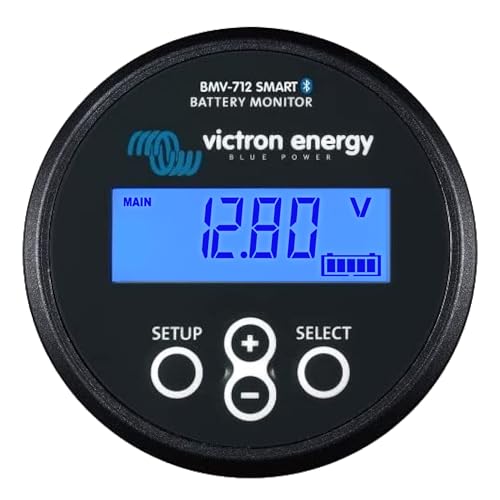
Victron Energy BMV-712 Smart
The Victron BMV-712 is a premium battery monitor that measures voltage, current, and calculates state of charge with precision. It features a compact display that can be surface mounted or recessed. The Bluetooth module allows you to monitor from your phone, and it stores historical data. Owners report excellent build quality and reliable readings.
Pros
- Accurate state of charge tracking
- Bluetooth monitoring and data logging
- Compact design with flexible mounting
Cons
- Higher price point
- Requires a shunt for installation
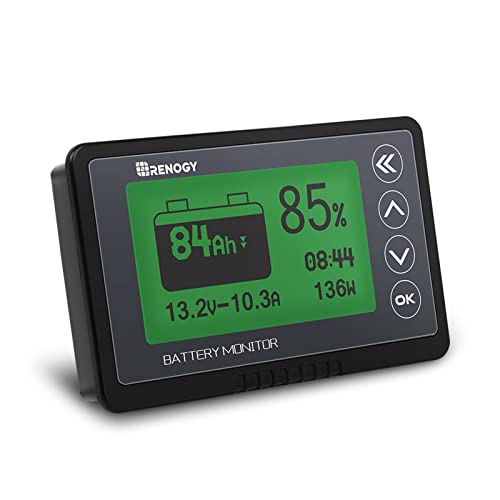
Renogy 500A Battery Monitor with Shunt
Renogy’s 500A monitor offers essential features at a budget friendly price. It shows voltage, current, power, and state of charge on a clear display. The included shunt is easy to install. Many RVers use this to keep track of their house battery bank. It lacks Bluetooth, but for basic monitoring it performs well.
Pros
- Affordable without sacrificing accuracy
- Simple to use interface
- Reliable readings
Cons
- No wireless connectivity
- Display is not color

AIOSI Battery Monitor Meter
The AIOSI is a tiny digital voltmeter that plugs into a 12V outlet or cigarette lighter. It shows real time voltage, which is a quick way to assess battery health. It doesn’t measure current or state of charge. Because it is compact, it fits anywhere. But it requires being plugged in, so it is not a permanent monitor.
Pros
- Very low cost
- No wiring needed
- Compact and portable
Cons
- Only shows voltage, not SOC
- Not a permanent installation

DROK DC 0-100V 10A
The DROK is a panel mount voltmeter and ammeter that is very compact. It can measure up to 100V and 10A, which is suitable for small loads. It requires a power source and can be wired in line. This monitor is popular among DIY enthusiasts. It is not intended for large RV house batteries but works for a 12V system with lower current.
Pros
- Very small footprint
- Measures voltage and current
- Affordable
Cons
- Limited to 10A
- Requires wiring into circuit
Bayite DC 6.5-100V 0-100A
The Bayite monitor features a large color LCD that shows voltage, current, power, and charge. It is compact but the screen is easy to read from a distance. It includes a shunt and is suitable for up to 100A. Installation requires connecting the shunt, but many find it straightforward. Owners appreciate the bright display.
Pros
- Large, clear display
- Shows multiple parameters
- Reasonable price
Cons
- Current limit lower than some
- No Bluetooth
JideTech 0-200V 0-200A
JideTech offers a versatile monitor with a wide measurement range, up to 200A and 200V. It has a backlit LCD and can be calibrated. It is suitable for larger RV battery banks. The monitor includes a shunt and a remote display feature. Users report accurate readings and a sturdy build.
Pros
- Measures high current
- Remote display option
- Accurate readings
Cons
- Slightly larger size
- Installation may be complex for some

MICTUNING Battery Monitor with Bluetooth
The Mictuning is a smart battery monitor that connects to your phone via Bluetooth. It tracks voltage, current, and calculates remaining power. The compact display is easy to mount. It comes with a 300A shunt. The app provides clear graphics. This is a good choice if you want wireless monitoring without paying a premium.
Pros
- Bluetooth connectivity
- Compact and sleek
- Affordable compared to Victron
Cons
- App has occasional bugs
- Shunt rated at 300A may be low for some
How to choose
The lineup, side by side
| # | Model | Display | Best for | Score | Price |
|---|---|---|---|---|---|
| 1 | Victron Energy BMV-712 Smart | 2.1 inch LCD with backlight | Best overall for accuracy and Bluetooth | 9.6 | Check price |
| 2 | Renogy 500A Battery Monitor with Shunt | LCD with backlight | Best value for basic monitoring | 9.3 | Check price |
| 3 | AIOSI Battery Monitor Meter | 0.28 inch LED | Best for a quick voltage check | 8.2 | Check price |
| 4 | DROK DC 0-100V 10A | Dual LED display | Best for small battery banks or DIY | 8.0 | Check price |
| 5 | Bayite DC 6.5-100V 0-100A | 2.4 inch color LCD | Best for a visible readout | 8.5 | Check price |
| 6 | JideTech 0-200V 0-200A | LCD with backlight | Best for high current accuracy | 8.8 | Check price |
| 7 | MICTUNING Battery Monitor with Bluetooth | LCD, 1.8 inch | Best for Bluetooth on a budget | 8.9 | Check price |
Good to know
What is the difference between a battery monitor and a voltmeter?
A voltmeter only reads voltage, which is not a reliable indicator of state of charge. A battery monitor measures current in and out and calculates the actual remaining capacity. This gives you a more accurate picture of battery health.
Do I need a shunt for a battery monitor?
For accurate current measurement, yes. A shunt is a precision resistor that creates a small voltage drop proportional to current. The monitor measures this voltage to determine current. Some simple monitors are voltmeters only and do not require a shunt.
Can I install a battery monitor myself?
If you have basic electrical skills, yes. You’ll need to connect the shunt in the negative line and run a small sense wire to the monitor. Always disconnect power first and use proper fuses. If unsure, hire a professional.
Will a battery monitor work with lithium batteries?
Yes, as long as the voltage range is compatible. Lithium batteries have a different discharge curve, but many monitors allow you to set the battery type or customize the parameters. Check the specifications for compatibility.
How often should I check my battery monitor?
You can check it as often as you like. It is especially useful during heavy usage or when charging. Set alarms to alert you when voltage drops or state of charge is low.
What is a good state of charge to keep my battery at?
For lead acid, keep above 50% to prevent damage. For lithium, you can go lower, but it’s best to stay above 20%. Regularly fully charging your battery is also important for longevity.
Can I use a battery monitor for multiple battery banks?
Some advanced monitors can handle multiple banks, but most budget monitors are single bank. If you have a starter and house battery, you may need two monitors or a model with dual inputs.
What is the best placement for the display?
Place it where you can easily see it, like near the main electrical panel. Avoid areas with high heat or moisture. Ensure the display is not in direct sunlight to prevent glare.
Do battery monitors drain the battery?
Most monitors have a very low power draw, often less than 10 milliamps. This is negligible and will not significantly affect battery life. Some models have a sleep mode.
How accurate are battery monitors?
Quality monitors are accurate to within 1% for current and voltage. The state of charge accuracy depends on proper calibration and battery type settings. Over time, you may need to recalibrate to full charge.
Our take
For most RV owners, the Victron BMV-712 Smart is the best investment because it offers unmatched accuracy and Bluetooth convenience, despite its higher cost. If you are on a budget and don’t need wireless, the Renogy 500A provides reliable monitoring at a great price. Avoid the AIOSI if you need more than voltage; it is only a quick check tool.