Top Cooling Fans for Every Room and Budget
The Vornado 660 Large Air Circulator is our top pick for whole-room cooling, offering powerful, vortex airflow that reaches every corner, but it lacks oscillation and can be noisy at high speeds.
A good fan can make a world of difference during hot months, providing relief without the energy cost of air conditioning. But with so many models on the market, choosing one can be overwhelming.
This roundup breaks down the best fans for various needs, from compact desk models to high-velocity floor fans, so you can cool down effectively and efficiently.
What we recommend

Vornado 660 Large Air Circulator
The Vornado 660 uses a unique vortex technology to circulate air throughout an entire room, ensuring consistent temperatures. Its deep-pitch blades and aerodynamic grill create a powerful, focused airflow that can be felt from across the room. Owners report that it effectively eliminates hot spots and works well in large living areas.
Pros
- Powerful, far-reaching airflow
- Quiet operation at low speeds
- Durable build quality
Cons
- No remote control
- Bulky design

Dyson Pure Cool Link TP02
The Dyson Pure Cool Link is not just a fan; it also purifies the air with a HEPA filter and activated carbon filter. It connects to Wi-Fi and can be controlled via the Dyson Link app or voice assistants like Alexa. The bladeless design makes it safe for children and pets, and it automatically senses and reacts to air quality changes.
Pros
- Combines cooling and air purification
- Smart app and voice control
- Safe bladeless design
Cons
- Expensive
- Filter replacements required
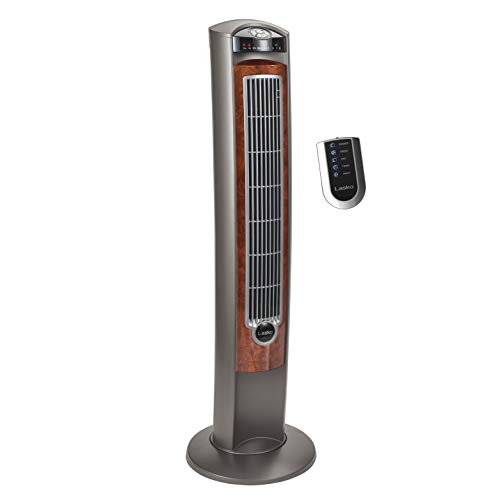
Lasko 2551 Wind Curve Tower Fan
The Lasko Wind Curve is a sleek tower fan that fits into tight spaces while delivering strong, oscillating airflow. It features a remote control and a digital display with touch buttons. The fan has three speed settings and a built-in timer for energy savings. Owners like its quiet performance and the fact that it takes up little floor space.
Pros
- Slim profile
- Remote and timer
- Quiet operation
Cons
- Not as powerful as pedestal fans
- No air purification

Honeywell TurboForce Power Fan
The Honeywell TurboForce is a compact fan that delivers powerful airflow from a small footprint. It has a pivoting head for directional cooling and offers three speeds. Its sturdy base and rubber feet prevent slipping, and it is easy to clean. Reviewers mention it is perfect for desks, nightstands, or kitchen counters.
Pros
- Compact and powerful
- Pivoting head for directional airflow
- Affordable price point
Cons
- Small coverage area
- No remote or timer

Black+Decker High-Velocity Floor Fan
The Black+Decker High-Velocity fan is built for heavy-duty use in garages, workshops, or gyms. It features a rugged metal frame and a powerful motor that moves massive amounts of air. The fan has three speed settings and a 360-degree tilt for versatile positioning. Owners appreciate its durability and ability to cool large spaces quickly.
Pros
- Extremely powerful airflow
- Durable metal construction
- 360-degree tilt
Cons
- Very noisy at high speed
- Not suitable for quiet environments

Rowenta Turbo Silence Oscillating Fan
The Rowenta Turbo Silence is designed for whisper-quiet operation, making it ideal for bedrooms or nurseries. It offers five speed settings, including a silent night mode, and oscillates for wide coverage. The fan is energy-efficient and has a timer. Users report that it is one of the quietest fans available without sacrificing airflow.
Pros
- Very quiet operation
- Multiple speed settings including silent mode
- Oscillation for wide coverage
Cons
- Higher price for a table fan
- Remote is not backlit

Pelonis Pedestal Fan
The Pelonis Pedestal Fan offers a tall, adjustable design that can reach up to 4 feet, with a wide oscillation range to cover large areas. It features three speed settings, a timer, and a remote control. The metal base provides stability, and the fan is easy to assemble. Owners like its powerful airflow and the ability to direct it at different heights.
Pros
- Adjustable height
- Wide oscillation
- Remote and timer
Cons
- Takes up floor space
- Assembly required
Side by side
| # | Model | Airflow | Best for | Score | Price |
|---|---|---|---|---|---|
| 1 | Vornado 660 Large Air Circulator | Vortex action, up to 100 ft | Whole-room air circulation | 9.4 | Check price |
| 2 | Dyson Pure Cool Link TP02 | Air Multiplier technology | Air purification and smart features | 9.1 | Check price |
| 3 | Lasko 2551 Wind Curve Tower Fan | Oscillating, 90 degrees | Space-saving oscillation | 8.9 | Check price |
| 4 | Honeywell TurboForce Power Fan | High-velocity turbo force | Small spaces and personal cooling | 8.7 | Check price |
| 5 | Black+Decker High-Velocity Floor Fan | High-velocity airflow up to 1,200 CFM | Garages and workshops | 8.5 | Check price |
| 6 | Rowenta Turbo Silence Oscillating Fan | Turboforce, up to 1,000 CFM | Quiet operation for bedrooms | 9.0 | Check price |
| 7 | Pelonis Pedestal Fan | Oscillating, 90 degrees | Large rooms and adjustable height | 8.6 | Check price |
What to look for
Questions worth asking
What is the best type of fan for a bedroom?
For a bedroom, a quiet fan like the Rowenta Turbo Silence or a tower fan with a silent mode is ideal. Look for fans with low noise ratings and features like timers and remote controls for convenience.
How do I choose the right fan size for a room?
Consider the room’s square footage. For small rooms, a table or personal fan may suffice. For larger rooms, choose a pedestal or high-velocity fan with higher CFM (cubic feet per minute) to move more air.
Are tower fans as powerful as pedestal fans?
Generally, pedestal fans have larger blades and can move more air, but tower fans are designed to circulate air over a wider area with oscillation. They are often quieter and more space-efficient, but may not be as powerful for very large rooms.
Can a fan cool a room without air conditioning?
Fans create a wind chill effect that makes you feel cooler, but they do not lower the room temperature. They work best when used with open windows or in conjunction with an air conditioner to circulate cool air.
What does CFM mean and why is it important?
CFM stands for cubic feet per minute, which measures the volume of air a fan moves. A higher CFM means more airflow, which is better for cooling larger areas. Look for fans with at least 1,000 CFM for big rooms.
Do fans use a lot of electricity?
Most fans use between 50 and 100 watts, which is significantly less than air conditioners. Running a fan for 8 hours a day typically costs a few cents, making them an energy-efficient cooling option.
How often should I clean my fan?
It depends on usage and environment, but a general rule is to clean your fan at least once a month during peak usage. Dust buildup can reduce efficiency and cause noise.
Are bladeless fans safer than traditional fans?
Bladeless fans, like Dyson models, are safer for households with small children or pets because there are no exposed blades. They are also easier to clean, but they are typically more expensive.
Can I use a fan outdoors?
Some fans are designed for outdoor use, but most indoor fans are not weather-resistant. Check the product specifications for outdoor ratings. High-velocity fans with metal frames are often more durable, but they should still be kept away from rain.
The verdict
For most households, the Vornado 660 offers the best combination of powerful circulation and durability, making it our top recommendation. If you prioritize smart features and air purification, the Dyson Pure Cool Link is worth the investment, while the Rowenta Turbo Silence is the best choice for noise-sensitive environments.