Desk Organisers That Actually Tame Cable Clutter
For most desks the SimpleHouseware Mesh Desk Organizer with Sliding Drawer offers the best mix of footprint and storage. The Marbrasse Mesh Desk Organizer suits paperwork heavy setups thanks to its file holder, while the Amazon Basics Mesh Desk Organizer covers pen and clip duty on a budget.
Most desks are best served by the SimpleHouseware Mesh Desk Organizer with Sliding Drawer, with the Marbrasse unit close behind for paper heavy setups and the Amazon Basics caddy covering simple pen and clip duty.
Listing photos rarely show how much desk space an organizer eats or how shallow its trays really are. We compared published dimensions, compartment counts and build materials against the patterns in owner feedback, weighting stability when fully loaded and whether drawers slide smoothly rather than binding.
The shortlist, ranked

SimpleHouseware Mesh Desk Organizer with Sliding Drawer
Three storage types share one compact footprint here: an upright letter tray, a sliding drawer and a pen cup. Powder coated steel mesh resists dents better than flexing plastic rivals. Owners report the drawer runs smoothly beside a monitor riser without crowding the keyboard.
Pros
- Combines three storage types in one footprint
- Sturdy steel mesh instead of flexing plastic
- Drawer glides without sticking
Cons
- Mesh gaps let small clips fall through
- Only one finish suits lighter desks

Marbrasse Mesh Desk Organizer with File Holder
Vertical file slots sit above the pen storage on this taller unit, suited to anyone still handling printed folders. Papers stay visible instead of buried in a flat stack. Specifications point to more upright capacity than flatter mesh trays offer.
Pros
- Vertical slots keep folders sorted and visible
- Good height to width ratio for small desks
- Separate drawer for stationery
Cons
- Taller build can obstruct a low monitor
- Thinner mesh than heavier steel units

Amazon Basics Mesh Desk Organizer
A steel mesh caddy with a handful of fixed compartments covers pens, scissors and sticky notes without extra features. Nothing here can jam or needs assembling. Owners report it matches the listing photos with no surprises either way.
Pros
- Very small footprint
- No assembly or moving parts
- Easy to wipe clean
Cons
- No drawer or file storage
- Lightweight enough to slide when nudged

Rolodex Mesh Collection Desk Organizer
Rolodex has built mesh desk accessories for decades, and the heavier gauge frame plus non slip feet show it. Divided upright compartments favor pens, rulers and letter openers over bulky items. It reads as an office product rather than a home desk accessory.
Pros
- Heavier build stays put on the desk
- Long standing brand with consistent quality
- Non slip feet protect desk surfaces
Cons
- Plain styling suits offices more than homes
- No enclosed storage for small items

mDesign Plastic Divided Desk Organizer
A shallow divided tray replaces the upright caddy shape here, better suited to paper clips, USB drives and charging cables. Solid plastic walls stop anything slipping through mesh gaps. It also fits inside a standard desk drawer when hiding the clutter matters more than displaying it.
Pros
- Solid walls stop tiny items falling through
- Fits inside standard desk drawers
- Rinses clean under a tap
Cons
- Uses more desk surface area
- Plastic feels less premium than metal

Safco Onyx Mesh Desktop Organizer
Safco sells into commercial office supply, and the Onyx line uses thicker steel mesh with reinforced seams. Years of daily use are the target here, not occasional home desk duty. Expect a heavier unit with a strictly functional look in exchange.
Pros
- Notably rigid compared with home grade mesh
- Powder coat resists chipping
- Built for daily commercial use
Cons
- Heavier and harder to reposition
- Strictly functional appearance
Bostitch Konnect Desk Organizer
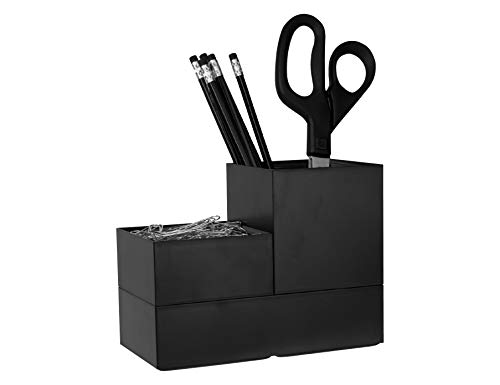
Trays, cups and cable holders clip into a shared base in this modular system, so the layout matches whatever a desk needs. Owners report connectors hold firmly once seated, though separating pieces takes a deliberate tug. Modularity pays off most when a setup changes often.
Pros
- Configure the layout to your own desk
- Add modules later without replacing everything
- Built in cable management
Cons
- Costs more once you buy several modules
- Pieces can be stiff to separate
The lineup, side by side
| # | Model | Material | Best for | Score | Price |
|---|---|---|---|---|---|
| 1 | SimpleHouseware Mesh Desk Organizer with Sliding Drawer | Powder coated steel mesh | Best overall | 9.4 | Check price |
| 2 | Marbrasse Mesh Desk Organizer with File Holder | Metal mesh with plastic trim | Best for paperwork | 9.2 | Check price |
| 3 | Amazon Basics Mesh Desk Organizer | Steel mesh | Best budget | 9.0 | Check price |
| 4 | Rolodex Mesh Collection Desk Organizer | Heavy gauge mesh steel | Best for offices | 8.7 | Check price |
| 5 | mDesign Plastic Divided Desk Organizer | BPA free plastic | Best for small items | 8.5 | Check price |
| 6 | Safco Onyx Mesh Desktop Organizer | Reinforced steel mesh | Best build quality | 8.3 | Check price |
| 7 | Bostitch Konnect Desk Organizer | Plastic with metal accents | Best modular system | 8.0 | Check price |
How to pick the right one
What size desk organizer should you buy? The most common complaint about desk organizers is that they arrive larger or smaller than expected, since listing photos rarely include a reference object. Measure the free area beside your keyboard first, then compare that number to the published dimensions rather than the picture. Leave extra clearance if the unit will sit under a shelf or monitor arm.
Which organizer format matches your clutter? Upright mesh caddies suit pens, scissors and rulers. Vertical file holders suit anyone still printing documents regularly. Shallow divided trays suit small hardware such as clips, cards and memory sticks. Cataloguing what is currently scattered on your desk before choosing a shape avoids buying the wrong format and ending up with a half empty organizer.
Mesh, plastic or wood: which material holds up? Steel mesh is the most durable option and stays looking tidy, though its open weave lets very small items slip through. Solid plastic contains everything and wipes clean, but can flex under weight over time. Wood and bamboo suit a home office look and hide fingerprints well, yet they mark from spills and rarely include drawers. No single material wins outright; the right choice matches your desk and your clutter.
Why do tall desk organizers tip over? A tall unit packed with pens sits high and tips easily, especially on a light plastic base. Non slip feet, a wide base and a low center of gravity reduce that risk, while narrow footprints on very tall units increase it. Owners report the organizers they keep long term stay planted when reached for quickly, regardless of how many compartments they offer.
Questions worth asking
What size desk organizer should I buy?
Measure the clear space beside your keyboard first, then subtract a few centimetres for elbow room. Most people are better served by a compact unit they actually use than a large one that pushes the mouse out of reach.
Are mesh or plastic desk organizers better?
Mesh is more durable and looks tidier long term, while solid plastic contains small items that would fall through mesh gaps. Choose mesh for pens and tools, plastic for clips, cards and cables.
Do desk organizers with drawers hold up over time?
The better ones use metal runners or well moulded plastic channels. Owners report cheap drawers stick or sag once loaded, so favor models where feedback specifically mentions smooth drawer action.
Can a desk organizer sit inside a drawer?
Shallow divided trays such as the mDesign unit are designed for exactly that. Upright caddies with pen cups are too tall for most standard desk drawers.
Will an organizer fit under a monitor riser?
Only if you check the height first. Tall file holders commonly foul risers and monitor arms, so measure the clearance under the riser before ordering an upright unit.
How do you stop a desk organizer from sliding around?
Look for models with rubber or felt feet. If yours lacks them, self adhesive furniture pads on the base solve the problem cheaply and also protect the desk finish.
Is a modular desk organizer worth buying?
It is if your setup changes often or you want cable management built in. For fixed needs, a single well chosen caddy is simpler and takes up less room.
How do you clean a mesh or plastic desk organizer?
Mesh units respond well to a dry brush followed by a damp cloth. Plastic trays can be emptied and rinsed. Avoid soaking any unit with a wooden base or plastic trim glued to metal.
Our take
The SimpleHouseware Mesh Desk Organizer with Sliding Drawer earns the top spot by solving three storage problems in one small footprint while holding up better than plastic alternatives. Printed documents point toward the Marbrasse unit instead, and simple pen and clip duty is handled well enough by the Amazon Basics caddy.
You might also need

Thunderbolt Docks for a True One Cable Desk Setup
How to Organize Cables on a Home Office Desk
Desk File Organisers That Keep Paperwork Findable