Which Digital Battery Tester Fits Your Battery Type?
ZTS MBT-1 checks more battery chemistries than any single-purpose tester here, from AA cells to lithium coins, using a two-second pulse load. Tenergy T-333 handles ordinary household batteries at a lower cost. Drivers monitoring a car battery gain continuous Bluetooth readings from the ANCEL BM200 without lifting the hood.
ZTS MBT-1 suits anyone checking more than one kind of battery, since its pulse load method works across AA cells, button batteries and lithium types that most single-purpose checkers skip. Tenergy’s T-333 covers ordinary AA, AAA and 9V batteries at a simpler price point. Drivers who want Bluetooth readings from a car battery without popping the hood each time should look at the ANCEL BM200 instead. MBT-1’s own limitation is its power source: it needs four AA batteries to run and has no automotive mode at all.
Household and automotive testers measure entirely different things, and a listing rarely explains which. A pulse load checker judging an AA cell has nothing to do with the conductance test a clamp-on unit runs against a car battery’s cold cranking rating. We compared supported battery types, the test method each unit uses, display clarity and what owners report about repeat readings on the same battery to make these picks.
What to look for
What a digital reading actually measures Digital testers do not all measure the same thing. A pulse load checker like the ZTS MBT-1 draws a brief real-world load from an AA or button cell and reports the result as a percentage. Conductance testers used on car batteries, including the LAUNCH BST-460, estimate cranking amps electronically without draining the battery. A charge-and-discharge analyzer such as the OPUS BT-C3100 goes further, running a full cycle to report actual measured capacity in mAh. Knowing which method a listing uses explains why two testers can disagree on the same battery.
Testing AA, AAA and 9V batteries at home Simple checkers like the Tenergy T-333 sort a battery into Poor, Fair or Good instead of a raw voltage figure, which is easier to act on at a glance. Test one battery at a time rather than a whole bin together. Under load, a battery often reads lower than it does at rest, closer to what a flashlight or remote actually demands. Button cells and 9V batteries need their own contact points on the tester, so check the compatibility list first if odd sizes come up often.
How to test a car or truck battery Automotive testers add cranking and charging checks that a simple voltage reading cannot replicate. Cranking voltage should stay above roughly 9.6 volts on a 12V battery while the starter turns. A reading below that signals weakness even if the battery looks fine at rest. Alternator charging output should sit around 13.5 to 14.7 volts with the engine running. Chemistry matters too: FOXWELL BT780 lists AGM support explicitly, while the ANCEL BM200 adds lithium alongside standard lead-acid. Trucks running 24V systems need a tester rated for it, ruling out 12V-only units like the INNOVA 3721.
Checking rechargeable battery capacity without guessing A rechargeable NiMH or Li-ion cell degrades gradually, so a pass or fail reading tells less than a measured capacity number does. OPUS BT-C3100 runs a full discharge after charging and reports the result in mAh, directly comparable to the number printed on the battery. A pack reading well under half its rated capacity is due for replacement, not another recharge. Refresh mode occasionally revives cells left unused for months, though a cell that fails to recover twice running is not worth cycling again.
The top picks, ranked
ZTS MBT-1
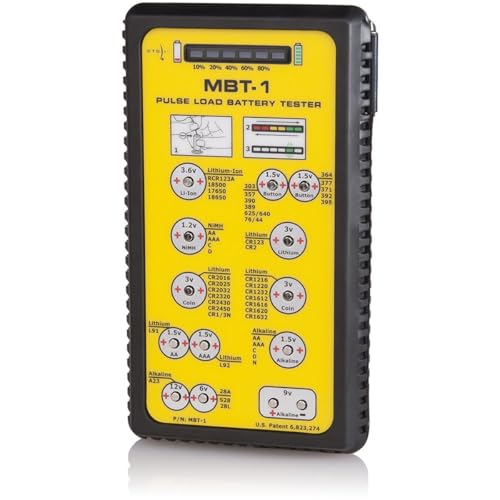
Pulse load technology delivers a real capacity percentage in two to three seconds instead of a rough voltage guess. Over forty battery types fall within its range, covering AA, AAA, C, D, 9V, N, button cells and several lithium chemistries. Nickel-plated brass terminals and a metal-reinforced body come from assembly in the United States.
Pros
- Covers more battery chemistries than most single-purpose checkers
- Skips dials and settings before a reading
- Brass, nickel-plated terminals withstand repeat testing
Cons
- Needs its own set of AA batteries to run
- Has no automotive or 12V testing mode
Tenergy T-333
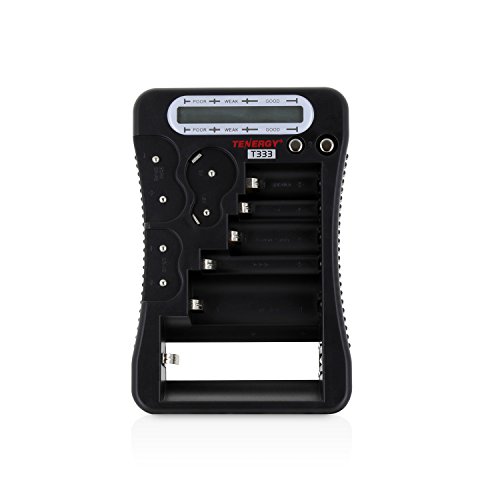
Household and camera batteries register together on one LCD screen, spanning AA, AAA, C, D, 9V and several button cell sizes. An 18-segment bar sorts each result into Poor, Fair or Good rather than a raw number to interpret. One battery goes in at a time, and a single AAA cell powers the unit itself.
Pros
- Reads more than a dozen household and camera battery types
- Small enough for a kitchen drawer
- Poor/Fair/Good result needs no interpretation
Cons
- Tests one battery at a time, not a full bin
- Draws its own AAA battery to run the screen

OPUS BT-C3100
Four independent bays each run a full charge and discharge cycle, reporting measured capacity in mAh rather than an estimate. NiMH and NiCd sizes from AAAA through SubC fit alongside Li-ion cells from 10440 up to 26650, including common 18650s. Refresh and Cycle modes recondition packs left unused, then confirm whether the recovered capacity is worth keeping.
Pros
- Reports measured capacity instead of a percentage guess
- Tests four different chemistries at once across four channels
- Refresh mode can recover cells left unused for months
Cons
- A full capacity test takes hours, not seconds
- Skips AA/AAA alkaline and car battery testing entirely

INNOVA 3721
Rather than clamping to terminals, this tester plugs into a 12V accessory socket and reads continuously while the engine runs. An LCD bar graph shows voltage alongside color-coded LEDs for a quick glance at charge state. Its head swivels, so the display faces the driver instead of a dashboard vent.
Pros
- Tracks voltage continuously while driving, not just once
- Color LEDs give a fast pass or fail read
- Swivel head improves visibility from the driver’s seat
Cons
- Works only with 12V negative-ground systems, no 6V or 24V
- Requires a working accessory socket, so it can’t test a battery off the vehicle

ANCEL BM200
Clamps stay fixed to the battery terminals while Bluetooth 4.2 sends readings to a phone app up to thirty feet away. Cranking and charging tests run alongside a core 100 to 2000 CCA health check, covering lead-acid and lithium chemistries alike. History logs every two minutes for up to seventy days, turning single checks into a trend.
Pros
- Reads from up to thirty feet away over Bluetooth
- Supports lithium batteries in addition to lead-acid
- Seventy-day logged history reveals gradual decline
Cons
- Full history and alerts depend on a working phone app
- Limited to 12V systems, no 24V truck support

FOXWELL BT780
Coverage spans 6V, 12V and 24V batteries, so motorcycles and dual-battery trucks both fall within range. A built-in thermal printer outputs measured CCA against the rated figure, cranking voltage and time, and charging ripple on the spot. Start-stop system testing comes standard, a feature flooded-only testers typically skip.
Pros
- Covers three voltage classes in one tool
- Documents results on paper without a phone or PC
- Start-stop system test suits modern stop-start cars
Cons
- Bulkier than a simple clamp tester because of the printer
- Replacement thermal paper adds an ongoing supply cost
LAUNCH BST-460
Conductance testing estimates cranking amps without a full load, displaying results on a 3 inch backlit LCD with adjustable brightness. Support for CCA, BCI, MCA, DIN, EN, JIS, SAE and other standards means it matches ratings printed on batteries sold outside the US too. An anti-acid ABS shell and a minus 20 to 55 Celsius operating range suit an unheated garage.
Pros
- Reads batteries rated in CCA, DIN, EN, JIS and more
- Acid-resistant shell holds up in a working garage
- Adjustable screen brightness helps in daylight or a dark bay
Cons
- Skips a built-in printer or app logging
- Limited to 12V and 24V, no 6V motorcycle mode
The lineup, side by side
| # | Model | Battery types supported | Best for | Score | Price |
|---|---|---|---|---|---|
| 1 | ZTS MBT-1 | 40+ types: AA, AAA, C, D, 9V, N, button cell, lithium | Best overall | 9.4 | Check price |
| 2 | Tenergy T-333 | AA, AAA, C, D, 9V, CR123A, button cells (12+ types) | Best for household batteries | 9.2 | Check price |
| 3 | OPUS BT-C3100 | NiMH/NiCd (AAAA to SubC), Li-ion (10440 to 26650, 18650) | Best for rechargeable batteries | 9.0 | Check price |
| 4 | INNOVA 3721 | 12V lead-acid, negative ground systems | Best for automotive/car batteries | 8.8 | Check price |
| 5 | ANCEL BM200 | 12V lead-acid and lithium, 100-2000 CCA | Best with Bluetooth monitoring | 8.6 | Check price |
| 6 | FOXWELL BT780 | Flooded, AGM flat plate, AGM spiral, GEL | Best for printed workshop reports | 8.3 | Check price |
| 7 | LAUNCH BST-460 | 12V/24V lead-acid, multiple rating standards | Best value | 8.0 | Check price |
Good to know
How does a digital battery tester work?
Method depends on the type. Handheld checkers apply a brief pulse load and translate the response into a percentage. Automotive clamp testers use conductance to estimate cranking amps without draining the battery. Charge-and-discharge analyzers run a full cycle and report measured capacity in mAh.
What is the difference between a digital and analog battery tester?
An analog tester, like a needle-gauge load tester, shows only a pass or fail zone. Digital units report an actual number, whether a percentage, a CCA figure or measured mAh capacity, making decline over time trackable. Some owners still prefer analog tools since they need no batteries of their own.
Can one battery tester check both AA batteries and a car battery?
Not among these seven picks. Handheld checkers such as the ZTS MBT-1 and Tenergy T-333 cover household and lithium cells but skip 12V testing entirely. Car battery testers like the ANCEL BM200 and FOXWELL BT780 are built only for automotive voltages.
How do you test a 9V battery with a digital tester?
Match the battery’s two terminals to the tester’s 9V contacts, usually a separate slot from the AA/AAA pins. Hold contact for a second or two until the display settles. A reading in the Tenergy T-333’s Poor range means the battery needs replacing, not another try.
Is a Bluetooth car battery tester worth buying?
It pays off for anyone checking a battery regularly or tracking its decline over months. The ANCEL BM200 logs a reading every two minutes for up to seventy days, turning single checks into a trend. For an occasional pass or fail, a standalone clamp tester needs less setup.
What CCA rating should a car battery tester support?
Match it to the figure printed on the battery’s own label. A range reaching around 2000 CCA, covered by both the ANCEL BM200 and LAUNCH BST-460, handles cars, SUVs and most light trucks.
Can a digital tester measure the real capacity of a rechargeable battery?
Yes, but only a charge-and-discharge analyzer like the OPUS BT-C3100 does it properly. It charges the cell fully, discharges it under a set load, and reports the measured mAh. A simple pulse-load checker only estimates condition rather than measuring exact capacity.
How accurate are cheap digital battery testers?
Basic LCD checkers like the Tenergy T-333 are accurate enough for a pass or fail on household batteries, since the thresholds are wide. Automotive conductance testers need the correct CCA rating entered to return a meaningful health percentage. Wrong figures entered, not the tester itself, cause most incorrect verdicts.
Which battery tester works best for a motorcycle or 24V truck?
FOXWELL BT780 covers 6V, 12V and 24V batteries in one tool, so it fits motorcycles and dual-battery trucks alike. INNOVA 3721 and ANCEL BM200 stay limited to 12V negative-ground systems only. LAUNCH BST-460 handles 12V and 24V but has no 6V mode for motorcycles.
The verdict
ZTS MBT-1 earns the overall pick by covering more battery chemistries than any single-purpose checker here, from AA cells to lithium coins. Anyone testing mainly household AA, AAA and 9V batteries saves money with the Tenergy T-333 instead. Drivers checking a car battery often should skip both and choose the ANCEL BM200 for its Bluetooth logging, while a workshop handing customers printed proof needs the FOXWELL BT780.