Top Nail Guns for DIY Projects and Home Use
The Ryobi P320 is our top pick for most DIYers because it is cordless, lightweight, and works with Ryobi’s 18V battery system. Its main advantage is convenience and ease of use, but its main limitation is that it only accepts narrow crown staplers and 18 gauge brad nails, so it is not ideal for heavy framing.
Nail guns speed up DIY projects and reduce hand fatigue. But with so many options, picking the right one can be confusing.
We compared seven top rated models to help you choose. Whether you need a lightweight trim nailer or a powerful framing nailer, this roundup breaks down the key differences.
What we recommend

Ryobi P320 18V One+ Cordless AirStrike Nailer
This cordless nailer drives both 18 gauge brad nails and narrow crown staples. It uses Ryobi’s AirStrike technology, which eliminates the need for an air compressor. Owners report it is reliable for baseboards, crown molding, and crafts. It is a bit heavy at 6.6 pounds, but the convenience of cordless operation wins over many DIYers.
Pros
- No compressor or hose needed
- Dual functionality (brad nails and staples)
- Excellent battery life on a single charge
Cons
- Heavier than pneumatic models
- Battery and charger sold separately

BOSTITCH Smart Point 18 Gauge Brad Nailer Kit
The Bostitch BTFP12235 features Smart Point technology that allows you to see exactly where the nail will go. It is lightweight at under three pounds, reducing arm fatigue. This pneumatic nailer is a favorite among finish carpenters and serious DIYers. It requires an air compressor, which many DIYers already own.
Pros
- Accurate nail placement with Smart Point
- Lightweight and compact
- Tool-free jam release
Cons
- Requires air compressor and hose
- Operating pressure needs to be adjusted for different nail lengths

DEWALT 20V MAX Cordless Framing Nailer
The DEWALT DCN692B is a cordless framing nailer that delivers the power to drive 3-1/2 inch nails into engineered lumber. It uses a brushless motor and a rafter hook for convenience. While it is expensive and heavy, it provides the freedom of cordless operation on job sites. It is not for light DIY tasks, but for serious projects like building a shed or framing a wall.
Pros
- Powerful enough for framing and exterior projects
- No gas or compressor needed
- Durable construction
Cons
- Very heavy and pricey
- Battery and charger sold separately

Metabo HPT Framing Nailer
The Metabo HPT NR83A5 is a proven pneumatic framing nailer that has been a contractor favorite for years. It is reliable, powerful, and costs much less than cordless models. It requires an air compressor, but it drives nails quickly and consistently. DIYers who have a compressor will find this to be a great value.
Pros
- Reliable and durable construction
- Powerful driving force
- Lower price point for a framing nailer
Cons
- Requires air compressor and hose
- Limited to clipped head nails
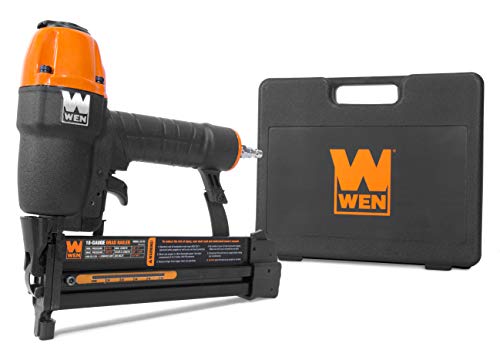
WEN 61741 18-Gauge 2-in-1 Brad Nailer and Stapler
The WEN 61741 is an affordable pneumatic combo that shoots both 18 gauge brad nails and narrow crown staples. It is simple to use and works well for small projects like crafts, picture frames, and light trim. It is not as durable as professional models, but it is a great entry point for DIYers on a tight budget.
Pros
- Very affordable price
- Lightweight and easy to handle
- Versatile 2-in-1 function
Cons
- Plastic magazine and housing may not withstand heavy use
- Requires an air compressor

Makita XA04Z 18V LXT Lithium-Ion Cordless Pin Nailer
The Makita XA04Z is a cordless pin nailer that drives 23 gauge headless pins. These pins leave almost invisible holes, making it perfect for delicate trim, cabinetry, and model building. It features a compact design and a depth adjustment dial. It is expensive, but for fine woodworking, it is a worthwhile tool.
Pros
- Minimal surface damage
- Cordless convenience
- Tool-free depth adjustment
Cons
- Limited to light duty applications
- Battery and charger sold separately

Porter-Cable 20V MAX Cordless Brad Nailer Kit
The Porter-Cable PCC895LA is a cordless brad nailer that comes as a kit with battery and charger. It is designed for trim work and crafts, and it is part of the Porter-Cable 20V system. It is lightweight and easy to use. However, some users report jamming issues with longer nails, so it is best for shorter brads.
Pros
- Complete kit with battery and charger
- No compressor needed
- Good for quick trim jobs
Cons
- Can jam with longer brad nails
- Battery life is moderate
How to pick the right one
Side by side
| # | Model | Power Source | Best for | Score | Price |
|---|---|---|---|---|---|
| 1 | Ryobi P320 18V One+ Cordless AirStrike Nailer | 18V Cordless (Ryobi One+ battery) | Versatile cordless trim work | 9.4 | Check price |
| 2 | BOSTITCH Smart Point 18 Gauge Brad Nailer Kit | Pneumatic (requires air compressor) | Precision trim and molding | 9.2 | Check price |
| 3 | DEWALT 20V MAX Cordless Framing Nailer | 20V MAX Cordless (battery not included) | Heavy-duty framing and sheathing | 9.0 | Check price |
| 4 | Metabo HPT Framing Nailer | Pneumatic | Budget-friendly pneumatic framing | 8.8 | Check price |
| 5 | WEN 61741 18-Gauge 2-in-1 Brad Nailer and Stapler | Pneumatic | Budget-conscious beginners | 8.5 | Check price |
| 6 | Makita XA04Z 18V LXT Lithium-Ion Cordless Pin Nailer | 18V LXT Cordless (battery not included) | Fine woodworking and pinning | 8.7 | Check price |
| 7 | Porter-Cable 20V MAX Cordless Brad Nailer Kit | 20V MAX Cordless (battery and charger included) | DIYers with Porter-Cable batteries | 8.3 | Check price |
Common questions
What nail gun should a beginner buy?
For a beginner, a pneumatic brad nailer like the Bostitch BTFP12235 is a great choice. It is lightweight, easy to use, and affordable. You will need an air compressor, but if you are starting from scratch, you can buy a small compressor kit. Alternatively, a cordless model like the Ryobi P320 is convenient if you already have the battery system.
What is the difference between a brad nailer and a finish nailer?
Brad nailers use thinner 18 gauge nails and are for light trim and small moldings. Finish nailers use thicker 15 or 16 gauge nails and are for heavier trim, door casings, and baseboards. Finish nailers have more holding power but leave larger holes. For most DIY trim work, a brad nailer is sufficient.
Can I use a nail gun for framing if I am a DIYer?
Yes, you can. If you are building a deck, shed, or wall, a framing nailer will save time and effort. However, framing nailers are heavier and more expensive. For occasional use, you might consider renting one or buying a pneumatic model like the Metabo HPT, which is more affordable but requires an air compressor.
Do I need an air compressor for a nail gun?
Not necessarily. There are cordless nail guns that run on batteries. They are more portable but they are heavier and cost more. Pneumatic nail guns require an air compressor and a hose, but they are lighter and often cheaper. If you already have an air compressor, pneumatic is the way to go. If not, a cordless model might be more convenient.
What does 18 gauge mean in nail guns?
Gauge refers to the thickness of the nail. An 18 gauge nail is relatively thin, leaving a small hole. It is used for light trim, crafts, and other fine work. Lower gauge numbers indicate thicker nails, such as 15 or 16 gauge for finish work. For framing, nails are typically 11 or 12 gauge.
Are cordless nail guns as powerful as pneumatic?
Modern cordless nail guns, especially those with brushless motors, are nearly as powerful as pneumatic models. They can drive nails into hardwoods and engineered lumber. However, they tend to be heavier and more expensive. Pneumatic guns are still preferred by professionals for continuous high volume work because they are lighter and never run out of battery.
What safety features should I look for in a nail gun?
Look for a sequential trip trigger that requires you to press the nose against the work surface before pulling the trigger, which prevents accidental firing. A contact trip allows rapid firing but is less safe. Also, check for a no-mar pad to protect the work surface, a dry-fire lockout, and a tool-free jam release for quick clearing.
How do I clear a jam in a nail gun?
First, disconnect the power source or remove the battery. Then, open the magazine and remove any nails that are stuck. Use a small tool to pry out any jammed nails in the firing mechanism. Consult the user manual for specific instructions. Most modern nail guns have a tool-free jam release for easy access.
What size air compressor do I need for a nail gun?
For most trim and brad nailers, a small pancake compressor with 1 to 2 gallons capacity is sufficient. They provide enough air for intermittent use. For framing nailers, you might need a larger tank, like 4 to 6 gallons, to keep up with continuous firing. Check the nail gun’s CFM requirements and compare with the compressor’s output.
Can I use a nail gun for crafts and small projects?
Yes, a brad nailer or pin nailer is perfect for crafts, picture frames, and small woodworking projects. A pin nailer, like the Makita XA04Z, leaves nearly invisible holes, making it ideal for delicate work. For larger crafts, a brad nailer with 18 gauge nails works well.
Our pick
If you are a DIYer who wants one tool for most projects, choose the Ryobi P320 for its cordless convenience and versatility. For trim work with an air compressor, the Bostitch BTFP12235 is the best choice for accuracy. If you are framing, the Metabo HPT pneumatic framing nailer offers the best value for the money.


